
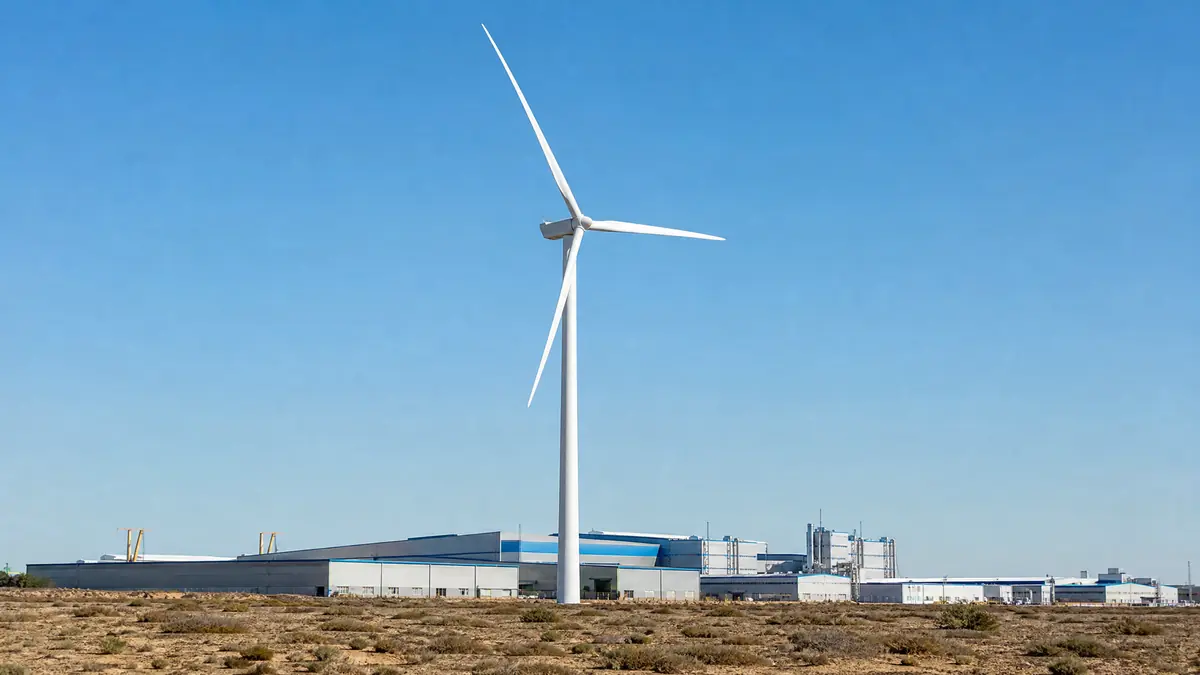
Wind Turbine for Industrial Enterprises: Selecting the Right Capacity
A wind turbine's rated capacity does not indicate how much electricity an enterprise will receive annually. Learn how to assess wind conditions at the site, calculate energy output, and select a system that meets production demands.
Why You Shouldn't Select a Wind Turbine Based Solely on the Size of Your Enterprise's Property
The capacity of a wind turbine for an enterprise is determined by two factors: the facility's actual electricity consumption and the site's wind potential. A large area alone does not mean that the installation will generate enough electricity.
A wind turbine converts the kinetic energy of wind into electrical energy. Its rated capacity indicates the maximum power output under specific operating conditions, not a constant output throughout the day. Therefore, when purchasing equipment, it is important to evaluate not only its capacity in kilowatts (kW), but also its expected energy output over a given period.
For enterprises in Uzbekistan, additional considerations include seasonal wind patterns, summer heat, dust, terrain characteristics, and the availability of open space for installing the tower. Selecting a system without assessing the site is risky: even powerful equipment may fail to deliver the expected results.
1. Determine What the Wind Turbine Needs to Do
Before selecting a capacity, determine what share of the enterprise's power supply the wind turbine should provide. This will determine the system configuration and equipment requirements.
There are three main objectives:
- Partial coverage of consumption. The wind turbine supplements the existing power supply and reduces the amount of electricity drawn from the external grid.
- Backup power for specific consumers. The installation operates together with energy storage systems and compatible equipment, supplying selected loads under certain conditions.
- Off-grid power supply. The system is designed to operate without permanent dependence on the external grid and requires coordination between generation, energy storage, and backup power sources.
For procurement specialists, it is important to define the target outcome before requesting commercial quotations. For example, determine which production lines, pumps, lighting systems, or engineering equipment should receive power from the wind turbine.
2. Collect Electricity Consumption Data
A preliminary wind turbine capacity calculation requires information about the enterprise's load by hour, day, and season. A single figure from an electricity bill is not sufficient.
Collect the following information:
- Average monthly and annual electricity consumption, kWh;
- Maximum simultaneous load, kW;
- Minimum load during nighttime and weekends;
- Enterprise operating schedule;
- List of equipment with its rated power;
- Starting currents of electric motors and pumps;
- Permissible duration of power interruptions;
- Critical consumers that cannot be disconnected.
Pay particular attention to equipment with electric motors. When pumps, compressors, and production machinery start up, their short-term power consumption can significantly exceed their normal operating levels.
When calculating inverter capacity and the electrical components of the system, consider not only the wind turbine's rated capacity but also the characteristics of the load.
Create a Load Profile
Divide consumers into groups:
| Consumer Group | What to Consider | Significance for Selection |
|---|---|---|
| Production lines | Operating power and schedule | Main energy consumption |
| Pumps and compressors | Starting currents and operating cycles | Peak load |
| Lighting | Operating hours | Predictable consumption |
| Ventilation and air conditioning | Seasonality and operating mode | Changes in summer load |
| Servers and automation systems | Power supply continuity requirements | Need for backup power |
This profile helps determine exactly when the enterprise needs electricity and whether those periods coincide with times when sufficient wind is available.
3. Assess the Site's Wind Potential
The actual performance of a wind turbine is determined by wind conditions at the height of the rotor, not merely by the region's general climate characteristics.
Conditions in Uzbekistan can vary significantly between open plains, foothills, valleys, and built-up industrial sites. Data from one location cannot automatically be applied to another.
To assess the site:
- Obtain available meteorological data for the installation area.
- Study the average wind speed and its seasonal variations.
- Check the frequency and duration of low-wind periods.
- Assess the prevailing wind directions.
- Account for obstacles such as buildings, trees, structures, and terrain.
- If necessary, arrange instrumental measurements at the proposed installation height.
For an industrial project, it is preferable to use measurements taken directly at the site over a representative period. Short-term observations do not always reflect the annual wind pattern.
Why Tower Height Matters
Wind speed can vary with height. In addition, buildings and other obstacles create turbulent airflow, which can reduce rotor operating efficiency.
When comparing quotations, ask the seller for the recommended installation height and clearance requirements around the rotor. Do not select a tower based solely on its lowest cost: its height affects generation conditions, structural loads, and foundation requirements.
4. Understand Rated Capacity and Actual Energy Output
A wind turbine's rated capacity is not the same as its constant output. To assess the economic and technical feasibility of a project, calculate the expected annual energy production in kWh.
A preliminary estimate can be calculated using the formula:
E = P × 8760 × CF, where:
- E — estimated annual energy production, kWh;
- P — rated capacity of the installation, kW;
- 8760 — number of hours in a standard year;
- CF — capacity factor.
The capacity factor depends on wind conditions, equipment characteristics, operating restrictions, and system losses. It must not be assigned arbitrarily: for a project, the value should be supported by calculations based on wind data and the specifications of the specific model.
For example, if an installation has a rated capacity of 50 kW, its annual energy production will not automatically equal 438,000 kWh. This figure corresponds to continuous operation at rated capacity throughout the entire year, which is not a realistic assumption for a typical wind turbine.
Therefore, request the power curve from the supplier. It shows how much electricity the installation generates at different wind speeds.
5. Compare the Main Types of Wind Turbines
When selecting equipment, it is important to compare not only rated capacity but also design, starting conditions, operating wind speed range, and installation requirements.
| Parameter | What It Indicates | What to Request from the Seller |
|---|---|---|
| Rated capacity | Maximum specified operating power under defined conditions | Capacity in kW and the conditions under which it is achieved |
| Cut-in wind speed | Wind speed at which the rotor starts turning | Value in m/s |
| Rated wind speed | Wind speed at which rated capacity is achieved | Value in m/s |
| Cut-out wind speed | Threshold for protective shutdown | Value and protection mechanism |
| Rotor diameter | Size of the blade swept area | Diameter in meters |
| Installation height | Rotor placement conditions | Recommended tower height |
| Power curve | Relationship between energy output and wind speed | Manufacturer's power curve |
| Maintenance schedule | Frequency of technical maintenance | Maintenance schedule |
Horizontal-Axis and Vertical-Axis Wind Turbines
Horizontal-axis wind turbines have a rotor with a horizontal axis of rotation and generally require alignment with the wind direction. When selecting them, consider the rotor diameter, tower height, and control system characteristics.
Vertical-axis wind turbines have a rotor with a vertical axis. Their design differs in how they interact with airflow, but this does not automatically mean higher output or suitability for every industrial site.
Compare models based on verified power curves and calculated annual energy production for the specific location, not just their design type.
6. Choose a Power Supply Configuration
The system configuration depends on whether the enterprise will use the external electricity grid, batteries, or a fully autonomous setup.
A grid-connected system feeds generated electricity into the facility's electrical network through appropriate power conversion equipment. Its compatibility with grid parameters and connection requirements must be checked.
An off-grid system provides for energy storage or coordination of generation with the load and backup power sources. Accounting for periods without wind is particularly important in this configuration.
A hybrid system combines several energy sources, such as a wind turbine and solar panels. This configuration can distribute generation across different weather conditions but requires coordinated operation of the equipment and control system.
When purchasing, request a single-line electrical diagram, inverter specifications, protection system details, controller description, and connection requirements. If batteries are included, clarify their capacity, permissible depth of discharge, and operating temperature range.
7. Calculate the Required Capacity Based on Operating Conditions
A preliminary selection can be made in several stages.
Stage 1 — Define the energy target. Determine what share of annual electricity consumption the wind turbine should cover.
Stage 2 — Calculate the required energy output. If an enterprise consumes 120,000 kWh per year and plans to cover 25% of its consumption with wind power, the target energy output will be:
120,000 × 0.25 = 30,000 kWh per year.
Stage 3 — Select the rated capacity. Use the expected capacity factor, supported by site data and equipment specifications.
Preliminary formula:
P = E / (8760 × CF).
In the example above, assuming a calculated capacity factor of 0.20, the required capacity would be:
30,000 / (8760 × 0.20) ≈ 17.1 kW.
This is solely an illustration of the calculation method, not a capacity recommendation for any specific enterprise. An actual project must account for losses, connection restrictions, the actual power curve, and the seasonal distribution of energy production.
Stage 4 — Check compatibility. Make sure the inverter, controller, cable infrastructure, and protective equipment match the installation and load parameters.
8. Consider Uzbekistan's Climate and Operating Conditions
To operate in Uzbekistan, a wind turbine must be suitable for local temperature, wind, and dust conditions.
When selecting equipment, check:
- Permissible operating temperature;
- Protection of electrical components against dust and moisture;
- Resistance of materials to ultraviolet exposure;
- Permissible wind loads on the rotor and tower;
- Anti-corrosion protection of metal components;
- Maintenance requirements in highly dusty conditions;
- Foundation and installation requirements.
In summer, high temperatures can affect the operation of power conversion equipment and batteries. During the cold season, permissible starting and operating temperatures must be considered. Dust can accelerate component contamination and increase inspection requirements.
Also check in advance whether installation machinery can access the site, whether there is sufficient space for the tower, and whether there are any obstacles that could compromise safe operation.
9. What Documents and Specifications to Request from the Supplier
Before approving a purchase, request technical documentation for the exact model being offered.
The documentation package should include:
- Wind turbine datasheet;
- Technical specifications of the rotor and generator;
- Power curve;
- Permissible operating wind speed range;
- Description of the braking and protection systems;
- Tower and foundation requirements;
- Connection diagram;
- Controller and inverter specifications;
- Scope of supply;
- Installation and operating instructions;
- Maintenance schedule;
- Delivery terms and procedure for handling warranty claims, if the seller provides a warranty.
Make sure the technical documents refer to the same model and configuration. If the commercial quotation specifies one capacity while the datasheet lists another, ask the seller to explain the discrepancy in writing.
How to Compare Commercial Quotations
Do not limit your comparison to rated capacity. For an accurate comparison, use identical initial parameters: installation area, tower height, target energy output, and load characteristics.
Separately check whether the quotation includes the tower, foundation components, inverter, controller, cables, protection equipment, and installation work. Differences in the scope of supply can significantly change the overall procurement requirements.
10. How to Inspect and Accept a Wind Turbine
Acceptance should confirm that the delivered equipment matches the ordered model, configuration, and technical documentation.
Before signing the documents, check:
- Equipment markings and model compliance with the order.
- The quantity of main components and accessories.
- The absence of visible damage to the housing, blades, and electrical connections.
- The completeness of the tower, fasteners, and installation components.
- The availability of datasheets, instructions, and connection diagrams.
- Compliance of the inverter and controller with the stated specifications.
- The availability of documents for completed installation and commissioning work, if included in the contract.
After installation, testing should be carried out according to the agreed commissioning program. Check electrical connections, protection system operation, conversion parameters, and correct delivery of energy to consumers.
Do not assess the installation's performance based solely on a brief test run. Actual energy production must be compared with measured wind speed and the calculated power curve.
11. Get Supplier Quotations on BRIX
To obtain wind turbine prices and delivery terms, open the relevant product on BRIX and click "Submit a Request."
Submitting a request is free and does not require registration. Simply provide your name and phone number. The request is sent directly to the seller of the specific product, who then contacts you independently to provide the price and terms.
To receive a more accurate quotation, prepare the following information:
- Quantity: Number of installations or required total capacity.
- Specifications: Rated capacity, installation type, tower height, inverter requirements, and configuration.
- Site address: Region and proposed installation location.
- Timeline: Preferred delivery period and planned project implementation date.
- Operating conditions: Availability of the electricity grid, operating schedule, expected load, and need for energy storage.
After submitting the request, you can answer additional questions about the quantity, facility, timeline, and region. This helps the seller prepare a more accurate quotation.
Get Prices from Sellers on BRIX
- Open the wind turbine catalog on BRIX.
- Select a suitable product.
- Click "Submit a Request" and provide your name and phone number.
- Specify the quantity, installation specifications, and site address.
- Indicate your preferred timeline and wait for a call or message from the seller.
You arrange the price, payment, and delivery directly with the seller. BRIX is not involved in payment processing. You can also view the seller's other products on the company's page.
Procurement Checklist: 7 Mistakes to Avoid When Selecting a Wind Turbine
Before approving a purchase, check that you have avoided the following mistakes:
- Selecting equipment based only on rated capacity. Request the power curve and annual energy production calculation.
- Using general wind data instead of site-specific data. Account for local terrain, obstacles, and rotor height.
- Ignoring seasonality. Compare generation periods with the enterprise's electricity consumption schedule.
- Underestimating starting loads. Check electric motor specifications and inverter compatibility.
- Failing to calculate tower and foundation requirements. Request specifications for the installation structure and wind loads.
- Comparing quotations with different configurations. Define the scope of supply and list of additional work.
- Having no maintenance plan. Clarify inspection schedules, spare parts availability, and service requirements.
FAQ: Frequently Asked Questions About Wind Turbine Capacity
1. What Wind Turbine Capacity Should an Enterprise Choose?
Capacity is calculated based on the required annual energy output and the site's wind potential. Peak load and consumption patterns must also be considered.
2. Is Average Monthly Electricity Consumption Enough?
No. You also need to know the maximum load, equipment operating schedules, and how consumption is distributed throughout the day.
3. Which Is More Important: Rated Capacity or Rotor Diameter?
Both parameters are important. Rated capacity indicates the generator's capabilities, while rotor diameter affects the swept area exposed to the wind. They should be compared together with the power curve.
4. Can a Wind Turbine Operate Without Batteries?
Yes, if the project uses a suitable grid-connected configuration or directly coordinates generation with consumption. Batteries or other balancing methods may be necessary for off-grid operation.
5. Is It Necessary to Measure Wind Directly at the Enterprise Site?
For an accurate industrial project, it is advisable to obtain measurement data from the site and at the proposed rotor height. This helps reduce uncertainty in energy production calculations.
6. Can a Wind Turbine Be Installed Next to a Production Building?
This depends on the building's height, turbulence, distance from obstacles, wind loads, and safety requirements. The proposed location must undergo a technical assessment in advance.
7. What Documents Should Be Requested Before Purchasing?
The equipment datasheet, power curve, technical diagram, protection specifications, foundation requirements, installation instructions, and maintenance schedule.
8. How Can I Quickly Request a Quotation on BRIX?
Open the product page, click "Submit a Request," and provide your name and phone number. Registration is not required. The product seller receives the request immediately and contacts you directly.
Get Prices from Sellers on BRIX
Choose a wind turbine that meets your enterprise's requirements and submit a request directly to the seller.
- Open wind turbine products on BRIX.
- Select a suitable model and click "Submit a Request."
- Provide your name and phone number.
- Specify the required quantity, equipment specifications, site address, and timeline.
- Wait for a call or message from the seller with the price and terms.
Submitting a request is free, and registration is not required. Confirm the scope of supply, payment, and delivery directly with the seller. The more accurate your initial technical data, the easier it will be to compare quotations and select equipment suited to the enterprise's actual operating conditions.