
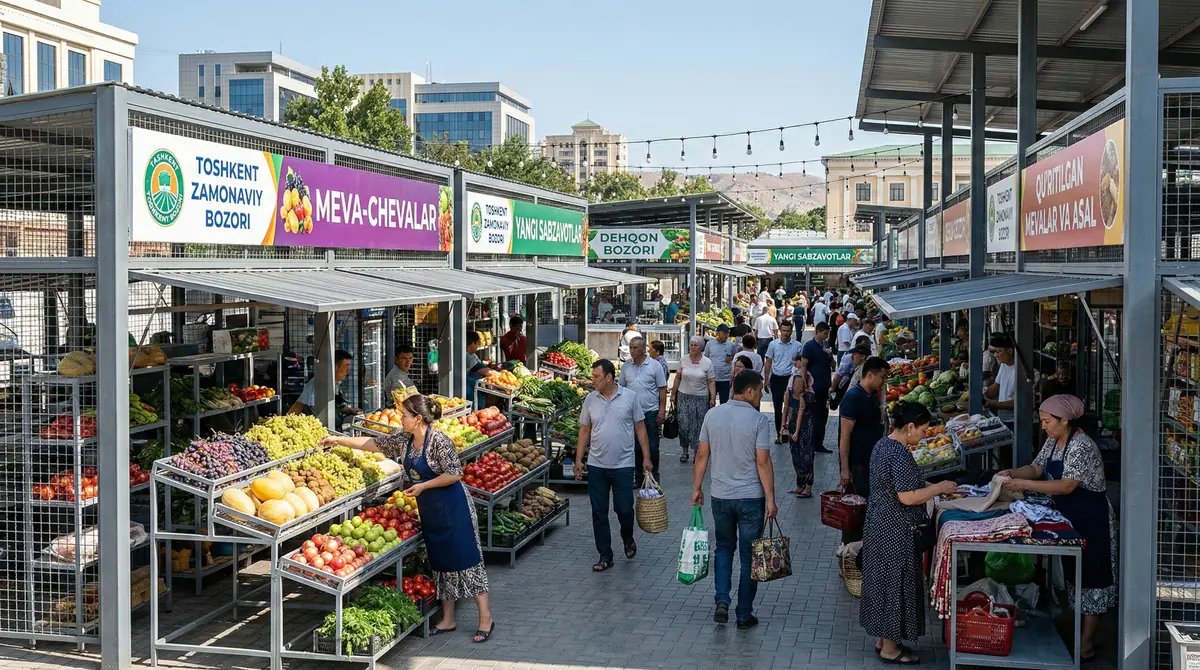
Outdoor Shelving and Signage for Farmers’ Markets
Preparing a farmers’ market in Tashkent? It’s best to plan outdoor shelving, signage, and metal frames in advance. Here’s what structures you need, what to make them from, and what to include in the technical specification (TS) for an accurate estimate.
Why prepare for the season in advance: tasks of organizers and farmers
Farmers’ markets and bazaars in Tashkent operate within tight seasonal windows. A mistake with equipment at the start of the season means lost traffic and revenue. That’s why outdoor shelving, signage, and metal frames should be planned in advance, taking into account the site format, foot traffic, and tenant requirements.
Who this is critical for:
- Market and fair organizers — responsible for the overall appearance of the site, safety, and ease of navigation.
- Farming enterprises — want to make their row stand out, present products neatly, and assemble/disassemble equipment quickly.
- Commercial landlords — interested in durable metal structures that can be reused from season to season.
Properly designed shelving, signage, and metal frames solve several tasks at once:
- organize the trading space;
- increase the visibility of rows and individual vendors;
- protect products from sun and precipitation (in combination with canopies);
- speed up installation/dismantling when the season or market format changes.
What structures a farmers’ market needs: basic set
Outdoor markets usually require not a single product, but a set of metal structures and advertising elements.
1. Outdoor shelving for products
Shelving defines the “face” of a trading row. Main options:
- Linear shelving along the aisle — for vegetables, fruits, greens, dairy products.
- Island shelving — for central zones, tastings, promo activities.
- Modular shelving — sections that can be rearranged and assembled into different configurations to match the market format.
When designing, consider:
- display height (so it’s convenient for customers to view the goods);
- permissible load on the shelves;
- possibility of quick cleaning and washing;
- resistance to moisture and sun.
2. Metal frames for rows and trading spots
The metal frame is the base that supports shelving, canopies, signage, and sometimes lighting.
Typical elements:
- trusses and columns for spans between rows;
- individual spot frame (a frame structure that defines the dimensions of a stall);
- brackets for mounting signage and lighting.
The frame must withstand not only the weight of shelving and goods, but also wind loads and potential upgrades (adding signage, lighting, canopies).
3. Signage and navigation
For outdoor markets, the following are especially important:
- general zone signs (for example, “Farm Products”, “Dairy Products”);
- individual vendor signs — flat or 3D letters, lightboxes;
- navigation plates — rows, stall numbers, directional arrows.
Structurally, these can be:
- flat panels on a metal frame;
- lightboxes on brackets;
- 3D letters mounted to trusses or columns.
Materials and technologies: what to use for outdoor shelving and frames
The choice of material directly affects service life, appearance, and cost. For Tashkent, it’s important to consider temperature fluctuations, dust, sun, and outdoor operating conditions.
Metal for frames and shelving
Most commonly used:
- Steel profile (angle, tube, channel) — the basis of metal structures: hangar frame, trusses, columns, shelving.
- Galvanized steel — for elements that are constantly outdoors and exposed to corrosion.
- Stainless steel — selectively, where hygiene and regular washing are critical (contact with food products, wash areas, individual shelving elements).
Processing technologies:
- laser cutting — for precise geometry of parts, holes for fasteners, decorative elements of signs;
- metal bending — for shelves, brackets, frames for signs;
- welding — for assembling frames, trusses, stairs, railings, and reinforced shelving;
- powder coating — for corrosion protection and adding color to match the market or chain’s brand style.
Materials for shelves and cladding
- Metal (perforated or solid sheet) — withstands high loads, suitable for crates with products.
- Combined solutions — metal frame + wooden or composite inserts for a more “natural” farmers’ area look.
- Plastic/composite — for front panels of shelving and signs where color and branding are important.
Materials for signage
- Metal frame + composite/acrylic — a standard solution for a sign or lightbox.
- 3D letters made of metal and plastic — for main entrance groups and key zones.
The combination of materials is always chosen according to the TS: service life, appearance requirements, budget, and the possibility of off-season storage.
Signage and navigation: how not to lose the customer in the flow
Even a well-organized row of shelving won’t perform if the customer doesn’t understand where they are and what is sold here.
Navigation levels at the market
-
Entrance group
- large sign of the market or fair;
- information about opening hours.
-
Zonal navigation
- signs “Vegetables and Fruits”, “Meat”, “Dairy Products”, “Honey and Nuts”;
- color coding of zones using powder-coated metal structures.
-
Local vendor signs
- small lightboxes or panels on brackets above the stall;
- a consistent sign format to maintain the overall market style.
Technical points when choosing signage
- Mounting: the sign must be safely fixed to trusses, columns, or separate brackets.
- Maintenance: access to light sources and wiring without dismantling the entire frame.
- Weather resistance: materials and coating designed for outdoor conditions.
What affects the price: key budget factors
The exact price of outdoor shelving, signage, and metal frames is always calculated based on the TS. Below are the main factors included in the estimate.
| Factor | How it affects cost | Comment |
|---|---|---|
| Structure dimensions | The larger the dimensions and spans, the higher the metal consumption and complexity | It’s important to consider the actual size of the site and aisles |
| Type of metal | Galvanized and stainless steel are more expensive than mild steel but last longer | The choice depends on service life and storage conditions |
| Profile thickness and cross-section | Heavier profile increases price but improves rigidity and safety | Critical for trusses, columns, and heavily loaded shelving |
| Design complexity | Non-standard shapes, radii, decorative elements increase labor intensity | Especially noticeable on signage and branded shelving |
| Type of finish | Powder coating, multiple colors, branding are more expensive than simple priming | But improve appearance and service life |
| Order volume | A series of modules is cheaper per unit than one-off items | It makes sense to standardize stalls and shelving |
| Installation and logistics | Turnkey installation and site remoteness affect the final budget | You can plan phased installation |
| Production deadlines | Rush orders may require additional resources and shifts | It’s better to plan the season in advance |
To get a realistic estimate, the contractor requests a detailed TS and calculates based on it.
Production and installation timelines: how not to miss the season opening
Timelines depend on volume and complexity, but there is a general logic that Tashkent market organizers should consider.
Work stages
-
Collecting initial data and TS
- site measurements or work based on a plan/drawings;
- defining the market format, number of stalls, zones.
-
Design and calculation
- development of metal structure and shelving layouts;
- calculation according to the TS, taking into account materials and finishes.
-
Production
- laser cutting, metal bending, frame welding;
- powder coating, module assembly.
-
Delivery and installation
- assembling shelving and frames on site;
- installing signage, checking fastenings.
How to shorten timelines without losing quality
- use standard shelving and frame modules instead of fully unique solutions;
- approve colors and sign formats in advance to avoid redesigning layouts;
- include a time buffer for approvals and possible changes to the placement scheme.
Standard solutions vs custom manufacturing to TS
When standard solutions are suitable
- stalls of the same size and format;
- standard rows without complex architectural features;
- limited budget and tight deadlines.
Pros: faster launch, lower unit cost in series, easier storage and reuse.
When custom manufacturing is needed
- non-standard site (height differences, narrow aisles);
- special branding and appearance requirements;
- need to integrate with existing canopies, stairs, railings;
- increased load requirements (large product volumes, heavy crates).
In this case, the contractor develops metal structures and outdoor advertising according to your TS, prepares a cost estimate, and offers material and technology options to match your tasks and budget.
Common mistakes when ordering outdoor shelving and signage
-
No clear TS and placement scheme
- As a result, structures don’t fit on site, block aisles or fire exits.
-
Saving on metal and coating
- Too thin a profile and lack of proper corrosion protection lead to deformation and rust after just one season.
-
Inconsistent signage style
- Each vendor makes their own sign, the market looks chaotic, navigation suffers.
-
No load margin for shelving
- Shelving is designed “to the limit”, but in reality is loaded heavier than calculated.
-
Ignoring installation and logistics
- Access for delivery, assembly time, and the need to work outside market hours are not considered.
-
Unrealistic launch deadlines
- The contractor is brought in too late, and you either have to postpone opening or simplify solutions.
-
No off-season storage plan
- Structures are not dismantled, take up extra space, or get damaged due to careless storage.
How to prepare a TS for calculating metal structures for a market
A good TS saves time and reduces the number of revisions. Minimum data set for calculating outdoor shelving, signage, and metal frames:
-
Site description
- address and type (permanent market, seasonal fair, temporary site);
- area dimensions, layout or plan (if available).
-
Trading format
- which product groups are planned (vegetables, fruits, meat, dairy, honey, etc.);
- number of stalls and rows.
-
Required set of structures
- outdoor shelving (approximate quantity and length);
- metal frames (rows, individual stalls, trusses, columns);
- signage and navigation (general, zonal, individual);
- need for additional elements (railings, stairs, canopies).
-
Material and finish requirements
- metal preferences (mild steel, galvanized, stainless steel in specific areas);
- presence of brand colors and logo for coating and branding.
-
Operation and seasonality
- year-round or seasonal only;
- whether dismantling and storage of structures is planned.
-
Timelines and budget range
- desired launch date;
- indicative budget (to immediately select a realistic level of solutions).
Based on such a TS, the contractor can prepare a TS-based estimate, offer several options for materials and technologies, and also assess production and installation timelines.
FAQ: typical questions from market organizers
1. Can the same shelving and frames be used at different sites?
Yes, if you initially design a modular system: demountable metal frames, sectional shelving, universal brackets for signage.
2. What’s better for outdoors: regular metal or galvanized?
For permanent outdoor use, galvanized metal and quality powder coating are usually justified by a longer service life. But the choice is made according to the TS and budget.
3. Can existing canopies and frames be upgraded for new rows?
Often it’s possible to reinforce or extend existing metal structures, add brackets for signage and shelving. An inspection or at least photos/drawings are needed for calculation.
4. How far in advance should the project start?
Ideally, several months before the season starts, to calmly go through TS, estimation, production, and installation without rush surcharges and oversimplified solutions.
5. Is it possible to build one row first and expand later?
Yes, if frames and shelving are initially designed as a modular system. This allows you to gradually increase the number of stalls and zones.
6. Do you prepare estimates without exact drawings?
A preliminary estimate is possible based on a layout or plan with main dimensions. For the final budget and production, a refined TS and dimensions will still be required.
7. What is more important when choosing a contractor: price or deadlines?
In practice, balance is important. Too low a price often means saving on metal and coating, and excessive haste means a risk of errors in design and installation.
8. Can the same signs be used when tenants change?
If the design is thought out in advance (replaceable panels, cassettes, lightboxes with replaceable film), the frame and lighting remain, and only the front part is changed.
Season preparation checklist for markets and farmers
- Define the market format and number of stalls.
- Fix the layout of rows and aisles.
- Decide which structures are needed: shelving, metal frames, signage, canopies, railings.
- Prepare a basic TS with dimensions, material requirements, and appearance.
- Plan timelines: design, TS-based estimate, production, installation.
- Think through off-season storage of structures (if the market is not year-round).
- Agree on a unified style of signage and navigation for all tenants.
Submit a request for an estimate
To get an estimate for outdoor shelving, signage, and metal frames for your farmers’ market or bazaar in Tashkent, prepare and send the following data:
- brief site description (type, address, format);
- plan or layout with main dimensions (if available);
- number of rows and stalls;
- list of required structures (shelving, frames, signage, canopies, railings, etc.);
- material preferences (metal, galvanizing, stainless steel for specific zones);
- coating and branding requirements (colors, logos);
- expected site launch dates;
- contact person for clarifying questions.
Based on this data, it’s possible to prepare a detailed TS-based estimate, offer material and technology options, and assess realistic production and installation timelines for your season.