
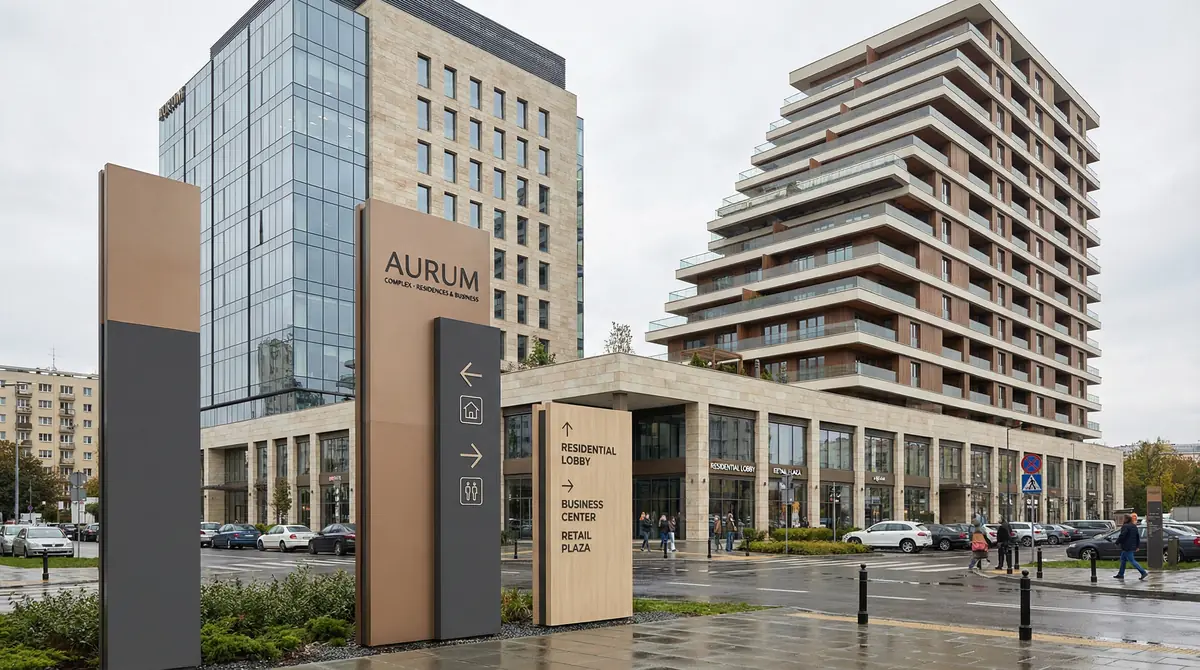
Timeline for Launching Wayfinding and Steles for Residential and Business Complexes
Wayfinding and information steles are often remembered at the very end of construction — and they are exactly what ends up delaying commissioning. Let’s break down the real project schedule by stages and how to build it into the project in advance.
Developer’s task: why wayfinding timelines are critical
For a developer of a residential complex or business center in Tashkent, wayfinding and information steles are not just “outdoor advertising.” How timely they are launched affects:
- the readiness of the property for commissioning and occupancy;
- perception of the complex’s and developer’s brand;
- safety and comfort of movement for residents and tenants;
- reduced load on the property management company and reception service.
In practice, wayfinding is often remembered at the last moment — when the building has already been handed over, and landscaping, utility connections, and residents’ move-in are all happening on site at the same time. Under these conditions, any delay in the production and installation of steles, signs, and pylons becomes a problem.
To avoid this, it is important to understand in advance:
- what stages a turnkey wayfinding and information stele project consists of;
- how much time each stage and the entire cycle actually take;
- how the choice of materials, technologies, and volumes affects timelines;
- what data the contractor needs from you at the start (TOR).
What wayfinding and stele elements new residential and business complexes need
New residential complexes and business centers usually require not just one type of structure, but a set of urban infrastructure and outdoor advertising solutions.
For residential complexes
- Entrance steles / pylons with the RC name — shape the project’s image, visible from the roadway.
- Information steles in the courtyard — site plan, buildings, playgrounds and sports grounds, parking.
- Traffic and parking signs — directional plates, wayfinding to guest and underground parking.
- Building and entrance numbering — façade elements that must be visible both day and night.
For business centers
- Main BC stele — name, logo, sometimes a list of anchor tenants.
- Totems and pylons in the parking area — zones, rows, levels, entry/exit.
- Pedestrian wayfinding signs — entrances, elevator lobbies, reception, service areas.
All these solutions require a metal structure (frame), cladding, lighting if needed, and on-site installation. Accordingly, timelines depend not only on design, but also on production capabilities: laser cutting, metal bending, welding, powder coating, assembly, logistics.
Key project stages and typical timelines for each
Turnkey wayfinding and stele launch timelines consist of several stages. Understanding their logic makes it easier to plan deadlines for commissioning construction phases.
1. Collecting initial data and estimate based on TOR
At this stage, the client provides the contractor with a technical specification or initial information to prepare it:
- master plan and floor plans (for BCs);
- layouts of driveways, entries, parking areas;
- brand book or corporate identity requirements;
- preferences for structure formats, lighting, materials.
Based on the TOR, the contractor prepares a preliminary estimate of cost and timelines and proposes options for materials and structural solutions.
What affects the duration of this stage:
- completeness of the TOR and availability of up-to-date plans;
- number of approvers on the developer’s side;
- need for a site visit for clarification.
2. Concept and working documentation
Next, the visual and technical parts of the solution are developed:
- wayfinding concept (style, media types, information levels);
- layouts for placing steles and signs on the site;
- working drawings of metal structures and mounting nodes;
- material and technology specifications (metal, composite, acrylic, lighting, etc.).
The more complex the property and the more stakeholders involved in approvals (developer, property management company, city services), the more time is required.
3. Production of metal structures and elements
Once the documentation is approved, contract manufacturing starts:
- laser cutting of frame and cladding parts;
- metal bending according to drawings;
- welding of frames and mounting nodes;
- preparation for powder coating and the coating itself;
- production of front panels, lighting elements, decorative details.
At this stage, it is important to design for manufacturability in advance: unification of sizes, repeatability of parts, rational choice of metal thicknesses.
4. Logistics and site preparation
Large steles and pylons require coordinated deliveries and site readiness:
- power supply is in place (for illuminated solutions);
- foundations or embedded parts in the pavement are prepared;
- time windows for equipment access (truck crane, aerial platform) are agreed.
5. Installation and handover
Installation includes:
- installation and leveling of metal structures;
- electrical and lighting connection (if applicable);
- sealing and final assembly;
- performance testing and acceptance.
Timelines depend on the number of structures, installation height, site density, and parallel works on site.
How materials and technologies affect launch timelines
The choice of materials and technologies directly impacts timelines.
Frame and cladding materials
- Steel with powder coating. A universal solution for outdoor steles and wayfinding. Requires a full preparation and curing cycle but ensures resistance to Tashkent’s climate.
- Aluminum elements. Lighter in weight, more convenient for installation on façades and thin pavements, but require more careful design of joints.
- Composite panels, acrylic, glass. Add stages of cutting, milling, bonding, which must be factored into planning.
Manufacturing technologies
- Laser cutting. Speeds up production of complex parts and improves accuracy but requires ready files and approved dimensions.
- Metal bending. Reduces the number of welds and speeds up assembly if the structure is initially designed for bending.
- Welding. Affects timelines for large volumes and complex spatial frames.
- Powder coating. Adds stages of preparation, coating, and curing. For large batches, it is beneficial to combine items by colors and types.
Lighting
- No lighting. Fewer stages, simpler installation, fewer electrical approvals.
- Internal or contour lighting. Adds electrical work and sealing, requires on-site testing.
If the deadline is tight (for example, phase opening or sales launch), it makes sense to consider simplified or modular solutions with the contractor that can be upgraded later without dismantling the frame.
What affects the cost of turnkey wayfinding and steles
Even without specific prices, it is important to understand the main budget drivers. These often affect timelines as well.
Key parameters considered in the estimate based on the TOR:
- Volume and range: number of steles, pylons, signs, façade elements.
- Dimensions and height: large steles require more massive metal structures and more complex installation.
- Materials: metal type, thickness, cladding type, presence of stainless steel or decorative inserts.
- Lighting: type of lighting elements, power supplies, cable routing.
- Design complexity: curved shapes, custom joints, non-standard solutions.
- Installation requirements: work at height, night installation, restrictions on equipment access.
The more detailed the TOR and the earlier the contractor is involved in the project, the more accurately both timelines and budget can be estimated.
Table: how timelines change under different conditions
Below is a generalized scheme of how key factors affect timelines. These are not specific figures, but a planning logic.
| Factor | Impact on timelines | Comment |
|---|---|---|
| TOR completeness | Low → High | The more detailed the TOR, the faster the estimate and production launch |
| Number of structures | Small volume → Large complex | As volume grows, serial production becomes more efficient, but the overall cycle increases |
| Shape complexity | Simple rectilinear → Complex curved | Complex shapes require more time for design and production |
| Materials | Basic (steel, composite) → Mixed, stainless steel, glass | Complex materials add processing and approval stages |
| Lighting | No lighting → Complex dynamic lighting | Electrical installation and testing timelines increase |
| Approvals | One responsible person → Multiple departments and authorities | Multiple approvals stretch documentation timelines |
| Site readiness | Site ready → Parallel construction works | Installation may be postponed and crews may be idle |
Typical client mistakes that cause timelines to slip
1. Launching wayfinding “after everything else”
Wayfinding and information steles are often placed at the end of the checklist. As a result, the contractor is squeezed between the property handover date and the actual site readiness.
2. No person responsible for the TOR
When the TOR is “assembled” from fragments provided by marketing, operations, architects, and sales, the approval stage is extended many times over.
3. Constant design changes at late stages
Any change in dimensions, materials, or lighting after production has started means reworking drawings and parts and shifting timelines.
4. Ignoring site constraints
Failure to account for the real situation on site (underground utilities, slopes, lack of equipment access) leads to foundation and mounting adjustments during installation.
5. Overly optimistic expectations about timelines
Basing plans on “ideal” timelines without contingency for approvals, logistics, and weather leads to opening delays and conflicts with the contractor.
6. Splitting the project among several contractors
When one company makes the metal structures, another handles lighting, and a third does installation, the risk of mismatches and downtime increases.
7. Lack of prioritization
If all wayfinding elements are considered “equally urgent,” it is hard to phase the work. As a result, nothing is ready, even though the property could have been launched with a minimum required set.
How to prepare a TOR to meet your deadline
A well-prepared TOR is the main tool for managing timelines. For wayfinding and information steles in residential and business complexes, it should include:
- Project goals. What matters most: branding, orientation, safety, architectural consistency.
- Plans and layouts. Master plan, vehicle and pedestrian traffic schemes, entry/exit points.
- List of media. What types of structures are needed: steles, pylons, signs, façade elements.
- Material requirements. Basic preferences for metal, cladding, lighting (or readiness to consider options).
- Constraints. Height limits, load limits on pavement, equipment access, site operating mode.
- Key dates. Planned commissioning, sales launch, parking opening, etc.
The earlier the contractor joins the discussion, the easier it is to optimize solutions for real timelines and budget.
FAQ on wayfinding production and installation timelines
When should work on wayfinding for a new residential or business complex start?
Ideally, at the stage of finalizing the master plan and architectural solutions for entrance groups and parking. This allows you to integrate steles and signs into landscaping and utilities instead of “wedging” them into an already finished environment.
Can timelines be reduced by simplifying solutions?
Yes, if together with the contractor you define the minimum required set of structures and use more manufacturable formats: standard metal structures, unified sizes, avoiding complex curved shapes and non-standard materials at the first stage.
How does order volume affect timelines?
As volume increases, the overall project duration grows, but due to serial production, individual operations (laser cutting, metal bending, powder coating) can be performed more efficiently. It is important to plan the sequence correctly: what is critical for commissioning and what can be installed later.
What if the site is not ready yet but the structures are already manufactured?
You need to agree in advance with the contractor on temporary storage options and an installation schedule. Ideally, synchronize production with the readiness of foundations and equipment access to avoid unnecessary risks of product damage.
Is it possible to run design and production in parallel?
Partially, yes. With a clear concept and approved standard sizes, you can start production of typical elements while secondary details are being finalized. This requires clear agreements and prioritization of structures.
How do weather conditions in Tashkent affect installation timelines?
The climate allows outdoor work for most of the year, but during hot periods and rainy seasons there may be restrictions on crew working hours and equipment use. This should be considered when planning outdoor and high-altitude installations.
What is needed from the property management company to keep timelines?
Appoint a person responsible for interaction with the contractor, ensure site access, approve installation locations, provide connection to power grids (for illuminated structures), and promptly accept completed work.
Can you estimate not only the timeline but also the risks of delays in advance?
Yes, when preparing an estimate based on the TOR, the contractor can highlight critical points: approvals, site readiness, delivery of non-standard materials. These should be fixed in the schedule, and predefined actions for each potential delay should be agreed in advance.
What working with a full-cycle contractor provides
For the developer and property management company, not only production speed matters, but also the manageability of the entire process. A contractor that combines design, manufacturing, and installation can:
- propose manufacturable solutions already at the TOR stage;
- account for metal structure and installation specifics in the wayfinding design;
- optimize the use of laser cutting, bending, welding, and powder coating to meet your timelines;
- synchronize production and installation with the construction schedule.
This is especially relevant for complex urban infrastructure projects where wayfinding, information steles, and outdoor advertising elements must work as a single system.
What data is needed to estimate timelines and cost
To obtain a realistic estimate of timelines and budget for launching turnkey wayfinding and information steles, prepare:
- a brief description of the property (residential complex or business center, number of buildings/phases);
- current master plan and vehicle and pedestrian traffic schemes;
- a list of desired structures (steles, pylons, signs, façade elements);
- branding requirements (logo, corporate colors, style);
- basic preferences for materials and lighting (if any);
- installation constraints (equipment access, site operating mode, height);
- key dates for commissioning and opening phases.
Submit a request for an estimate
If it is important for you to plan realistic timelines in advance for launching wayfinding and information steles for a new residential complex or business center in Tashkent, it makes sense to start with an estimate based on the TOR.
Include in your request:
- name and location of the property;
- property type (residential complex, business center, mixed-use format);
- construction and landscaping readiness stages;
- approximate list of wayfinding elements and steles;
- availability of a brand book and plans (files can be attached);
- desired launch timelines (by stages, if applicable);
- contact person for prompt approvals.
Based on this data, it is possible to propose a solution optimized for timelines and technologies and to form a clear schedule: from design to on-site installation.