
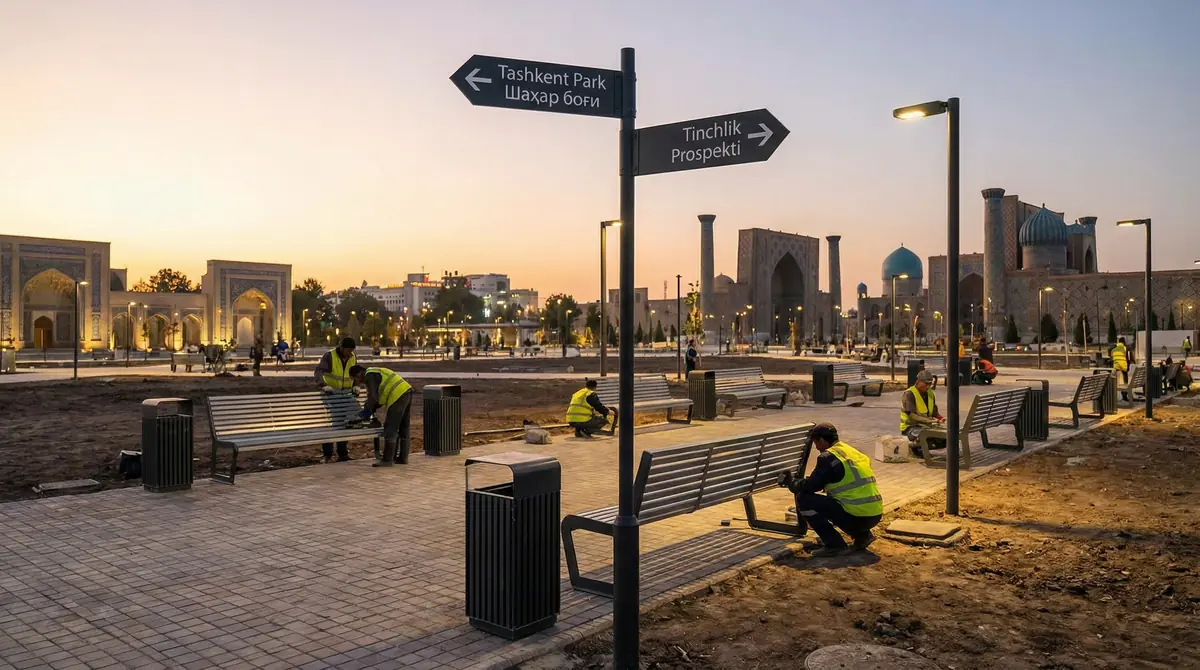
Timeframes for Implementing Urban Infrastructure B2G Projects
Deadlines for landscaping a park or a residential courtyard are often missed not because of installation, but due to overlooked nuances at the TOR stage. Here’s how to plan benches, bins, fences, and navigation so as to stay on schedule.
The role of timelines in B2G urban infrastructure projects
For municipal services, landscaping contractors, and residential developers in Tashkent, project implementation timelines are often more important than the lowest price. Benches, bins, fences, and navigation are tied to:
- budget cycles and tender obligations;
- commissioning schedules for facilities (residential complexes, parks, public spaces);
- seasonality of works (asphalt, landscaping, installation windows).
Delays at the manufacturing or installation stage of urban structures can lead to missed commissioning deadlines or contract penalties. Therefore, when choosing a contractor, it is important to understand what the timelines consist of and how they can be fixed already at the calculation stage based on the TOR.
Which infrastructure elements we consider
We are talking about standard solutions for the urban environment of Tashkent and the regions of Uzbekistan:
- benches and seats for parks, boulevards, and residential courtyards;
- bins and waste containers in public spaces;
- fences (courtyard, parking, pedestrian, roadside);
- navigation and signage: steles, plaques, information boards;
- auxiliary metal structures (brackets, supports, posts).
All these elements share common processes: design, fabrication of metal structures, surface preparation, powder coating, possible cladding with wood or composite, delivery, and installation.
Key project stages and typical timelines
Timelines depend on volume and complexity, but the structure is almost always the same.
1. Preliminary calculation based on the TOR
- analysis of initial data (drawings, sketches, site photos);
- clarification of volumes and materials;
- indicative calculation of timelines and cost.
The more complete the TOR, the faster a realistic schedule can be provided.
2. Design and approval of solutions
- development or adaptation of design documentation;
- site adaptation (anchoring to existing surfaces, elevation marks);
- approval with the client and, if necessary, with relevant authorities.
At this stage it is important to fix:
- types of benches, bins, fences, and navigation;
- materials (steel, stainless steel, wood, composites);
- type of coating (powder coating, galvanizing, etc.);
- installation requirements and delivery timelines by stages.
3. Production preparation
- procurement of rolled metal, fasteners, paints and coatings;
- reserving capacities (laser cutting, metal bending, welding);
- preparation of tooling and templates if the project is serial.
With stable supplies in Tashkent this stage often fits into a few days, but in case of shortages of certain items it may stretch out.
4. Fabrication of metal structures
Basic operations:
- laser cutting of parts according to drawings;
- metal bending (profiles, sheet elements);
- welding of frames for benches, bins, fences, navigation posts;
- grinding of welds, preparation for painting.
Timelines depend on:
- number of positions (different product types in one order);
- repeatability (series vs. one-off items);
- complexity of welded joints and metal thickness.
5. Powder coating and finishing
- surface preparation, priming (if provided);
- powder coating in a booth, polymerization;
- application of second layers or additional colors (if needed);
- installation of wooden elements, plaques, navigation inserts.
Time for color changes and line reconfiguration is accounted for separately: the more different colors and textures, the longer the cycle.
6. Logistics and installation
- packaging of products for transportation within Tashkent and to the regions;
- delivery to the site taking into account access control and work schedule;
- installation (anchoring to concrete/asphalt, installation of navigation, leveling);
- if necessary, phased handover (landscaping phases, residential complex phases).
Installation timelines depend on site accessibility, availability of prepared foundations, and parallel works by other contractors.
How the TOR affects timelines and cost
The technical specification is the main tool for managing timelines. The more precise it is, the lower the risk that the project will slip in time and budget.
What is important to specify in the TOR:
-
Nomenclature and volumes
- how many types of benches, bins, fences, navigation elements;
- quantity for each type;
- whether there is a prospect of increasing the volume during the process.
-
Dimensions and design
- length, width, height of products;
- requirements for rigidity and loads (for example, for roadside fences);
- presence of non-standard elements (radius fences, complex shapes).
-
Materials and coatings
- carbon steel, stainless steel, or a combination;
- presence of wooden or composite inserts;
- type of coating (powder coating, possible preliminary protection).
-
Installation requirements
- type of base (concrete, asphalt, paving, soil);
- concealed or exposed fasteners;
- elevation marks, tie-in to existing objects.
-
Delivery schedule
- one-time delivery or phased (construction phases);
- fixed dates for specific zones (for example, the central park alley by a specific event).
The more uncertainty in the TOR, the larger the time buffer that has to be included and the higher the likelihood of revisions during the project.
Materials and technologies: how the choice affects the schedule
The choice of materials and technologies directly affects timelines and cost.
Metal: steel or stainless steel
- Steel with powder coating is the standard solution for benches, bins, fences, and navigation in the urban environment.
- Stainless steel is more often used for elements with increased requirements for corrosion resistance and appearance (individual navigation elements, handrails, bin parts).
Stainless steel is more difficult to process (cutting, welding, grinding), which can increase the production cycle.
Processing technologies
- Laser cutting provides precise geometry and speeds up further assembly, especially in serial production.
- Metal bending makes it possible to reduce the number of welds and speed up fabrication, but requires precise drawing preparation.
- Welding is one of the most labor-intensive stages. Complex spatial frames (for example, designer benches or decorative fences) increase timelines.
- Powder coating requires preparing batches of products. If the project involves many colors and textures, it is worth planning painting in blocks.
Additional materials
- Wood (for bench seats, decorative elements) adds stages of processing, impregnation, and assembly.
- Composites and plastics for navigation and decorative inserts require separate logistics and coordination of delivery timelines.
When calculating based on the TOR, the contractor can offer alternatives (for example, simplify the shape or reduce the number of colors) to meet the specified deadlines.
Table of factors affecting timelines and price
| Factor | How it affects timelines | How it affects cost |
|---|---|---|
| TOR completeness | The more detailed, the fewer revisions | Lower risk reserves |
| Order volume | Large volume increases the cycle but gives a series effect | Unit price may decrease in series |
| Number of sizes/types | Many different positions complicate planning | Increases preparatory work |
| Design complexity | Complex shapes, radii, non-standard joints increase welding and assembly time | Increases labor intensity |
| Material choice | Stainless steel and combined solutions require more processing time | More expensive raw materials and processing |
| Type of coating | Multiple colors and textures increase line reconfiguration time | Increase material and labor consumption |
| Installation requirements | Difficult access, non-standard bases increase time on site | Increase installation costs |
| Logistics | Remote sites and phased deliveries require separate planning | Increase transportation costs |
| Seasonality | Peak periods (spring–autumn) can load capacities | May require work in compressed timeframes |
Typical client mistakes that cause delays
-
Unclear TOR and frequent changes during the project
They start with “make benches and bins in a modern style,” and then change the design, materials, and colors several times. Each revision means new drawings, production reconfiguration, and timeline shifts. -
No site tie-in
No information on base type, elevations, existing utilities. As a result, fasteners have to be modified during installation, installation points moved, which increases time on site. -
Ordering a non-standard solution without time buffer
Designer benches, complex fences, or unique navigation require pilot samples and refinements based on results. If no time is allocated for this, the project will inevitably go beyond the schedule. -
Ignoring seasonality and schedules of related trades
Installation of benches and navigation is planned in parallel with heavy machinery, asphalt laying, or landscaping. Site access is limited, equipment interferes, and timelines stretch. -
Splitting supply and installation between different contractors
One company manufactures the products, another installs them. In case of discrepancies with actual site conditions or errors in fasteners, the parties start shifting responsibility, and timelines grow. -
Underestimating approval time
B2G projects often require approval of solutions with several authorities. If this stage is not included in the schedule, even finished products may “wait” for approval of installation schemes. -
No buffer for logistics and weather
Especially relevant for sites outside Tashkent. Travel time, weather conditions, and work time restrictions can shift installation.
How to organize a project to stay on schedule
-
Start with a clear TOR and key deadlines
Immediately specify desired timelines by stages: design, production, delivery, installation. Provide the contractor with the most detailed TOR possible for calculation. -
Divide the project into phases
For large parks or residential complexes, it is advisable to split the delivery of benches, bins, fences, and navigation into stages. This allows you to start landscaping key areas earlier and close secondary ones later. -
Use standard solutions where possible
Not every bench or bin has to be unique. Often it is enough to highlight several accent zones, and cover the rest with standard, proven designs — this speeds up production. -
Early approval of colors and materials
Powder coating colors, type of wood or composites are best fixed at the start. Reconfiguring for new solutions in the middle of the project almost always leads to delays. -
Coordinate the schedule with other contractors
It is important to understand when the site will be ready for installation, where other services will be working, and what time restrictions exist (for example, in residential courtyards). -
Choose a contractor with transparent planning
Request a preliminary schedule from the metal structures manufacturer: when laser cutting, bending, welding, painting start, when shipment and installation are planned. This will allow you to integrate the project into the overall landscaping plan.
Why a contractor with its own metal fabrication is beneficial
For urban infrastructure, it is important not only to manufacture products according to drawings, but also to ensure predictable timelines.
Advantages of a contractor that combines design and production:
- Control of all stages: from development to powder coating and installation.
- Flexible capacity planning: resources can be redistributed between laser cutting, metal bending, welding, and painting depending on project priorities.
- Fast response to TOR changes: adjustments are made in production without lengthy coordination between several companies.
- Experience in B2G projects: understanding the requirements of municipal services and the specifics of working with sites in Tashkent and the regions.
When calculating based on the TOR, such a contractor can offer several scenarios:
- basic (optimal balance of price and timelines);
- accelerated (with tighter loading of production capacities);
- phased (splitting deliveries by landscaping phases).
FAQ on timelines and calculation of urban infrastructure projects
1. Can manufacturing and installation timelines be fixed in advance?
Yes, provided there is a well-developed TOR and an agreed schedule. In the contract, timelines are usually tied to the dates of documentation approval and prepayment.
2. What if the TOR is not final yet?
You can start with a preliminary calculation based on the available data. The contractor will propose an indicative schedule and indicate which clarifications in the TOR are critical for fixing timelines.
3. How does an increase in volume during the project affect timelines?
Additional items require separate evaluation. If capacities are loaded, new volumes may be moved to the next production batch, which will increase the overall timeline.
4. Can timelines be reduced by simplifying solutions?
Often yes. Simplifying the design, reducing the number of colors, and using standard solutions for benches, bins, fences, and navigation helps speed up production and installation.
5. How to plan installation in existing courtyards and parks?
You need to consider work time restrictions, access for transport, and the presence of residents and visitors in advance. This may increase the calendar installation time with the same work volume.
6. Does the choice of stainless steel affect timelines?
Yes, stainless steel processing is more complex and requires more careful welding and finishing. This must be taken into account in planning.
7. Can delivery be split into several batches?
Yes, for large sites this is standard practice. It is important to fix in the TOR in advance which zones and by what dates must be provided with benches, bins, fences, and navigation.
8. When is it best to involve the manufacturer in a residential complex or park project?
Ideally at the stage of developing the landscaping concept. Then you can immediately lay down realistic timelines and structural solutions that will go into production without problems.
What to prepare for calculating timelines and cost
To obtain a realistic calculation based on the TOR and an implementation schedule, prepare:
- a site plan with dimensions and tie-ins;
- a list of elements: benches, bins, fences, navigation (with quantities for each type);
- sketches or design references (if available);
- requirements for materials and coatings (metal, stainless steel, wood, type of coating);
- information on bases and installation conditions;
- desired timelines by stages (design, production, delivery, installation);
- site data (Tashkent or region, access and logistics specifics).
Providing this data at the start allows the contractor to propose an optimal option in terms of timelines and cost, as well as to identify potential risks in advance.
Submit a request for calculation
If you need to plan timelines and budget for benches, bins, fences, and navigation for a site in Tashkent or a region, it makes sense to obtain a calculation based on the TOR at an early stage.
To submit a request for calculation, prepare and send:
- a brief description of the site (type, location);
- a site plan or master plan with landscaping zones;
- a list of products with indicative volumes;
- requirements for materials and coatings;
- preferences regarding manufacturing and installation timelines;
- contact details of the responsible specialist.
Based on this data, a preliminary commercial proposal can be prepared with indicative timelines by stages and recommendations for project optimization.