
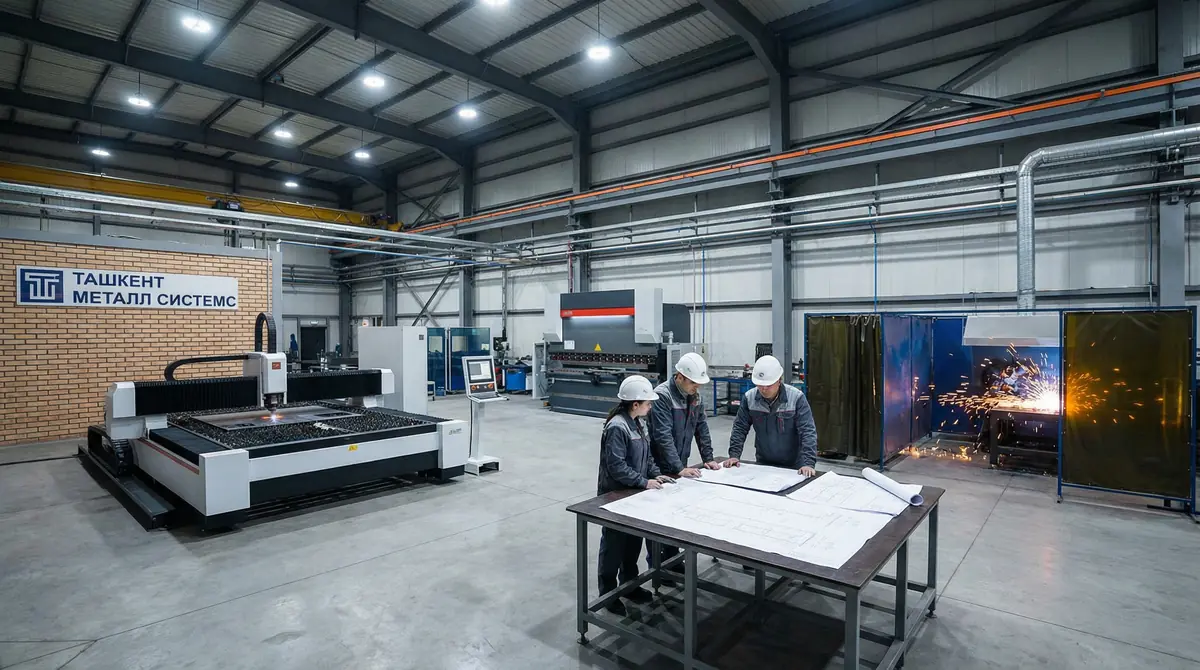
Lead Times for Contract Metal Manufacturing in Tashkent
Planning to launch a production run and looking for a contractor for laser cutting, bending, and welding in Tashkent? Learn what real contract manufacturing lead times consist of and how to calculate them already at the specification (TOR) stage.
Why calculate contract manufacturing lead times in advance
For manufacturing companies, engineering bureaus, and hardware startups in Tashkent, timing is more important than a price difference of a few percent. Any delay in laser cutting, bending, or welding metal shifts:
- the launch of a new line or product;
- installation of metal structures, frames, fences, stairs, and canopies;
- delivery of assemblies to your customers.
Contract manufacturing allows you not to invest in your own equipment fleet, but it adds another critical parameter — the contractor’s calendar. To avoid committing to unrealistic deadlines, it’s important to understand what they consist of and how to correctly formulate the TOR.
What lead times really consist of: stages from TOR to first batch
The lead time for a batch of metal products is not only the time for cutting, bending, and welding. A typical project has several blocks.
1. Preparation and approval of the TOR
- Checking drawings and 3D models.
- Clarifying materials: steel, stainless steel, aluminum, etc.
- Agreeing on tolerances, requirements for welds, edge quality after laser cutting, bend radii.
- Discussing batch size and delivery schedule.
The more accurate the initial TOR, the fewer revisions and back-and-forth, and therefore the shorter the initial stage.
2. Technological preparation of production
- Developing nesting layouts for laser cutting.
- Selecting tools and fixtures for metal bending.
- Selecting welding equipment and filler materials.
- Planning machine loading for your project.
At this stage, it is determined how efficiently the material will be used (waste minimization) and how to optimize the part’s route through the production areas.
3. Procurement and delivery of material
Even if the contractor keeps stock of main items, a specific project often requires:
- a different metal thickness;
- a different steel or stainless steel grade composition;
- a specific sheet or profile format.
Lead times for metal delivery in Tashkent and across Uzbekistan may differ from the usual European or Russian ones. This must be taken into account when planning the launch, especially for large volumes.
4. Production cycle: cutting, bending, welding, additional operations
The main "body" of the lead time:
- laser cutting of sheet or profile;
- metal bending on press brakes;
- welding (manual, semi-automatic, robotic — depending on the contractor’s capabilities);
- if necessary — machining, grinding, preparation for powder coating.
5. Quality control and packaging
- Checking dimensions and tolerances.
- Visual inspection of welds and edges after cutting.
- Assembly of a test unit (if provided for in the TOR).
- Packaging, labeling, preparation for shipment.
6. Logistics
Delivery time within Tashkent and the regions of Uzbekistan depends on dimensions, weight, and unloading conditions at your site (availability of a crane, forklift, etc.).
How the TOR affects lead times: what needs to be specified immediately
A high-quality TOR is the main tool for managing lead times. The less uncertainty, the faster the calculation and launch.
The TOR should immediately specify:
- Product purpose: hangar frame, trusses, columns, stairs, fences, outdoor advertising elements, equipment assemblies, etc.
- Material: steel, stainless steel, aluminum; specify the grade if available.
- Thicknesses and type of rolled stock: sheet, tube, profile.
- Drawings: vector files for laser cutting, 2D/3D models, specifications.
- Accuracy requirements: tolerances for dimensions, geometry, flatness.
- Welding requirements: type of weld, type of finishing (grinding, polishing), appearance requirements.
- Final finishing: whether powder coating, galvanizing, priming is needed.
- Volume and schedule: one-off batch or regular deliveries, expected annual volume.
The more "industrial" the TOR, the lower the risk that after launch you will have to change the design or technology, stopping the line.
Materials and metal thickness: how they shift the schedule
Material and thickness directly affect both lead time and cost.
Material impact
- Carbon steel — generally the most predictable in terms of lead time: a wide choice of suppliers, well-known laser cutting and bending modes.
- Stainless steel — may require separate procurement, different tooling and instruments, careful welding, especially for food equipment (tables, sinks, racks, fences). This adds time for preparation and quality control.
- Aluminum and non-ferrous metals — require different laser cutting and welding modes, which may limit the available equipment fleet and increase the waiting time for a free machine.
Thickness impact
- Thick metal is cut more slowly, requires higher laser power, and may require additional passes.
- When bending thick sheets, more powerful presses and specific tooling are needed, which may be occupied in other projects.
- In welding, thickness affects the number of passes, material consumption, and cooling time.
If you have a range for material or thickness (for example, a close equivalent is allowed), this can sometimes speed up the project due to material availability in stock and the availability of the required equipment.
Choice of technologies: when laser, bending, and welding speed up or slow down the series
Laser cutting
The advantage of laser cutting is quick changeover. This is critical for serial production:
- no need to manufacture dies;
- easy to make changes to the part contour between batches;
- high repeatability.
But with a large number of small items and frequent changeovers, the laser queue can become a bottleneck. Therefore, it is important to agree in advance on priorities and operating mode: one large batch or several small deliveries.
Metal bending
Bending provides stiffness and shape to the part without welding along the entire length. However:
- each press brake setup (changing punches and dies) takes time;
- complex bending sequences increase cycle time.
Sometimes it is more beneficial to simplify the product geometry at the design stage to reduce the number of operations and speed up production.
Welding
Welding is one of the most labor-intensive stages, especially in serial production of metal structures, frames, stairs, fences, outdoor advertising elements, and retail equipment.
Lead times are affected by:
- weld length and accessibility;
- appearance requirements (for example, for exposed areas on signs, lightboxes, channel letters, and brackets);
- the need for subsequent grinding and preparation for powder coating.
If the design can be adapted for bolted connections or the number of welds can be reduced, lead times are often shortened.
Table: main factors affecting lead time and price
| Factor | How it affects lead time | How it affects price |
|---|---|---|
| Completeness and quality of TOR | The more uncertainty, the longer the calculation and approval, and the higher the chance of rework | Additional engineer hours, risk of defects and rework increase the final cost |
| Material (steel, stainless steel, aluminum) | Stock availability and processing complexity affect cycle duration | Different raw material and tooling costs, different cutting and welding modes |
| Metal thickness | Thick metal takes longer to cut, bend, and weld | Increases material consumption and machine time, affects processing cost |
| Batch size | Small batches start faster but utilize production less efficiently | Large batches are cheaper per unit but require a larger calendar window |
| Number of changeovers | Many sizes and variants of parts stretch the cycle | Changeover time is spread over fewer parts, increasing the price per piece |
| Final finishing (painting, etc.) | Adds a separate stage and time for drying and internal logistics | Increases cost due to materials and additional operations |
| Logistics and packaging | Oversized items and complex packaging require extra time | Affect the cost of delivery, packaging materials, and loading |
Pilot batch vs serial production: how not to mix up the modes
For engineering bureaus and hardware startups, it is especially important to distinguish between:
- pilot (test) batch — to verify design, assembly, installation;
- serial production — when the design is fixed and a stable output is needed.
Pilot batch
- Allows small deviations in lead times for the sake of process development.
- Often includes several variants of the same part.
- Requires closer communication with the contractor’s process engineers.
Serial production
- Focused on a stable delivery rhythm.
- Requires a pre-agreed schedule and capacity reservation.
- Any design changes after launch directly affect lead times.
When contacting a contractor, it is important to immediately indicate what stage you are at: prototype, pilot, or series. This determines both lead times and the approach to cost calculation.
Typical customer mistakes that make lead times "slip"
-
Sending incomplete or "raw" drawings
- Without dimensions, tolerances, material, and thickness. Time is spent on clarifications and rework.
-
Ignoring design manufacturability
- Complex bends, hard-to-reach welds, excessive elements that do not affect function but significantly lengthen the cycle.
-
No separation between pilot and series
- Trying to immediately launch a large series without design verification leads to modifications and production stoppages.
-
Frequent TOR changes during the project
- Repeated reconfiguration of laser cutting, bending, and welding during the process shifts deadlines and complicates planning.
-
Underestimating material delivery times
- Expecting that any metal is available in the contractor’s stock. In reality, rare items require procurement time.
-
Unrealistic expectations for lead times
- Relying on the experience of small workshops where one welder "did it overnight" does not work at an industrial level and in serial mode.
-
No time buffer for logistics and installation
- Even with exact adherence to production lead times, delays are possible at the delivery and installation stage.
How to plan a launch: recommendations for plants, bureaus, and hardware startups
1. Include technological preparation in the schedule
Even if it seems that "there are only a couple of parts", time is needed to develop nesting layouts, select tooling for bending, and prepare welding fixtures.
2. Plan material in advance
If you know that the project will go into series, it makes sense to agree in advance with the contractor on:
- types and volumes of metal;
- possible stock reserved for your project;
- alternatives in grades and thicknesses.
3. Define critical deadlines
It is important to distinguish between:
- the date when you need first samples;
- the date when the first industrial batch must be ready;
- the frequency of subsequent deliveries.
This will help the contractor schedule machine and welding station loading.
4. Allow time for modifications
Even with good design, the first batches often reveal minor changes: holes for fasteners, cutouts for cables, additional stiffening elements. Allow time for one or two modification cycles.
5. Agree on the format of reporting and control
For complex projects, it is useful to define in advance:
- what quality control protocols are needed;
- which dimensions and assemblies are critical;
- how acceptance will take place: sampling, first-article inspection, assembly of a test unit.
This will reduce the risk of disputes and delays at the shipment stage.
FAQ on contract manufacturing lead times in Tashkent
1. What do lead times for a batch depend on first of all?
On the completeness of the TOR, material availability, equipment loading (laser, bending, welding), batch size, and the presence of final finishing (for example, powder coating).
2. Is it possible to speed up a project if deadlines are tight?
Sometimes yes, by simplifying the design, choosing more readily available material, changing the delivery schedule (splitting into several batches). This is discussed individually based on your TOR.
3. How long does it take just to calculate based on the TOR?
The calculation time depends on product complexity and volume. For simple parts with ready drawings it is shorter; for complex metal structures or sets it is longer. The more detailed the TOR, the faster the calculation.
4. What if we don’t have full drawings, only sketches?
It is possible to develop them into production drawings, but this is a separate stage that must be included in the schedule. It is better to immediately understand which dimensions and product requirements are critical.
5. How does powder coating affect lead times?
Coating adds surface preparation, the coating process itself, and drying. You also need to consider the loading of the coating line and the time to transport products between areas.
6. Can we first make a few samples and then move to series?
Yes, this approach is often optimal: first a pilot batch to verify design and assembly, then the launch of serial production based on updated drawings.
7. How to plan logistics within Tashkent and the regions?
When calculating lead times, you should consider product dimensions and weight, site access, warehouse operating hours, and availability of unloading equipment. It is best to provide this data to the contractor right away.
8. Can different products be combined in one order (for example, frames, fences, and outdoor advertising elements)?
Yes, but this increases the number of changeovers and complicates planning. It is important to structure the TOR by product groups and agree on priorities in terms of deadlines.
What is needed to calculate lead times and cost based on the TOR
To obtain a realistic calculation of lead times and cost for contract manufacturing in Tashkent, prepare:
- a description of product purpose (where and how they will be used);
- drawings or 3D models (it is better to clarify formats with the contractor);
- indication of materials and metal thicknesses;
- requirements for accuracy, welding, and final finishing;
- expected batch size and planned order frequency;
- desired dates for receiving samples and the first industrial batch;
- address and conditions for shipment/delivery.
The more detail you provide, the more accurately it will be possible to plan lead times for laser cutting, bending, welding, and related operations.
Summary: how to work with BRIX.UZ on lead times and batches
Contract manufacturing of metal products is not only laser cutting, bending, and welding, but also competent lead time planning. For manufacturing companies, engineering bureaus, and hardware startups in Tashkent, it is critical to understand in advance when samples, the first batch, and subsequent deliveries will be ready.
BRIX.UZ helps build this process: from analyzing your TOR to calculating lead times and optimizing technology for series.
Submit a request for calculation
For a preliminary calculation of lead times and cost, specify:
- a brief description of the project and product purpose;
- drawings/models or sketches with main dimensions;
- material and metal thickness for each item;
- volume of the first batch and planned annual volume;
- requirements for welding, accuracy, and final finishing (powder coating, no coating, etc.);
- desired dates for receiving samples and the first batch;
- city, address, and shipment/delivery conditions.
Based on this data, it is possible to prepare a justified calculation according to the TOR and propose a realistic contract manufacturing schedule for your series.