
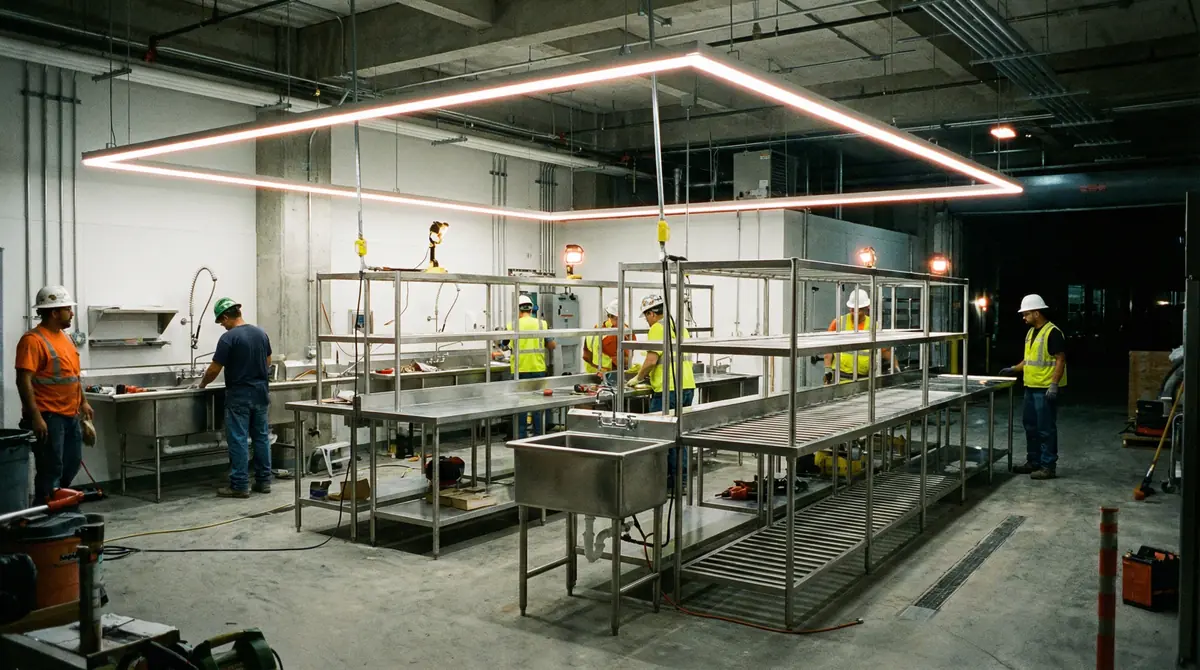
Lead times for manufacturing stainless steel equipment for a food shop
Planning to upgrade stainless steel tables, sinks, and racks in an operating food shop but can’t stop production? Here’s how to phase manufacturing and installation so you don’t miss deliveries.
When you can’t stop a food shop for modernization: initial conditions
For operating food production facilities in Tashkent, shutting down a shop for several weeks for modernization is often unacceptable. Contracts with chains, delivery deadlines, limited warehouse stocks — all this forces technologists and directors to look for an option to upgrade stainless steel equipment and infrastructure without stopping the line.
In this format, the key parameter becomes time:
- lead times for custom stainless steel equipment;
- delivery and sectional assembly times;
- installation “windows” without stopping production;
- retuning and commissioning times.
At the same time, the project cost directly depends on the specification, materials, scope, and chosen technologies. Without them, it’s impossible to correctly estimate either the budget or the schedule.
Typical stainless steel tasks solved during modernization
In operating food shops, stainless steel modernization is most often associated with:
- replacing outdated tables, sinks, and racks with modern solutions that meet current sanitary requirements and product flow;
- restructuring internal logistics in the shop: new stainless steel racks, trolleys, guides, separation of clean/dirty zones;
- organizing additional washing and sanitary zones without expanding the area;
- integrating new process equipment into the existing framework: stands, platforms, guards, stairs, transition platforms;
- converting part of the processes to stainless steel solutions instead of combined or painted structures.
All these tasks require precise measurements, 3D coordination with existing utilities, and phased installation so as not to stop production.
Project stages: from specification to launch without stopping the line
To control deadlines, it’s important to understand the project structure. For stainless steel equipment in an operating food shop, the stages usually look like this:
1. Preliminary audit and data collection
- site visit in Tashkent or work based on drawings/plans;
- recording dimensions, heights, tying into existing walls, columns, utilities;
- photo documentation of bottlenecks: passages, doors, elevators, zones where installation is only possible at night.
2. Technical specification (TS)
Calculation based on the TS is the starting point for deadlines and price. The TS records:
- list of stainless steel equipment units (tables, sinks, racks, guards, stairs, platforms, etc.);
- material requirements (grade of stainless steel, thickness, surface type);
- requirements for welds, disassembly, adjustable feet;
- sanitary and operational requirements (washing, disinfection, temperature conditions);
- installation constraints: night shifts only, weekends only, sectional replacement, etc.
The more detailed the TS, the more accurate the forecast for manufacturing times and installation windows.
3. Design and coordination with the existing shop
- development of 3D models and working drawings of stainless steel equipment;
- checking how new tables/sinks/racks pass through existing openings;
- splitting large structures into assembly units based on real delivery and installation conditions;
- agreeing on phasing: what is installed first, what in parallel, what in a backup window.
4. Manufacturing stainless steel equipment
At this stage, contract manufacturing and standard technologies are used:
- laser cutting of sheet stainless steel;
- metal bending on press brakes;
- welding of stainless steel elements;
- grinding, weld treatment, and, if necessary, final surface finishing.
Lead times here depend on production load, batch size, and product complexity.
5. Logistics and installation preparation
- packaging of units with regard to sanitary requirements of the food shop;
- planning deliveries in “batches” for installation windows;
- preparing fasteners, consumables, coordinating passes and access.
6. Installation without stopping production
- night or weekend work;
- sectional replacement: dismantling the old section and installing the new one in a single window;
- temporary solutions (bypass routes, temporary tables/guards) to keep the process continuous.
7. Inspection, acceptance, adjustments
- checking compliance with the TS and actual dimensions;
- testing staff ergonomics;
- minor on-site adjustments (leveling feet, trimming, adding elements).
What determines stainless steel equipment lead times
Lead times cannot be named “in general” — they are always calculated for a specific TS. The main factors are:
1. Scope and range
One table and a comprehensive modernization of the entire shop are tasks of different scale.
- number of items (tables, sinks, racks, stairs, guards, platforms);
- repeatability of products (serial or each unique);
- need for non-standard solutions for a specific process.
2. Design complexity
- presence of adjustable feet, shelves, sliding elements;
- combined structures (stainless steel + other materials);
- integration with process lines, conveyors, equipment.
3. Selected materials
- stainless steel grade and its availability in stock in Tashkent or on order;
- sheet and profile thickness;
- surface type (ground, matte, etc.).
If the required material is in stock, lead times are shorter. If it’s ordered, logistics are added to the schedule.
4. Processing technologies
Using modern technologies shortens lead times but requires proper planning:
- laser cutting speeds up part preparation and improves accuracy;
- metal bending on CNC equipment reduces the number of welds;
- welding (TIG and others) requires qualified personnel and time for quality control;
- machining and finishing — grinding, cleaning, preparation for operation in a food environment.
5. Process parallelization
If design, material procurement, and some preparatory operations run in parallel, the overall schedule is reduced. But for this, the TS must be stable enough, without constant changes.
How to plan stainless steel installation in an operating shop
Installation in an operating food shop is a separate task, often more critical in terms of timing than manufacturing.
1. Splitting the project into phases
- identifying zones that can be modernized independently;
- determining the minimum set of equipment that must operate at any time;
- building the sequence: from the “least critical” areas to key ones.
2. Installation windows
- night shifts after the end of the main shop shift;
- weekends or holidays with minimal production load;
- short windows between batches if the process is cyclical.
3. Sectional replacement
Instead of a complete shutdown of a zone:
- new tables/sinks/racks are manufactured with precise dimensions in mind;
- during the installation window, only part of the old equipment is dismantled;
- the new unit is installed in its place, connected, and put into operation;
- the next part is moved to the next window.
This approach requires very accurate measurements and careful design but allows downtime to be reduced to hours instead of days.
4. Coordination with technologists and quality department
- agreeing on the sequence of work with the shop technologist;
- taking sanitary requirements into account: protecting products from dust, organizing cleaning after installation work;
- planning disinfection of new zones before launch.
Night and “windowed” installations: how it works in practice
When modernizing without stopping production, the following formats are often used:
- night installations: the crew enters after the shift ends, performs dismantling and installation, and by morning the zone is ready for operation;
- weekend installations: longer windows for complex areas (stairs, platforms, guards);
- floor-by-floor or zonal modernization if the shop is multi-level;
- temporary bypass routes for staff and products so they don’t intersect with installers.
When planning such work, it’s important in advance to:
- check the actual passability of equipment through doors and corridors;
- provide for demountable structures if access is limited;
- think through storage of dismantled equipment before removal.
Materials and technologies: how the choice affects lead times and cost
The choice of materials and technologies directly affects both the schedule and the budget.
Materials
- Type of stainless steel. Common grades are available faster; rare ones require waiting for delivery.
- Metal thickness. Thicker sheet is more difficult to process, increasing cutting, bending, and welding time.
- Fittings and components. Adjustable feet, special fasteners, non-standard elements may have their own lead times.
Technologies
- Laser cutting speeds up part preparation, especially with complex geometry.
- Metal bending reduces the number of welds and speeds up assembly.
- Stainless steel welding requires time for high-quality weld treatment, especially for exposed and sanitary-critical areas.
The more complex the structure and the higher the requirements for appearance and sanitary treatment, the more time is allocated for finishing.
Table of factors affecting project lead times and cost
| Factor | Impact on lead times | Impact on cost |
|---|---|---|
| TS detail level | Clear TS shortens approval and rework time | Reduces risk of extra costs due to changes during the project |
| Scope and range | Large scope and many items increase manufacturing time | With large scope, unit price may be lower, but total budget is higher |
| Design complexity | Non-standard solutions and complex geometry require more time for design and production | Increases labor intensity and cost |
| Stainless steel grade choice | Stock availability speeds up start; rare grades add delivery time | Rare and special grades are usually more expensive |
| Metal thickness | Thick metal takes longer to cut and bend and is harder to weld | Increases material consumption and labor costs |
| Technologies used (laser, bending, welding) | Modern equipment shortens lead times with proper planning | Affects cost structure but improves accuracy and quality |
| Installation conditions (night/weekend windows) | Limited windows stretch the installation schedule | Night and urgent work may cost more |
| Access and dimension constraints | Need for demountable solutions and sectional assembly increases time | Complicates structures and installation, raising cost |
| Number of approval stages | Multi-stage approval lengthens the project | May lead to rework and additional costs |
Common mistakes when planning modernization without shutdown
- Lack of a full TS. Trying to “do it on site” without clear requirements leads to rework, schedule shifts, and budget growth.
- Underestimating approval time. Changes from technologists, quality department, and management often take no less time than manufacturing itself.
- Ignoring real installation windows. Planning installation “as if the shop is free” ends in postponements and conflicts with production.
- No time buffer. Any delay in material delivery or TS changes during the process disrupts the entire schedule.
- Ordering only by dimensions without considering internal building logistics. Structures may not fit through doorways or elevators, leading to on-site rework.
- Separate contractors for manufacturing and installation. Harder to coordinate deadlines and responsibility, higher risk of mismatches.
- No phased launch plan. When all new equipment is launched at once, the risk of production failures increases.
FAQ on stainless steel equipment manufacturing and installation lead times
Can you give exact lead times in advance without a site visit?
Without understanding the scope, complexity, and installation conditions, you can only talk about approximate ranges. For an accurate schedule, you need at minimum: TS, shop layout, and information on installation windows.
What’s more important for lead times: scope or product complexity?
Both factors matter. A large volume of standard tables and racks can be handled serially. A small but very complex set (stairs, platforms, guards) can take comparable or more time due to design and fitting.
How to understand whether installation without stopping production is possible?
You need to analyze:
- the structure of the process;
- available time windows;
- possibility of sectional replacement;
- quality department requirements.
After that, a phased plan is drawn up, and it becomes clear which zones can realistically be modernized “on the fly”.
Can part of the equipment be manufactured first and the rest later?
Yes, phased manufacturing and delivery is standard practice for operating shops. This allows you to align production and installation with real shutdown and financing capabilities.
How do TS changes during the process affect lead times?
Any change after design or production has started:
- requires recalculation and redesign;
- may entail reworking already manufactured parts;
- shifts manufacturing and installation deadlines.
That’s why it’s important to work through the TS as thoroughly as possible at the start.
Can existing metal structures (frames, guards) be reused and only upgraded with stainless steel?
Often this is possible and economically justified, but it requires inspection of existing structures and assessment of their condition. This can reduce manufacturing scope and lead times but adds a stage of inspection and design of transition nodes.
How to account for sanitary requirements during night installation?
At the planning stage, you need to agree with technologists and the quality department on:
- zones where work is allowed;
- procedures for protecting products and lines from dust and sparks;
- cleaning and disinfection regulations after installation;
- “rest” time for the zone before resuming operation.
Can stainless steel equipment modernization be combined with other work (electrical, ventilation)?
It can, but this complicates coordination and affects lead times. It’s important to allocate responsibility and work sequence between contractors in advance to avoid mutual downtime.
What data are needed to calculate lead times and cost
To provide a justified estimate of lead times and budget for stainless steel equipment modernization in an operating food shop, you need:
- shop layout with main zones and equipment locations;
- list of required items (tables, sinks, racks, stairs, guards, platforms, etc.);
- material requirements (type of stainless steel, thickness, surface treatment specifics);
- sanitary and operational requirements for the equipment;
- photos and description of bottlenecks: openings, corridors, access restrictions;
- information on acceptable installation windows (night, weekends, window duration);
- desired launch dates for individual zones and the entire project.
The more detailed the initial data, the more accurately you can plan the schedule and minimize the risk of shifts.
How to request a stainless steel equipment estimate for an operating shop
If you’re planning to modernize a food shop in Tashkent and can’t afford to stop production, the optimal start is a TS-based estimate that takes real installation windows into account.
Submit a request for an estimate
For a prompt estimate of manufacturing and installation lead times, specify:
- brief description of production (product, shop operating mode);
- city and site address;
- shop plan or layout (preferably in electronic form);
- list of required stainless steel equipment (tables, sinks, racks, stairs, guards, platforms, etc.);
- material and design requirements (type of stainless steel, thickness, design features);
- photos of the current state of zones to be modernized;
- desired phased launch dates;
- installation constraints (time, access, sanitary requirements);
- contact details of the responsible technologist or engineer.
Based on this data, it’s possible to prepare a realistic schedule and a preliminary project budget so you can safely modernize the shop without stopping production.