
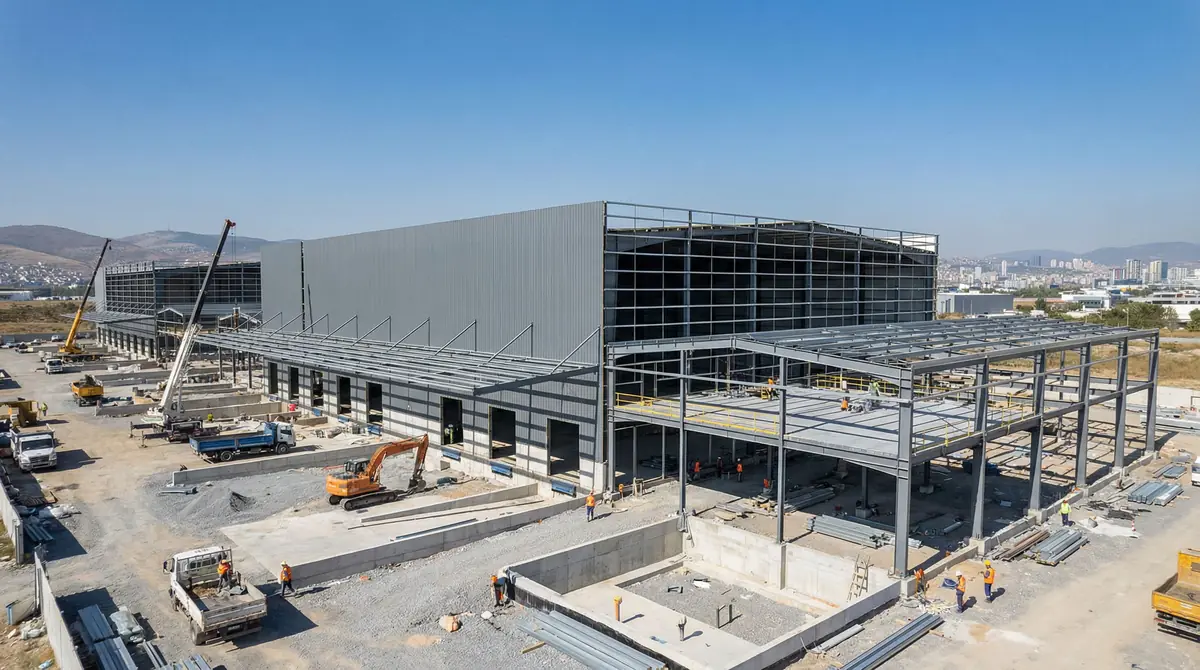
Estimate of Metal Structures for an Industrial Park
Planning an industrial park and need to understand the budget for metal structures? We break down how to calculate in a single estimate the frame of a hangar, canopies, technological platforms, and fences—without schedule gaps and cost surprises.
Industrial park: why metal structures should be calculated comprehensively
For an industrial park, metal structures are not a single standalone building but an interconnected system: the hangar frame, load-bearing frames, canopies, technological platforms, stairs, and fences. A mistake is to calculate each zone separately as if they were different projects.
A comprehensive estimate calculation allows you to:
- see the total metal consumption for the facility, not in fragments;
- optimize profile and truss sizes for different zones simultaneously;
- coordinate solutions for installation and supports (foundations, embedded parts);
- estimate production and installation timelines in advance without “gaps” between stages.
For initiators of industrial parks, developers, and government customers in Tashkent, this directly affects the project budget and the construction schedule.
Which metal structures are included in an industrial park estimate
A typical estimate for an industrial or logistics park most often includes:
-
Load-bearing frames and hangar frame
- columns and beams of the frame;
- roof trusses and purlins;
- bracing elements.
-
Canopies and annexes
- canopies for loading and unloading areas;
- canopies for special equipment parking;
- awnings above entrances and docks.
-
Technological platforms and stairs
- service platforms for engineering equipment;
- walkways between buildings;
- flight and vertical stairs, guardrails.
-
Fences and barrier structures
- perimeter fencing of the site;
- internal partition fences between zones;
- protective barriers along traffic routes.
Each of these blocks can be calculated separately, but with a comprehensive approach it is possible to unify joints, reduce the range of profiles and fasteners, and therefore reduce the total cost of fabrication and installation.
Why the estimate for frames, canopies, platforms, and fences should be calculated together
Fragmented calculation often leads to:
- metal duplication — different contractors include inflated safety margins “just in case”;
- incompatible solutions — different support schemes, different level marks, more complex installation;
- loss of time — re-approval of joints and reworking of drawings during construction.
A comprehensive estimate based on a single technical specification (TS) allows you to:
- use a common calculation scheme for the hangar frame and adjoining canopies;
- take into account in advance the load from technological platforms, stairs, and fences on the main columns and foundations;
- lay down a unified approach to metal protection (powder coating, hot-dip galvanizing, combined solutions).
As a result, the customer receives not a set of disparate prices but a structured estimate by sections, where it is clear how a change in one solution (for example, canopy height or column spacing) affects the overall budget.
Initial data for estimate calculation: what is important to specify in the TS
The accuracy of the estimate directly depends on the quality of the technical specification. To calculate metal structures for an industrial park in Tashkent, it is important to provide at least the following information.
1. General data on the facility
- location (city, district, site specifics);
- purpose of buildings and zones (warehouse, production, sorting center, etc.);
- required commissioning dates.
2. Dimensions and layouts
- planning solutions (drawings, schemes, layouts);
- dimensions: length, width, height of the hangar frame and canopies;
- location of technological platforms and stairs;
- length and height of fences.
3. Loads and operating conditions
- expected live loads on floors and platforms;
- presence of overhead cranes, suspended equipment;
- intensity of traffic flows in canopy zones;
- temperature regime (cold warehouse, heated workshop, etc.).
4. Requirements for materials and finishes
- preferred steel grades (if any);
- corrosion protection requirements (painting, galvanizing);
- fire resistance requirements for structures;
- aesthetic requirements (exposed structures, visible welds, etc.).
5. Scope of installation work
- whether full turnkey installation is needed or fabrication only;
- presence/absence of existing foundations;
- equipment constraints on site (crane, truck crane, work at height).
The more detailed the TS, the fewer assumptions have to be included in the calculation, and therefore the closer the estimate is to the final cost.
Materials and technologies: how the choice affects cost
The price of metal structures for an industrial park depends not only on the tonnage of metal but also on processing and assembly methods.
Choice of profiles and sections
- Hot-rolled steel (I-beams, channels, angles) — most often used for load-bearing frames and columns.
- Cold-formed profiles — allow reducing the weight of structures, especially in canopies and fences.
Optimizing sections for design loads provides significant savings for long spans of frames and canopies.
Processing technologies
- Laser cutting — precise cutting of parts, reduced waste, neat edges for welding.
- Metal bending — allows replacing welded joints with bent elements, reducing the number of welds.
- Welding — forming joints and frames; the durability and geometry of structures depend on welding quality.
- Powder coating — uniform coating, resistance to the environment, neat appearance.
Each stage adds cost, but with competent design it allows reducing overall metal consumption and simplifying installation.
Materials for different zones
- Main hangar frame — structural steel with protective coating.
- Canopies and open platforms — increased corrosion protection requirements.
- Technological platforms and stairs — focus on anti-slip decking and guardrails.
- Fences — possible combination of metal with mesh, sheet, panels.
The choice of materials and technologies is always discussed at the estimate stage based on the TS: sometimes a heavier profile without complex processing is more cost-effective than a lighter one that requires extensive welding and non-standard operations.
Stages of calculating the estimate for metal structures within one project
1. TS analysis and division into blocks
First, the facility is divided into logical blocks:
- hangar frame and load-bearing frames;
- canopies and awnings;
- technological platforms and stairs;
- fences and barriers.
For each block, dimensions, loads, and requirements are recorded.
2. Preliminary technical solutions
At this stage, the following are selected:
- types of sections (I-beam, channel, cold-formed profile);
- approximate truss and frame schemes;
- options for anchoring to foundations and to each other;
- options for corrosion protection.
Based on preliminary solutions, it is already possible to provide an indicative estimate with ranges.
3. Detailed calculation and specification
After agreeing on the basic solutions, a detailed calculation is performed and a specification is drawn up:
- list of elements with dimensions and weight;
- volumes of laser cutting, bending, welding;
- volumes of painting and other types of processing;
- assessment of installation labor intensity.
On this basis, a detailed estimate by sections is formed.
4. Coordination of timelines
The estimate is always linked to timelines:
- production of metal structures in stages (frame, then canopies, then platforms and fences);
- shipping and installation schedule;
- possible “bottlenecks” in production capacity or equipment access to the site.
For an industrial park in Tashkent, it is important to consider the seasonality of outdoor work and the schedule of rolled steel deliveries.
Typical mistakes when preparing the TS and estimate (and how to avoid them)
-
No unified TS for the entire park
Different areas are calculated by different contractors, and solutions do not match.
Solution: prepare a unified TS and order a comprehensive calculation. -
Unaccounted technological loads
Platforms and canopies are designed without real loads from equipment and vehicles.
Solution: immediately provide data on the weight and placement of equipment and traffic patterns. -
Overly general material requirements
Vague wording like “make it reliable” leads to excessive safety margins.
Solution: describe operating conditions and service life, not just wishes. -
Ignoring installation at the estimate stage
Only fabrication is calculated, and installation later turns out to be complex and expensive.
Solution: discuss installation methods, equipment access, and work sequence from the outset. -
Different approaches to corrosion protection within one facility
Some structures are painted, some galvanized, some insufficiently protected.
Solution: develop a unified metal protection standard for the entire park. -
Underestimating production timelines
The estimate does not reflect actual production load and logistics.
Solution: coordinate the schedule already at the calculation stage, not after signing the contract. -
No allowance for TS changes
Any change in the scheme causes recalculation and delays.
Solution: include a reasonable time buffer and discuss possible change scenarios in advance.
Timelines: how to plan production and installation of metal structures
Timelines depend on the volume of metal, complexity of joints, and readiness of design documentation. For an industrial park, it is important to divide the work into stages.
Stage 1. Hangar frame and main load-bearing frames
- priority block on which all subsequent work depends;
- requires maximum accuracy in geometry and installation tolerances;
- production capacity is planned primarily for this section.
Stage 2. Canopies and awnings
- can be fabricated in parallel with frame installation;
- it is important to agree in advance on joints to main columns and walls;
- timelines depend on the number of repeating sizes.
Stage 3. Technological platforms and stairs
- often depend on equipment layout;
- some solutions can be finalized after the main frame is installed;
- with proper planning, they can be allocated to a separate production batch.
Stage 4. Fences and barrier structures
- final block installed after main construction and engineering work;
- timelines depend on length and complexity of routes.
When calculating the estimate, it is important to immediately link cost to the schedule: sometimes a slight cost increase due to solution unification can significantly shorten timelines and avoid contractor downtime on site.
FAQ on metal structure estimates for an industrial park
1. Is it possible to get an estimate only for the hangar frame, without canopies and fences?
Yes, it is possible. However, solutions for canopies and fences should still be reflected in the TS, at least at the level of schemes and loads, so that joints do not have to be redesigned and the frame reinforced later.
2. How accurate can a preliminary estimate based on high-level data be?
Based on overall dimensions and loads, an indicative range can be provided. For a detailed line-item estimate, a more detailed TS and, if possible, drawings are required.
3. What if the project is not yet completed but the budget already needs to be approved?
In this case, it makes sense to prepare calculations for several scenarios (for example, different canopy heights, different platform options) and include them in the budget with stated assumptions.
4. Can the same solutions be used for different parks?
Partially yes: standard joints, recurring truss schemes, standard fence solutions. But loads, dimensions, and operating conditions must still be verified for each specific facility.
5. How should local specifics of Tashkent and the region be reflected in the estimate?
It is important to consider climate conditions, dust levels, temperature regime, availability of rolled steel, and logistics. This affects both the choice of materials and coatings and production and installation timelines.
6. What does the use of laser cutting and bending within one project provide?
More accurate geometry, reduced waste, fewer welded joints and, as a result, more predictable fabrication timelines.
7. Can payment be split by stages: frames, canopies, platforms, fences?
Yes, the estimate is usually structured by sections, which allows planning financing in line with construction stages.
8. What if the TS changes during construction (for example, additional platforms are added)?
Updated data must be promptly provided for recalculation. Having an initial comprehensive estimate simplifies such recalculation and allows faster assessment of the impact of changes on budget and timelines.
Table of factors affecting the price of metal structures
| Factor | How it affects cost | Comment |
|---|---|---|
| Dimensions and spans | The larger the spans and height, the higher the metal consumption | Especially noticeable for the hangar frame and canopies |
| Profile type | Different profiles with the same load capacity have different costs | Section optimization reduces total tonnage |
| Loads | Higher loads require reinforcement of sections and joints | It is important to specify loads correctly in the TS |
| Processing technologies | Laser cutting, bending, complex welding increase labor cost | But they reduce waste and simplify installation |
| Corrosion protection | Painting, galvanizing, combined solutions have different costs | Protection is critical for exposed structures |
| Batch volume | Large volumes are cheaper per ton | An industrial park benefits from economies of scale |
| Installation complexity | Work at height, confined conditions, limited equipment access increase installation cost | Better to account for this at the estimate stage |
| Implementation timelines | Tight deadlines may require extra shifts and resources | This is reflected in labor cost |
What an estimate based on the TS at BRIX.UZ provides and how to submit data
A comprehensive estimate of metal structures based on the TS allows you to:
- obtain a structured estimate by sections: frames, canopies, platforms, fences;
- see how changes in one section affect the overall budget;
- agree in advance on materials, technologies, and production timelines;
- plan phased financing and the installation schedule.
Submitting a request for calculation
To obtain an estimate of metal structures for an industrial park in Tashkent, prepare and provide the following data:
- a brief description of the facility and its purpose;
- site location (city, district);
- dimensions of the hangar frame and main buildings (length, width, height);
- schemes or drawings of canopies, technological platforms, stairs;
- length and height of fences, fence type (perimeter, internal zones);
- main loads (equipment on platforms, vehicles under canopies, stored goods);
- requirements for materials and corrosion protection (if there are preferences);
- need for installation and desired commissioning dates;
- contact details for clarification.
Based on this data, it is possible to prepare a substantiated estimate that reflects the real conditions and objectives of the industrial park.