
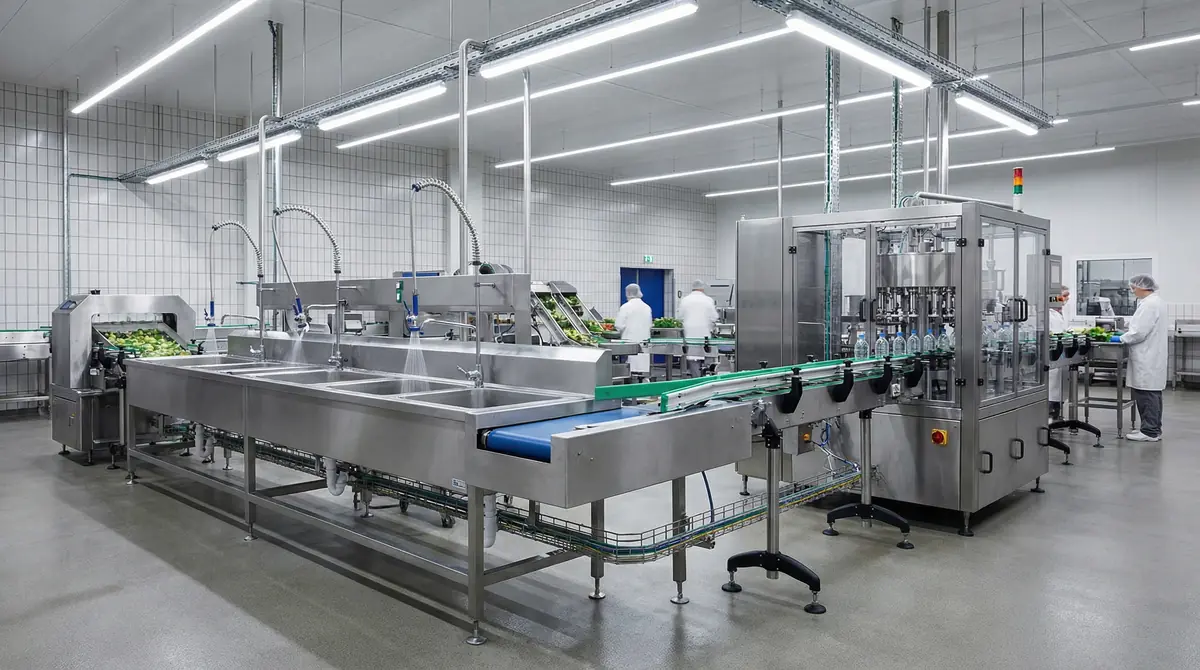
Mistakes When Ordering Stainless Steel Equipment for Food
A dishwashing table “like the neighbor’s” and a universal conveyor without a technical specification easily turn a food production area into a zone of constant rework. Let’s break down the key mistakes when ordering stainless steel equipment and how to avoid them.
The role of stainless steel equipment in food production
For food manufacturers, HoReCa kitchens, central kitchens, and processors in Tashkent, stainless steel equipment is not just “metal”. Dishwashing tables, conveyors, and filling lines directly affect:
- sanitary safety of products;
- speed and stability of output;
- personnel and maintenance costs;
- convenience of daily washing and disinfection.
Mistakes at the ordering stage of such equipment are the most expensive: line rework, downtime, on‑site modifications, and constant hygiene issues.
Why mistakes at the ordering stage are especially costly
When ordering stainless steel equipment for food‑processing, people often try to “speed things up”: provide a minimal technical specification, copy “what the neighbors have”, and not delve into material and technology details.
As a result:
- the equipment does not match real processes;
- “bottlenecks” in performance appear;
- washing and sanitation take several times longer;
- the price grows after launch due to modifications and repairs.
The right approach is calculation based on a technical specification that takes into account raw materials, operating modes, aggressiveness of detergents, room dimensions, and internal logistics in the production area.
Below are typical mistakes specifically when ordering dishwashing tables, conveyors, and filling lines.
Mistake #1: Vague or incomplete technical specification for dishwashing tables
Stainless steel dishwashing tables are often perceived as “simple furniture”. Because of this, the technical specification is limited to the phrase “2‑meter dishwashing table, stainless steel”. For food production this is categorically insufficient.
What is often forgotten in the technical specification
- Type of product and contamination (meat, fish, confectionery, oil, dough, etc.).
- Operating mode: shifts, load, intensity.
- Required configuration: number of washing sections, location of sinks, shelves, splashbacks.
- Type and location of traps, overflows, floor drains.
- Load on the worktop: weight of containers, crates, GN pans.
- Requirements for splashbacks and joints: height, shape, need for sealing.
- Whether adjustable feet, shelves, grids, cutouts for equipment are needed.
What this leads to
- Water flows onto the floor instead of into the drain — constant puddles.
- The table does not withstand the weight of containers, deformations appear.
- It is impossible to conveniently arrange dishes and utensils.
- The washing area becomes the “bottleneck” of the entire line.
The solution is a detailed calculation based on a technical specification: send to production not only dimensions, but also a layout, photos/plan of the room, process description, and sanitary authority requirements.
Mistake #2: Incorrect choice of grade and thickness of stainless steel
The phrase “any stainless steel will do” is the source of many problems in food production.
Typical miscalculations
- Metal that is too thin — tables and conveyors flex, vibrate, and sag.
- Unsuitable steel grade for the detergents and disinfectants used.
- Mixing materials (stainless steel + mild steel in hidden assemblies) — corrosion hotspots.
How this turns out
- Rapid appearance of stains, darkening, corrosion.
- Difficulty in proper cleaning — contaminants cling to microdefects.
- Reduced equipment life and frequent repairs.
During calculation it is important to immediately discuss:
- which chemical agents will be used;
- temperature of washing solutions;
- humidity and temperature in the production area;
- planned service life and operating mode (hours per day).
This directly affects the choice of grade and thickness of stainless steel, and therefore the cost.
Mistake #3: Ignoring sanitary and ergonomic requirements
Even if the material is chosen correctly, the equipment may be inconvenient and labor‑intensive to maintain.
Sanitary shortcomings
- Open gaps and hard‑to‑reach areas where product residues accumulate.
- Incorrect slopes of surfaces — water stagnates.
- Sharp edges, unprotected welds.
Ergonomic mistakes
- Incorrect height of dishwashing tables and work surfaces.
- No space for containers, crates, GN pans.
- Inconvenient location of faucets, mixers, spray guns.
Consequences — increased washing time, higher risk of injury, staff fatigue, constant complaints and on‑site modifications.
When ordering, you should immediately discuss with the manufacturer:
- height and composition of staff (men/women, working seated/standing);
- need for rounded corners, closed cavities, radii;
- requirements for weld and edge finishing.
Mistake #4: Underestimating the specifics of conveyors for food lines
A conveyor in food production is not just a transporter. It must take into account the product, packaging, speed, and sanitary regime.
What is often overlooked
- Type of product: wet/dry, sticky, with crumbs, with juice.
- Type of belt or deck: solid, modular, perforated, stainless steel.
- Washing system: manual, semi‑automatic, need for quick disassembly.
- Integration with other equipment: dispensers, scales, packaging machines.
Common mistakes
- Ordering a “universal” conveyor without linking it to a specific line.
- No quick‑release elements for washing.
- Incorrect choice of conveyor width and height.
- Unaccounted accumulation zones where product builds up and spoils.
As a result — constant stops, manual “pushing” of products, hygiene problems, and excessive staffing.
Conveyor calculation based on a technical specification should include product flow diagrams, photos/drawings of adjacent equipment, and speed and throughput requirements.
Mistake #5: Ordering filling lines without linking to technology and logistics
A stainless steel filling line is a complex unit that must be integrated into the overall process and logistics of the production area.
What is forgotten when ordering
- Type of container (volume, material, geometry, type of cap).
- Viscosity and temperature of the product.
- Need for CIP cleaning or manual disassembly cleaning.
- Scheme for supplying and removing containers, pallets, crates.
- Possible future changes in the product range.
How this ends
- The filling line does not reach the declared capacity.
- Frequent overfills, underfills, product contamination of equipment.
- “Traffic jams” before and after filling — containers are not supplied or removed in time.
The right approach is a joint calculation with the manufacturer based on a detailed technical specification, including process sheets, plant layout, and shift output requirements.
Mistake #6: Saving on manufacturing and finishing technologies
When comparing commercial offers, people often look only at the final amount, without delving into how exactly the equipment will be manufactured.
Where they try to save
- Refusal of laser cutting in favor of rough mechanical cutting — less accurate geometry.
- Simplified metal bending — extra joints and welds instead of single‑piece bent elements.
- Minimal welding and weld finishing — gaps, sharp edges.
- No final surface treatment (grinding, polishing in product contact zones).
Consequences
- Difficulty in sanitary treatment.
- Increased wear of assemblies and fasteners.
- Poor appearance of equipment in open kitchens and HoReCa production areas.
Yes, high‑quality stainless steel manufacturing technologies (laser cutting, precision bending, professional welding) affect the price, but they also determine service life and ease of operation.
What affects the cost of stainless steel equipment
Specific prices can only be correctly calculated based on a technical specification. But the main factors that affect the cost of dishwashing tables, conveyors, and filling lines can be structured.
| Factor | How it affects the price | Comment |
|---|---|---|
| Dimensions and design complexity | The larger and more complex, the higher the metal consumption and labor intensity | Complex shapes, multi‑level tables, and curved conveyor sections increase cost |
| Grade and thickness of stainless steel | More corrosion‑resistant and thicker sheets are more expensive | The choice depends on cleaning chemicals, temperature, and operating mode |
| Surface and weld treatment | Additional grinding, polishing, and finishing increase the price | Important for hygiene and appearance, especially for HoReCa |
| Type and number of welded joints | Complex assemblies and hermetic welds require more time | Single‑piece bent parts can reduce cost with proper design |
| Equipment and fittings | Faucets, spray heads, feet, rollers, sensors, drives | For conveyors and filling lines, the share of components in the price can be significant |
| Requirements for disassembly and washing | Quick‑release elements and special fasteners increase cost | But they save time on daily sanitation |
| Order volume | Series production is more cost‑effective than one‑off items | With large batches it is easier to optimize cutting and production |
| Installation and commissioning | Turnkey installation increases the total amount | Important for filling lines and conveyors where precise setup is needed |
Therefore, the correct question is not “How much does a dishwashing table cost?”, but “How much will a solution for my processes and conditions cost?”. The answer is only possible after studying the technical specification.
How to prepare a proper technical specification for calculation and production
To get a realistic estimate and avoid the above mistakes, when contacting a stainless steel equipment manufacturer in Tashkent you should prepare a basic data package.
For dishwashing tables and washing areas
- Purpose (dishwashing, utensils, containers, vegetables/meat, etc.).
- Area dimensions, relation to walls, doors, floor drains.
- Required length, width, and height of tables.
- Number and type of sinks.
- Presence and location of shelves, grids, splashbacks.
- Requirements for drainage, traps, overflows.
- Description of detergents and washing modes.
For conveyors
- Type of product and packaging.
- Required capacity (pcs/hour, kg/hour).
- Length, height, and route configuration.
- Required type of belt/deck.
- Operating conditions (humidity, temperature, aggressive media).
- Requirements for disassembly and washing.
- Schemes for integration with other equipment.
For filling lines
- Type of product (liquid, viscous, with inclusions).
- Type of container, volume range.
- Required dosing accuracy.
- Planned shift output.
- Need for CIP cleaning or manual disassembly cleaning.
- Room layout with utility connection points.
The more accurate the technical specification, the faster and more accurate the estimate, and the lower the risks in terms of deadlines and budget.
FAQ on ordering stainless steel equipment for food‑processing
1. Is it possible to “roughly estimate” first and refine the technical specification later?
A rough estimate can be given, but without a technical specification it will be very approximate. To make decisions on budget and deadlines, it is better to immediately provide basic data: dimensions, purpose, operating mode, and cleaning requirements.
2. Why can two similar dishwashing tables differ greatly in price?
Not only size matters, but also grade/thickness of stainless steel, frame type, presence of shelves, splashbacks, traps, weld finishing, adjustable feet. Tables that look similar may have different rigidity, service life, and ease of cleaning.
3. Is it possible to upgrade existing equipment instead of manufacturing new?
Sometimes it is possible: reinforce the frame, add splashbacks, modify drainage, add shelves. But if serious mistakes were initially made in material, geometry, or sanitary requirements, it is often more cost‑effective to manufacture a new solution based on a proper technical specification.
4. How long does it take to manufacture custom stainless steel equipment?
Lead times depend on complexity, volume, and production workload. Small dishwashing tables and racks take less time than conveyors and filling lines. A realistic timeframe can only be given after agreeing on the technical specification and scope of work (including installation, if required).
5. Can dishwashing tables, racks, and a conveyor be combined in one order?
Yes, a comprehensive order is often more convenient: all elements are coordinated with each other in terms of dimensions, height, and logistics. This allows optimization of stainless steel cutting and reduction of the number of approvals.
6. Which is better: a standard solution or a fully custom project?
If processes are standard and the room is typical, standard solutions with minimal modifications can be used. But for most existing production areas and kitchens, with their specific layouts and product ranges, custom manufacturing based on a technical specification is required.
7. How to understand that the manufacturer takes sanitary requirements into account?
Pay attention to the design of assemblies: presence of rounded corners, absence of “pockets”, quality of weld finishing, proposals for disassembly for washing. An important sign is the manufacturer’s questions about detergents, disinfection modes, and regulatory requirements.
8. Is it possible to plan for future line expansion right away?
Yes, when designing conveyors and filling lines, you can provide a reserve in length and power, and free space for additional equipment. This should be discussed at the technical specification stage so as not to redo the design later.
How to request a quote from BRIX.UZ: what data to prepare
To get a quote for stainless steel equipment for food production in Tashkent, it is important to immediately provide key information.
Submit a request for calculation
Recommended data set for the request:
- Name and type of production (HoReCa kitchen, central kitchen, processing, etc.).
- City and site (to assess the possibility of installation and measurements).
- List of required equipment (dishwashing tables, conveyors, filling line, racks, etc.).
- Purpose of each unit (what is washed, what is transported, what is filled).
- Dimensions and layout of the room (drawing, diagram, or at least photos with dimensions).
- Required capacity (pcs/hour, kg/hour, shift output).
- Description of detergents and disinfectants used.
- Special requirements (open kitchen, increased appearance requirements, limited height, operation in cold rooms, etc.).
- Desired manufacturing and commissioning dates.
Based on this data, a technical proposal can be prepared, the design can be optimized for your processes, and a justified estimate of cost and lead time can be provided.