
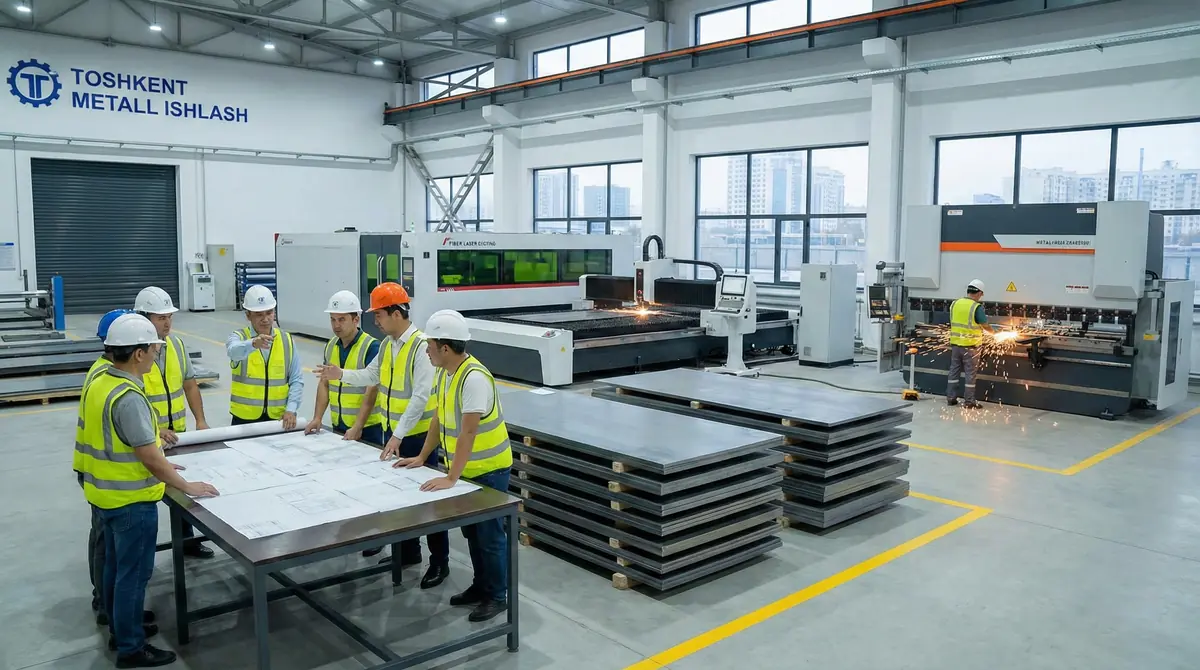
Mistakes When Ordering Laser Cutting and Metal Bending
Laser cutting and metal bending seem like simple services until rework, defects, and missed deadlines appear. We break down the key mistakes when ordering contract manufacturing and show how to avoid them already at the specification stage.
Why the final price and lead time differ so much for similar orders
For many industrial companies and engineering firms in Tashkent, laser cutting and metal bending are already “routine” services. But in practice, two orders of similar volume can differ in cost by several times and in lead time by weeks.
The reason is almost always the same: mistakes at the stage of setting the task for the contract manufacturing contractor. Incomplete specifications, unsuitable material, unaccounted tolerances, late changes — all this turns into extra hours of engineering preparation, machine re‑setup, downtime, and rework.
Below we will look at typical mistakes when ordering contract laser cutting and metal bending and show how to avoid them already at the quotation stage based on the specifications.
The role of a competent specification in calculating laser cutting and bending
For the contractor, a quotation based on the specifications is not just “calculating the price per kilogram or meter”. It is an assessment of:
- manufacturability of parts for laser cutting and bending;
- availability of the required material and thickness in stock;
- equipment load and realistic lead times;
- the need for additional processing (welding, grinding, powder coating, assembly);
- risks of defects and rework.
The more accurate the initial data, the closer the quotation will be to the actual cost and lead time. A vague specification almost always means:
- re‑estimating the budget;
- additional engineering preparation;
- shifting the queue on the machines;
- a “floating” shipping date.
Mistake No. 1: “Approximate” specifications without dimensions and tolerances
A common situation: the customer sends the contractor a rough sketch or 3D model without clear requirements and asks for an “approximate” quotation “by cutting area and weight”. As a result:
- when detailing, it turns out that some elements cannot be bent on the available equipment;
- bend radii have to be changed, holes added/removed, lengths adjusted;
- sheet nesting layouts change — and metal consumption increases.
What this leads to
- Recalculation of cost after clarifying dimensions and tolerances.
- Delay of production start by 2–3 days or more.
- Risk of part incompatibility during assembly at the customer’s site.
How to avoid this
For a quotation based on the specifications, a laser cutting and bending contractor needs at least:
- file format (2D drawings, 3D models — as agreed);
- a complete set of dimensions for all parts;
- tolerances for critical dimensions (fit holes, keyways, mounting surfaces);
- indication of which dimensions are “functional” and which can be adjusted to suit the process.
The earlier this data appears, the lower the chances of cost overruns and missed deadlines.
Mistake No. 2: Incorrect choice of material and sheet thickness
The second source of problems is choosing the material “by eye”: for example, stainless steel instead of structural steel, or a 3 mm sheet instead of 2 mm “just in case”.
Possible consequences
- Increased material cost. More expensive material or an extra millimeter of thickness immediately increases the cost of the blank.
- Change in technology. A thick sheet requires different laser cutting modes and sometimes different equipment.
- Bending limitations. Some press brakes have limits on thickness and part length. An unsuitable material may require splitting the part into several pieces with subsequent welding.
What is important to agree on before the quotation
- steel or aluminum grade (if there are requirements for corrosion resistance or weight);
- acceptable thickness range (for example: “from 2 to 3 mm, priority — cost savings” or, conversely, “thickness at least 3 mm due to stiffness”);
- the possibility of replacing the material with an equivalent that is available in Tashkent.
If the contractor is involved at the design stage, they can offer a compromise: the optimal thickness and material for your loads and budget.
Mistake No. 3: Ignoring part manufacturability for laser cutting and bending
A design model that works perfectly in CAD does not always pass through laser cutting and bending just as perfectly.
Typical problems:
- no allowance for the minimum internal bend radius;
- holes and slots are located too close to the bend line;
- elements are too small and difficult to cut without deformation;
- no allowances for subsequent welding and grinding.
What this leads to
- the need to rework drawings after the quotation has been issued;
- adding technological cuts, bridges, compensation holes;
- increased programming and machine setup time;
- risk of defects and repeated cutting.
How to act correctly
At the specification preparation stage, you should discuss with the contract manufacturing contractor:
- minimum hole and slot sizes for the selected thickness;
- limitations on bend length and height;
- accuracy requirements after bending (especially for long profiles and enclosures);
- the need for technological elements (for example, “ears” for hanging during powder coating, if it is also included in the order).
The more manufacturable the part, the cheaper and more stable the series will be.
Mistake No. 4: Uncoordinated changes during production
One of the most expensive mistakes is changing the design after production has started.
Examples:
- the fit dimension has changed — the cutting program needs to be reconfigured;
- new holes have been added — part of the batch has to be reworked;
- metal thickness has changed — old nesting layouts become invalid.
Consequences for budget and lead time
- excess material consumption due to defects and rework;
- line stoppage while the engineer reprograms the laser and press brake;
- shifting deadlines not only for your order but also for other clients — the contractor is forced to reschedule.
How to minimize risks
- Allow time for internal design approval before submitting the specifications.
- Split the project into stages: first a prototype/pilot batch, then full production.
- Fix the documentation version used for production.
If changes are still inevitable, it is important to immediately inform the contractor of the full list of revisions rather than introducing them one by one — this will reduce the number of re‑setups.
Mistake No. 5: Unrealistic deadlines and no buffer
Quotations based on specifications are often requested “for yesterday”, and production start is planned “from Monday”. At the same time, the following are not taken into account:
- current load of laser machines and press brakes;
- time for checking and adapting drawings;
- possible delays in metal delivery to the warehouse.
What happens as a result
- either the contractor refuses the order so as not to miss current commitments;
- or accepts the order, but the actual shipping date is postponed.
Recommendations on lead times
- Discuss approximate lead times already at the preliminary quotation stage.
- Include a buffer for specification approval and possible clarifications.
- For time‑critical projects, immediately indicate the “hard” date and readiness to adapt the design to faster technologies.
When working with serial batches, it makes sense to build a regular delivery schedule rather than agreeing each order separately in emergency mode.
Mistake No. 6: Splitting cutting, bending, and welding between different contractors
An attempt to save money by splitting the production chain between several providers often leads to the opposite result.
Typical scenario:
- one contractor performs laser cutting;
- the second — metal bending;
- the third — welding and possibly powder coating.
Problems with this approach
- it is more difficult to control tolerances: each stage adds its own deviations;
- there is no single responsibility for the final dimensions and assembly of the product;
- the risk of damage to parts during transportation between sites increases;
- time is lost on logistics and waiting.
If possible, it is more beneficial to entrust laser cutting, bending, welding, and painting to a single contract manufacturing contractor. Then they can immediately account for technological clearances, operation sequence, and packaging for your task.
Mistake No. 7: Failure to account for logistics and packaging
Another source of hidden costs is logistics.
What is often overlooked:
- part dimensions after bending do not fit into the customer’s transport;
- there is no rigid packaging, parts deform in transit;
- batches are not labeled, and assembly at the end customer turns into a “puzzle”.
How this affects cost
- additional transport trips;
- rework of damaged parts;
- time lost on sorting and searching for the required elements.
At the specification stage, you should discuss:
- shipping format (sheets after cutting, already bent parts, assemblies after welding);
- packaging requirements (pallets, crates, straps, edge protection);
- labeling of parts and batches.
What really affects cost: key factors
Below is a generalized table of factors that most strongly affect the price of laser cutting and metal bending, as well as lead times.
| Factor | How it affects cost | How it affects lead time |
|---|---|---|
| Thickness and type of material | Thicker and more expensive material increases consumption and cutting cost | Requires different modes, sometimes different equipment, possible queue |
| Contour complexity and number of holes | Increases cutting and programming time | Increases preparation time, may require test cuts |
| Number of bends and their length | Each bending operation is additional time and setup | Increases press load, possible queue for bending |
| Required accuracy and tolerances | High accuracy requires more careful modes and quality control | Adds measurement stages, may increase cycle time |
| Batch size (pcs./series) | Small batches are more expensive per piece due to setup | Small batches can be completed faster but depend on the queue |
| Need for welding and painting | Adds operations, material consumption, and man‑hours | Increases total production cycle and drying/cooling time |
| Quality of initial specifications | Vague specifications increase time for approvals and rework | Production start is postponed until all details are clarified |
| Logistics and packaging | Special packaging adds to cost but reduces defect risk | Requires additional time for shipment preparation |
Understanding these factors helps you make decisions at the design stage that will keep the project within budget and schedule.
How to properly prepare an order for laser cutting and bending in Tashkent
To make the quotation based on the specifications accurate and production predictable, you should establish a clear procedure.
1. Define the task and constraints
- purpose of the product (equipment, enclosure, frame, assembly);
- operating conditions (outdoor/indoor, loads, corrosion);
- priority: minimum price, minimum weight, maximum stiffness, fastest lead time.
2. Prepare technical documentation
- drawings or models of all parts with dimensions;
- indication of metal thickness and type (or range);
- tolerances for critical dimensions;
- list of operations: laser cutting, bending, welding, powder coating, assembly.
3. Agree manufacturability with the contractor
- check for problematic elements for laser cutting and bending;
- if necessary, adapt the design to the contractor’s equipment;
- determine which dimensions can be adjusted without compromising function.
4. Discuss logistics and shipping format
- in what form the parts are needed (flat, bent, in assemblies);
- packaging and labeling requirements;
- delivery address and conditions in Tashkent or regions.
5. Fix the specification version
- agree on the final set of documents for quotation and production;
- define how possible changes will be formalized (addenda, new drawing versions).
The more structured your approach to these steps, the lower the chances of cost overruns and missed deadlines.
Frequently asked questions about contract laser cutting and bending
Is it possible to first get a “quick quotation” and then send the rest of the specifications?
You can get an approximate estimate based on rough data, but it almost always differs from the final one. This is acceptable for budget planning, but for actual production start the contractor will still request the full set of specifications.
Is it necessary to provide 3D models if 2D drawings are available?
Not necessarily, but 3D models help identify potential problems during bending and assembly more quickly. In some cases, this allows you to avoid rework and save time on approvals.
What if the exact steel grade has not yet been determined?
You can specify requirements for strength, corrosion resistance, and budget. The contractor will offer materials available in Tashkent and calculate several scenarios so you can choose the optimal one.
What is the minimum batch size that makes sense to outsource to contract manufacturing?
Even single items can be made to order, but the share of preparation (programming, setup) in their cost will be higher. For serial projects, it is more profitable to discuss planned volumes and frequency in advance.
Is it possible to combine laser cutting, bending, welding, and painting in one order?
Yes, if the contractor has the appropriate equipment. This reduces interface risks, simplifies logistics, and allows optimization of the process for the final result.
How to estimate lead times in advance?
Lead time depends on volume, part complexity, equipment load, and metal availability in stock. At the request stage, you should indicate the desired shipping date and ask the contractor for several scenarios: standard lead time and expedited, with possible design adaptation.
What if design modifications are required during operation?
It is better to have the contractor keep all documentation and cutting/bending programs in advance. Then, during modification, you will not have to “recreate” the project from scratch, and changes can be made selectively.
Submit a quotation request
If you need custom metal parts with laser cutting and bending in Tashkent, it makes sense to start with a proper specification. The more accurate the initial data, the faster you will receive a quotation and the lower the risks in terms of lead time and budget.
To submit a quotation request, prepare and send:
- a brief description of the project and product purpose;
- drawings or 3D models of parts (with dimensions and tolerances);
- indication of material and sheet thickness (or acceptable range);
- batch size (pcs./series, planned frequency);
- list of operations: laser cutting, bending, welding, powder coating, assembly;
- requirements for packaging, labeling, and delivery (city, warehouse, unloading conditions);
- desired production lead time and possible time buffer.
Based on this data, the contract manufacturing contractor will be able to quickly prepare a quotation based on the specifications, offer material and process options, and agree on realistic start and shipping dates.