
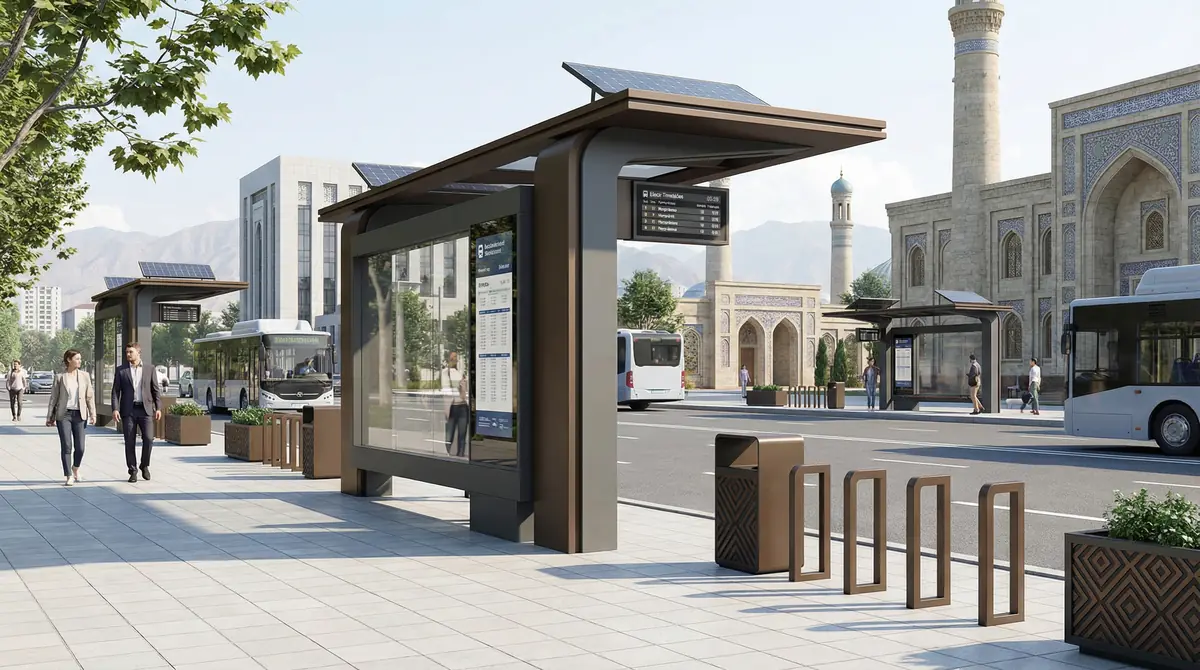
Mistakes When Ordering Urban Pavilions and Bus Stops
Urban pavilions and bus stops often look simple, but any mistake in the technical specification leads to missed deadlines and budget overruns. Let’s break down the key miscalculations made by municipal customers and designers.
The role of urban pavilions and small architectural forms in municipal projects
Urban pavilions, public transport stops, and small architectural forms (SAFs) are not just a canopy and a few supports. For Tashkent, these are elements of urban infrastructure that affect residents’ comfort, the visual appearance of streets, and safety.
For a municipal customer, design institute, or developer, such facilities are part of a larger improvement program: street reconstruction, development of transport corridors, creation of public spaces. Errors at the stage of ordering metal structures are more expensive here than in private projects: budgets are involved, deadlines are tied to tenders and state programs, and responsibility is higher.
What metal structures are used for pavilions and bus stops
A typical set of urban pavilions and SAFs includes:
- load-bearing frame of the pavilion or stop complex;
- support columns and roof trusses;
- canopies and awnings over boarding areas;
- stairs and ramps (if necessary);
- railings, handrails, safety elements;
- elements for mounting outdoor advertising, lightboxes, information boards.
A hangar frame is not used directly here, but the approach to calculating metal structures is similar: it is important to take into account wind and snow loads, possible impact loads, intensity of use, and durability requirements.
Why mistakes at the technical specification stage are especially costly for B2G projects
Municipal projects in Tashkent are implemented under conditions of:
- tight deadlines (budget utilization, seasonality of work, road closures);
- formalized procedures (tenders, bidding documentation, approvals);
- increased attention to appearance and safety.
If the technical specification (TS) for the manufacture of metal structures for pavilions and bus stops is formulated inaccurately, the contractor either lays in an excessive safety margin (higher cost) or underestimates the requirements (risk of rework and missed deadlines). In both cases, the customer loses.
Below are typical mistakes faced by municipal customers, design institutes, and developers.
Mistake No. 1: vague or incomplete technical specification
A common situation: the TS specifies only the overall dimensions of the pavilion and an example visualization. There is not enough data for correct calculation of metal structures and production planning.
What is usually omitted in the TS
- Exact dimensions: height, width, depth, column spacing, canopy overhang.
- Installation scheme: freestanding pavilion, integrated into existing development, integration with stairs and railings.
- Requirements for glazing and infill: type of glass or polycarbonate, anti-vandal solutions, possibility of replacement.
- Engineering load: mounting points for lightboxes, signs, brackets for cameras, route indicators.
- Operating conditions: intensity of pedestrian flow, proximity to the roadway, presence of overhead contact system, specific climatic features at a particular point in the city.
What this leads to
- Reworking of design documentation (KM/KMD) in the process, shifting production deadlines.
- Additional approvals and budget adjustments.
- Conflicts between the design institute, contractor, and facility owner.
Solution: start interaction with the contractor from a detailed calculation based on the TS. The more complete the initial data, the more accurate the proposal on the structure, timing, and cost.
Mistake No. 2: underestimating the choice of materials and technologies
Pavilions that look similar from the outside can differ in cost price and service life by several times. Often, the bidding documentation only states “metal structure, painted” without details.
Key choices that affect the result
-
Type of metal and sections
- thin-walled profile versus hot-rolled steel;
- saving on column and truss sections without considering wind loads.
-
Manufacturing technologies
- laser cutting instead of manual cutting — accuracy, repeatability, neat joints;
- metal bending instead of assembling many small elements — fewer welds, higher rigidity;
- proper welding (including hidden welds in critical joints) — affects the service life of the structure.
-
Protective and decorative coating
- powder coating provides resistance to outdoor conditions and a neat appearance;
- selection of a coating system for a specific environment (dust, de-icing agents, proximity to the road).
Typical mistakes
- Focusing only on the lowest cost of rolled metal.
- Ignoring that saving on painting leads to repainting after 1–2 seasons.
- Failing to include requirements for weld quality and surface preparation in the TS.
Solution: at the stage of requesting a commercial offer, discuss options for materials and technologies with the contractor instead of limiting yourself to the wording “metal, painting”.
Mistake No. 3: ignoring installation, foundations, and site conditions
The metal structure of the pavilion is only part of the solution. Mistakes often appear at the junction between manufacturing and construction.
What they forget to consider
- Type of base: existing surface (asphalt, paving slabs, concrete), need for foundations.
- Anchoring scheme: depth and type of anchors, consideration of underground utilities.
- Sequence of work: who and when prepares the site, when metal structures are delivered, how access is organized.
- Installation of canopies, stairs, railings: need for temporary supports and equipment.
Consequences
- Impossibility to install the pavilion according to the design without on-site modifications.
- Forced changes to the structure (shortened columns, relocation of supports).
- Additional costs and missed commissioning deadlines.
Solution: immediately include installation in the TS and contract or, at a minimum, clearly specify requirements for installation and foundations. The metal structure contractor must understand what their product is attached to.
Mistake No. 4: lack of coordination between design, navigation, and outdoor advertising
Urban pavilions and bus stops rarely exist “on their own”. They are used to place:
- route signs and route maps;
- advertising lightboxes;
- 3D letters, navigation elements;
- brackets for cameras, sensors, information boards.
A common mistake is to develop the architectural appearance separately and bring in outdoor advertising and navigation at the last moment.
What happens as a result
- The lightbox or sign is attached to elements not designed for additional load.
- “Random” homemade brackets appear, spoiling the appearance.
- During maintenance of advertising structures, the coating and frame elements are damaged.
Solution: at the TS stage, provide for mounting points for outdoor advertising and navigation. The metal structure contractor can immediately include reinforcing elements, embedded parts, and cable ducts.
Mistake No. 5: unrealistic deadlines and lack of phased planning
Municipal projects are often tied to dates: opening of a road section, reporting period, seasonal restrictions. Because of this, deadlines for manufacturing and installing pavilions and SAFs are set “from the end backward”.
Typical problems
- Bidding documentation does not account for time needed to develop working documentation and obtain approvals.
- The same deadline is set for production, installation, and possible rework.
- Contractor workload, metal and component deliveries are not considered.
What this results in
- The contractor is forced to simplify the structure to meet deadlines.
- Night or “emergency” installations with increased risks occur.
- Partial commissioning of facilities, temporary solutions.
Solution: when planning the project budget and schedule, take into account:
- time for calculation based on the TS and preparation of a commercial offer;
- development of KM/KMD documentation;
- production (laser cutting, metal bending, welding, powder coating);
- logistics and installation.
Mistake No. 6: trying a “universal solution” without considering operation
The desire to standardize pavilions and bus stops throughout the city is understandable: easier maintenance, easier procurement. The mistake is trying to use the same type of metal structure for different conditions.
Where this is especially noticeable
- Main roads with high wind speeds and heavy traffic.
- Courtyard areas, where compactness and integration with landscaping are more important.
- Interchange hubs, where passenger flow is above average.
If operating conditions are not taken into account, problems arise:
- underloaded or overloaded structures;
- inconvenient placement of stairs, railings, canopies;
- rapid wear of elements in high-load areas.
Solution: standardize not the “picture” but the approach to calculation and custom manufacturing. The basic concept can be common, but metal structures must be adapted to the specific location.
What affects the price of urban pavilions and bus stops
The cost of metal structures for urban pavilions, bus stops, and SAFs is always calculated based on the TS. Below are the key factors that affect the final price.
| Factor | What it includes | How it affects cost |
|---|---|---|
| Dimensions and structural complexity | Pavilion size, height, canopy overhang, presence of stairs and railings | Increased metal consumption and labor costs raise the price |
| Type of metal and sections | Profile, wall thickness, type of rolled product | More reliable and heavier sections cost more but increase service life |
| Manufacturing technologies | Laser cutting, metal bending, type of welding | Modern technologies increase accuracy and quality, may raise unit cost but reduce installation and rework costs |
| Coating and protection | Powder coating, surface preparation, number of layers | Coating systems resistant to outdoor environments cost more but reduce maintenance expenses |
| Infill and glazing | Glass, polycarbonate, metal panels, anti-vandal solutions | Anti-vandal and impact-resistant materials increase the budget but reduce damage risk |
| Integration with advertising and navigation | Embedded parts for lightboxes, signs, brackets | Additional elements and reinforcements increase cost but simplify further operation |
| Installation and foundations | Site preparation, anchoring, lifting and assembly | Difficult installation conditions (limited access, night work) increase cost |
| Batch size and project type | Number of identical modules, series or one-off object | Serial production reduces unit cost due to replication |
To obtain a realistic budget, the contractor needs initial data for each of these points.
Common customer mistakes (short list)
- Formulate the TS only through visualization, without structural requirements.
- Do not tie pavilions and bus stops to specific installation locations.
- Ignore installation and foundation requirements in bidding documentation.
- Choose a contractor solely by lowest price without analyzing technologies.
- Do not pre-coordinate mounting points for outdoor advertising and navigation.
- Do not account for design and approval time, budgeting only for “production”.
- Try to use one type of pavilion for all operating conditions.
How to organize work with the contractor: checklist for a municipal customer
To reduce risks in terms of deadlines, budget, and quality, it is useful to build a clear interaction process.
1. Prepare a basic TS
Include in it:
- purpose of the facility (bus stop, information pavilion, SAF);
- approximate dimensions and layout;
- appearance requirements (color, style, presence of glazing);
- expected intensity of use;
- addresses and placement schemes.
2. Perform a preliminary calculation based on the TS
Before announcing a tender or signing a contract, request from a potential contractor:
- options for structural solutions for your conditions;
- proposals on materials and technologies (laser cutting, metal bending, powder coating);
- approximate production and installation times for the specified volume.
3. Coordinate structure and joints
At this stage it is important to:
- clarify sections of columns, trusses, canopies;
- define mounting points for lightboxes, signs, brackets;
- agree on solutions for stairs, railings, ramps.
4. Fix installation requirements
The documentation must describe:
- types of foundations or anchors;
- requirements for site preparation;
- procedure for interaction with other contractors (road workers, electricians, advertising operators).
5. Plan deadlines realistically
Together with the contractor, form a schedule that takes into account:
- development of working documentation;
- production of metal structures;
- delivery and installation according to the address program.
FAQ on ordering urban pavilions and SAFs
1. Is it possible to first make a “standard” pavilion and then adapt it to different locations?
Yes, but you need to initially provide for a range of variations: in module length, height, types of supports, infill options. Otherwise, adaptation will turn into actual design of a new product.
2. Why does the contractor request so much initial data for the calculation?
Because metal consumption, manufacturing technologies, and deadlines directly depend on dimensions, installation conditions, and coating and glazing requirements. The more accurate the data, the lower the risk of revising price and schedule.
3. Is it possible to reduce project cost by abandoning powder coating?
Technically yes, but for outdoor urban structures this almost always leads to accelerated corrosion and the need for repainting. As a result, total costs over the service life increase.
4. Is it mandatory to order installation from the same contractor who manufactures the metal structures?
Not mandatory, but desirable. The manufacturer knows best the specifics of their products, joints, and tolerances. With a separate approach, it is important to ensure transfer of all documentation and installation requirements.
5. Can the same type of pavilion be used for main roads and courtyard streets?
Visually yes, but the structure and materials often require adaptation: frame reinforcement, changes in glazing type, different solutions for railings and canopies.
6. How to account for outdoor advertising and lightboxes at the pavilion ordering stage?
The TS should specify the intended sizes and locations, as well as loads. The contractor will include embedded parts and reinforcements so that advertising does not damage the structure and does not spoil the appearance.
7. What if the address program has not yet been approved, but pavilions need to be ordered now?
You can develop several standard sizes and structural options for typical conditions (main road, courtyard, interchange hub). But the final calculation of metal structures is better done after approval of specific installation locations.
8. How to control the quality of metal structures upon acceptance?
Compare actual dimensions and sections with working documentation, check weld quality, uniformity of powder coating, and compliance with the specified solutions for mounting canopies, railings, and advertising elements.
“Submit a request for calculation”: what data to prepare
To obtain an accurate calculation of cost and production time for urban pavilions, bus stops, and small architectural forms in Tashkent, it makes sense to prepare a basic data package in advance.
When submitting a request, specify:
- purpose of the facilities (bus stops, information pavilions, SAFs);
- approximate dimensions and number of modules;
- intended addresses or typical installation conditions (main road, courtyard, interchange hub);
- material requirements (type of metal, glazing/infill, presence of stainless steel in specific joints if necessary);
- coating requirements (powder coating, color scheme);
- need for integration with outdoor advertising, lightboxes, navigation;
- whether installation and foundations should be included in the calculation;
- desired production and commissioning deadlines.
The more detailed the initial data, the more accurate the calculation based on the TS and the lower the risk of errors, rework, and missed deadlines in a municipal project.