
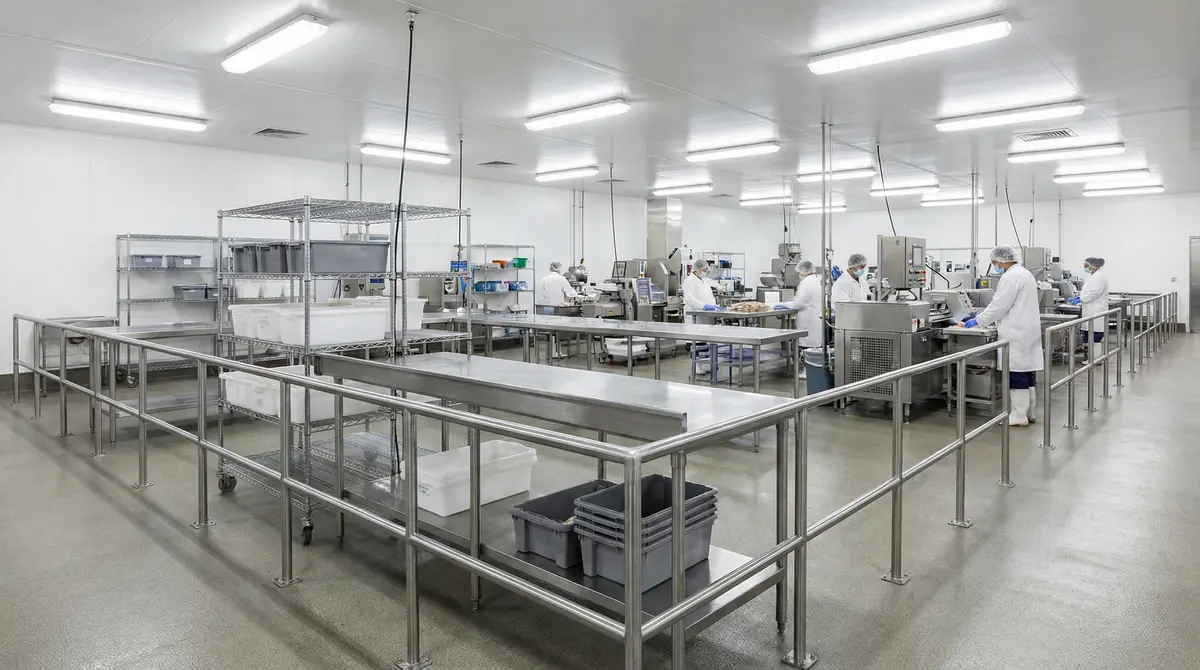
Stainless steel tables and racks for dairy and meat processing rooms
Stainless steel tables and racks in a dairy or meat processing room are not just “furniture”. Sanitation, work speed, and safety depend on their design. Here’s how to choose solutions for your processes and washing conditions.
The role of stainless steel tables, racks, and guards in dairy and meat processing rooms
For dairy and meat processing rooms, stainless steel process tables, racks, and guards are not just “furniture”. Their design and manufacturing quality affect:
- stability of sanitation and microbiology;
- convenience and speed of shift work;
- losses of raw materials and finished products;
- safety of personnel and equipment;
- compliance with regulatory requirements.
In Tashkent, many food-processing enterprises still upgrade their rooms “as needed” — buying separate tables and racks. In practice, it is more cost-effective to treat these elements from the outset as part of the overall metal structure of the room: well-thought-out layout, the right stainless steel, competent guards and fastenings.
What tasks different types of tables, racks, and guards solve
Stainless steel process tables
Main application areas:
- deboning and cutting meat;
- packing and packaging dairy products;
- preparation of spices, additives, ingredients;
- quality control and labeling.
By design, tables can be:
- solid worktop — for operations without intensive drainage;
- perforated or grating — for liquid drainage and washing;
- with sides — to prevent liquid from flowing onto the floor;
- with shelves and superstructures — for tools, containers, labeling;
- with washing sinks — for combined processes.
Stainless steel racks
Racks in dairy and meat processing rooms operate in different conditions: from preparation rooms to cold stores. They are used for:
- storing raw materials and semi-finished products in containers;
- holding and cooling products;
- placing detergents and disinfectants (in separate zones);
- storing containers, tools, consumables.
By design, racks can be:
- stationary — for permanent storage areas;
- knock-down — convenient for frequent reconfiguration of the room;
- on wheels — for moving between sections;
- grating shelves — for better air circulation in refrigerated areas.
Guards and zoning
Stainless steel guards help to:
- separate “dirty” and “clean” zones;
- designate walkways and safe corridors for personnel;
- protect equipment and utilities from impacts by trolleys and pallets;
- restrict access to hazardous areas (knives, saws, moving equipment).
Structurally, these can be:
- railing guards and handrails;
- barriers and bumpers;
- mesh or tubular screens;
- local guards around individual machines.
Materials and design: which stainless steel to choose for dairy and meat
The choice of stainless steel grade and surface type directly affects service life, ease of cleaning, and cost.
Steel grade and operating environment
For dairy and meat processing rooms, it is important to consider:
- frequent contact with water, salts, brines;
- use of alkaline and acidic detergents;
- temperature (hot areas, cold rooms);
- mechanical loads (impacts, abrasive contamination).
The more aggressive the environment and the more frequent the washing, the higher the corrosion resistance requirements. For different zones within the same room, different designs may be economically justified — for example, more resistant stainless steel in areas of constant contact with product and washing, and simpler designs for auxiliary racks.
Surface type and weld treatment
Key points when choosing:
- Ground or matte surface — easier to clean, signs of use are less visible.
- Minimum sharp edges and burrs — personnel safety and no areas for dirt accumulation.
- High-quality welding — smooth welds without pores and cavities that are difficult to wash.
- Final weld treatment — grinding and, if necessary, additional treatment in product contact zones.
Custom manufacturing uses a set of technologies: laser cutting, metal bending, welding, and sometimes powder coating for auxiliary elements (not in contact with product). It is important that the contractor understands where a combined “stainless steel + painted steel” design is acceptable, and where only stainless steel is allowed along the entire contour.
Design of process tables: what to look at when choosing
Dimensions and ergonomics
Incorrect choice of table dimensions leads to constant inconvenience and time losses for the shift. When calculating, consider:
- staff height and type of operations (forceful, precise, with small parts);
- need to place containers, boxes, scales, labelers;
- distances to adjacent equipment and walkways;
- possibility of trolley and pallet truck access.
The best approach is to tie the table design to the room layout and the process flow of the product.
Rigidity and load-bearing capacity
For meat processing and some operations in dairy rooms, the following are important:
- reinforced frames and trusses under the worktop;
- correct cross-section of legs and braces;
- presence of adjustable feet to compensate for floor unevenness.
If tables are used for heavy vessels or equipment, this must be specified in the technical specification: the contractor needs to know the maximum load and the nature of the work (static or impact).
Hygiene and washing
When choosing, pay attention to:
- presence of sides and drains if there are large amounts of liquid;
- absence of “pockets” and closed volumes where water accumulates;
- ability to easily move the table away for floor cleaning;
- compatibility of the design with the washing agents and regimes used (temperature, pressure).
Stainless steel racks: storage of raw materials, containers, and finished products
Functional zoning of racks
For dairy and meat production, it is important to separate:
- racks for raw materials and semi-finished products;
- racks for finished products;
- racks for containers and tools;
- separate areas for detergents and disinfectants.
This affects the design, height, shelf pitch, and permissible load.
Design solutions
When choosing stainless steel racks, pay attention to:
- shelf type — solid, perforated, grating;
- height adjustability — for different types of containers;
- knock-down design — convenient when reconfiguring storage areas;
- feet or wheels — stationary or mobile solutions;
- stoppers and sides — to prevent containers from sliding off.
For cold rooms, grating shelves and a design that ensures free air circulation are especially important.
Guards and zoning in the room: safety and product flows
Personnel and product flows
Stainless steel guards help to build logical flows:
- separate movement of raw materials and finished products;
- designate safe walkways for personnel;
- fence off high-risk areas (knives, saws, moving parts);
- protect walls, corners, and equipment from trolley impacts.
Types of guards
When designing, consider:
- height and length of guards;
- need for handrails and intermediate rails;
- presence of gates and removable sections;
- method of fastening to floors, walls, metal structures.
It is important that guards do not interfere with washing, do not create “blind spots”, and are resistant to regular contact with water and detergents.
What affects the price: table of key cost factors
The cost of stainless steel process tables, racks, and guards is formed based on a calculation according to the technical specification. Below are the main factors that affect the final budget.
| Factor | How it affects cost |
|---|---|
| Stainless steel grade and thickness | More corrosion-resistant and thicker sheets are more expensive but increase service life and rigidity of structures |
| Type of design (tables, racks, guards) | Complex multi-level solutions and integration with other equipment increase manufacturing labor intensity |
| Dimensions and load | Large sizes and high load-bearing capacity require reinforced frames, which increases metal consumption and production time |
| Quantity and series | For serial orders, the unit price is usually lower than for one-off items |
| Requirements for weld and surface treatment | Additional grinding, polishing, and finishing increase processing time and, accordingly, cost |
| Need for on-site installation | Installation in an operating room, work in confined conditions and tight deadlines affect the project’s final budget |
| Individual adaptation to layout | Fitting to existing walls, columns, and utilities requires additional measurements and drawing revisions |
| Additional elements | Sides, drainage devices, superstructures, perforated shelves, wheels, and other options increase the scope of work |
Therefore, without a detailed technical specification, it is not correct to name even an approximate price. A competent contractor always starts by clarifying the task and only then proceeds to calculation.
Calculation based on the technical specification: what data to prepare for the contractor
To obtain an accurate and quick calculation, it makes sense to collect basic information in advance.
Minimum data set
For calculating stainless steel tables, racks, and guards, it is useful to specify:
- type of products: tables, racks, guards (and their purpose);
- dimensions: length, width, height for each size type;
- load: maximum weight per table or rack shelf;
- installation area: standard room, washing area, cold room, etc.;
- washing regime: how often and with what you wash (temperature, chemicals);
- special requirements: sides, drains, perforation, wheels, superstructures;
- batch volume: quantity of each type.
If there is a room plan or at least a diagram with reference to walls and walkways, this will speed up proposal preparation and help avoid errors during installation.
Manufacturing and installation timeframes: what they depend on in practice
The implementation time for a project involving stainless steel tables, racks, and guards depends on several factors.
Main influencing factors
- Volume and range — the more items and the more diverse they are, the longer the production cycle.
- Design complexity — non-standard solutions and integration with existing equipment and utilities require additional time for design and approval.
- Production workload — with a large number of parallel orders, timeframes may shift; this is important to consider when planning line start-up.
- Availability of initial data — the more complete the technical specification and the clearer the understanding of the task, the fewer revisions and repeated approvals.
- Installation conditions — work in an operating room, night shifts, limited access by time and zones increase installation duration.
When requesting a calculation, it makes sense to immediately indicate the desired commissioning dates and “hard” deadlines (inspections, line commissioning, seasonal peak) so that the contractor can propose a realistic schedule.
Typical mistakes when choosing stainless steel tables, racks, and guards
-
Choosing only by price per kilogram of metal
Ignoring design features, steel grade, and operating conditions leads to accelerated wear and additional costs for modifications. -
No link to the process flow diagram
Tables and racks are purchased “by picture”, without considering real flows of raw materials, personnel, and finished products. The result is unnecessary movements, flow intersections, and problems with inspectors. -
Underestimating loads
The technical specification lists average weights, while in reality heavier loads are placed on the table or shelf. This leads to deflection, deformation, and emergency situations. -
Mixing “clean” and “dirty” functions on the same equipment
The same table or rack is used for both raw materials and finished products. This complicates sanitary control and increases the risk of cross-contamination. -
Saving on weld and edge treatment
Untreated welds and sharp edges are a source of injuries and hard-to-clean contamination. Over time, this results in downtime and claims from regulatory authorities. -
No allowance for future expansion
Design “to the limit” without considering possible volume growth. After a year or two, the area has to be rebuilt again, interfering with an already operating room. -
Failure to consider installation conditions
Structures are designed without understanding how they will be brought in and assembled in the existing premises. As a result — on-site cutting, welding modifications, and time loss.
FAQ: answers to common questions from production directors
Is it possible to combine stainless steel and painted metal in one product?
Yes, if these elements do not contact the product and are not in an intensive washing zone. For example, support frames or guard elements can be made of painted steel, while work surfaces are stainless steel. It is important to specify this in the technical specification.
How to take into account regulatory requirements when designing tables and racks?
The best option is to proceed from your current production control program and sanitary regulations. The technical specification should describe zone separation, washing and disinfection regimes, and indicate which operations are performed on each table or rack.
What if the room plan already exists but equipment is frequently rearranged?
In this case, it makes sense to combine stationary solutions (for key areas) and mobile/knock-down structures. When calculating, it is important to include a height adjustment range for shelves and the possibility of rearranging blocks.
Is it possible to upgrade existing tables and racks instead of full replacement?
Sometimes it is economically justified to reinforce frames, add guards, replace worktops or shelves with stainless steel ones. But this must be assessed on site: metal condition, weld quality, and dimensional compliance with the current process.
How to account for the impact of cleaning chemicals when choosing material?
The technical specification should list the detergents and disinfectants used, their concentrations, and temperature. This allows selection of a suitable surface finish and a design resistant to regular chemical exposure.
Are drawings necessary if only approximate dimensions and photos are available?
A basic calculation can be made using approximate dimensions and photos. But for manufacturing and installation, dimensions will still need to be clarified and, if necessary, a site visit for measurements carried out. This reduces the risk of errors and rework.
How best to organize guards around operating equipment?
First, describe risk zones: moving parts, hot surfaces, flow intersections. Then determine where stationary guards are needed and where removable sections or gates are required for maintenance. All these points should preferably be reflected in the technical specification.
What’s next: how to request a calculation without wasting time on approvals
To move from general questions to a specific project for your dairy or meat processing room in Tashkent, it is enough to prepare a brief technical specification.
Submit a request for calculation
For a prompt calculation of stainless steel process tables, racks, and guards, specify:
- purpose of the products (for which section and which operations);
- approximate dimensions of tables, racks, and guards;
- expected load (per table, shelf, guard section);
- operating conditions (temperature, humidity, washing and disinfection regime);
- design requirements (sides, drains, perforation, wheels, superstructures);
- whether on-site installation is required or not;
- room plan or layout (if available);
- desired manufacturing and commissioning timeframes.
Based on this data, it is possible to propose several options for materials and design, estimate timeframes, and prepare a detailed calculation according to your technical specification.