
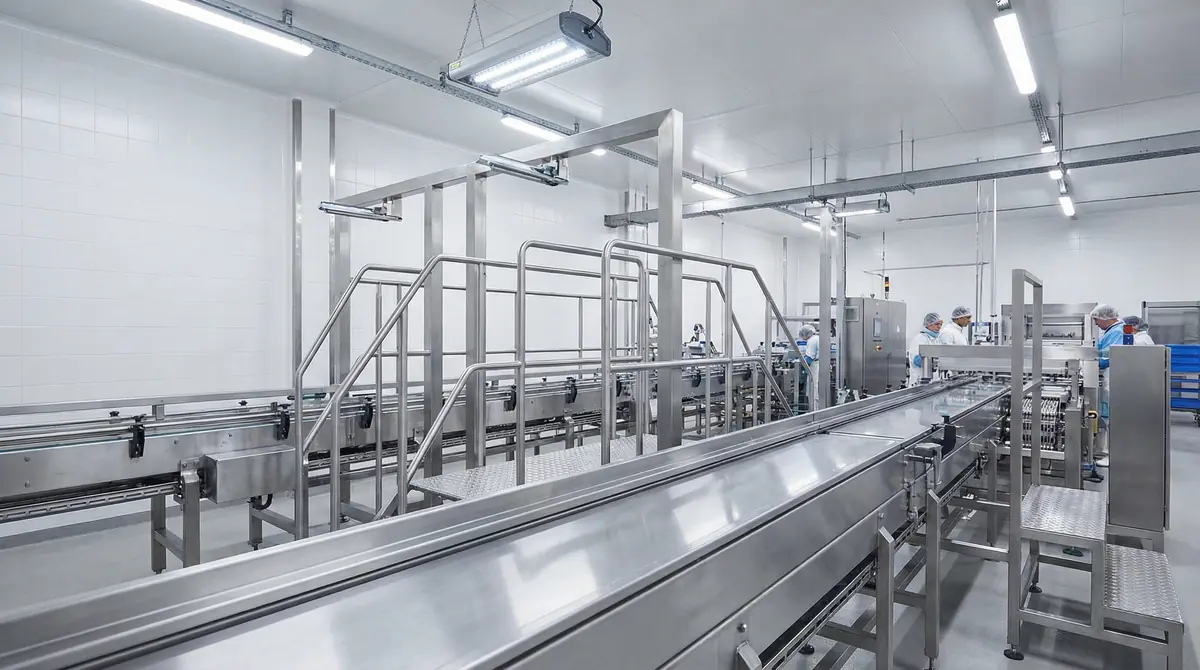
Stainless Steel Structures for Automated Lines
Planning to upgrade or launch an automated line at a food factory? Let’s figure out which frames, conveyors, and guards you need, what materials to use, and how this affects cost and lead times.
The role of metal structures in automated food production lines
For modern food production in Tashkent, metal structures are not just “metal around the equipment.” The quality of frames, conveyors, and guards affects:
- stability of automated line operation;
- compliance with sanitary requirements;
- personnel safety;
- ease of maintenance and upgrades.
A poor-quality frame or improperly designed conveyor leads to vibrations, misalignment, frequent downtime, and problems during washing. Therefore, when choosing a contractor, it is important to look not only at the price, but also at the design and manufacturing technology.
BRIX.UZ works with stainless and structural steel for the food industry, performing calculation according to the technical specification, manufacturing, and installation of metal structures tailored to the needs of a specific workshop.
What structures are needed: frames, conveyors, guards
Frames and support structures
Frames form the “skeleton” of an automated line:
- support frames for process equipment (mixers, dispensers, packaging machines);
- platforms and decks for line maintenance;
- posts and trusses for suspending pipelines, cable ducts, and light equipment.
Key requirements for frames in food production:
- sufficient rigidity with minimal “cluttering” of space (fewer places where contamination can accumulate);
- height and level adjustment capability;
- accessibility for washing and maintenance.
Conveyors and conveyor sections
Conveyors connect the units of the line into a single system. Depending on the product and section, the following are used:
- belt conveyors (dough, bakery products, confectionery, packaged products);
- roller and driven roller conveyors (crates, pallets, packaging);
- modular plastic belts (meat, fish, semi-finished products, frozen products);
- inclined and Z-shaped conveyors for lifting product between levels.
Stainless steel structures provide:
- rigidity and precise geometry of the route;
- correct installation of drives and tensioning units;
- ease of sanitary treatment (removable sides, drainage, slope of surfaces).
Guards, stairs, platforms
For safety and ease of operation of the lines, the following are used:
- protective guards around moving parts and hazardous areas;
- stairs, crossover bridges, service platforms;
- handrails and barriers to separate personnel and trolley traffic zones.
Guards and platforms must combine:
- strength and stability;
- absence of sharp edges and gaps where clothing or tools can get caught;
- corrosion resistance and suitability for frequent washing.
Materials: stainless steel, galvanized steel, painted metal — where each is appropriate
The choice of material directly affects both performance and project cost.
Stainless steel
The main material for product contact zones and areas with regular washing:
- conveyor elements in the product zone;
- frames of washing sections;
- supports and frames in high-humidity rooms.
Advantages:
- corrosion resistance;
- ability to withstand frequent washing with aggressive agents;
- neutrality to food products.
Galvanized steel
Used for auxiliary structures outside direct product contact:
- guards in warehouse areas;
- supports for cable routes;
- some load-bearing elements in dry rooms.
The advantages are lower cost compared to stainless steel with sufficient corrosion resistance under normal operating conditions.
Painted metal (powder coating)
Powder coating is used:
- for structures in dry zones where visual identification is important (color zoning);
- for guards and barriers in workshops and warehouses;
- for elements requiring additional protection against mechanical impact.
It is important to correctly select:
- type of coating for washing conditions and temperature;
- color and texture considering visibility of contamination and damage.
Key production technologies: from 3D design to installation
To ensure that metal structures fit seamlessly into the automated line and do not hinder service, the process chain is important.
Design and calculation
At the start, a calculation according to the technical specification is performed:
- analysis of the process flow diagram of the line;
- integration with existing equipment and premises;
- selection of profile sections, sheet thicknesses, and types of fasteners.
The result is 2D/3D drawings, bills of materials, load calculations, and a preliminary estimate.
Laser cutting
Laser cutting allows you to:
- obtain precise parts with minimal tolerances;
- cut complex holes, slots, and mounting seats for fasteners;
- reduce the amount of subsequent machining and fitting during installation.
For stainless steel this is especially important: a neat cut reduces the heat-affected zone and simplifies subsequent finishing.
Metal bending
Bending forms profile elements, ducts, conveyor sides, brackets:
- precise geometry is the key to proper fit-up during installation;
- reduced number of welds (fewer potential corrosion and contamination points);
- neat appearance and ease of washing.
Welding
For stainless and structural steel, appropriate welding technologies are used, taking into account:
- strength requirements;
- minimization of deformation;
- subsequent grinding and polishing of welds in areas where hygiene is critical.
Proper welding is especially critical for conveyor frames and service platforms.
Powder coating
For carbon steel and some galvanized elements, powder coating is used:
- uniform coating without runs;
- good abrasion resistance;
- ability to color-code zones and structures.
Installation and commissioning
The final stage is on-site installation:
- installation of frames, conveyors, and guards according to reference levels;
- alignment of geometry, adjustment of supports and belt tension;
- integration with existing equipment and utilities.
At this stage, accurate drawings and manufacturing quality are especially important: the higher the accuracy, the fewer on-site modifications and the lower the risk of delays in line start-up.
Hygiene and safety: what to include in the technical specification at the calculation stage
For food production in Tashkent, the key requirements are sanitation and personnel safety. This must be considered already in the technical specification.
It is recommended to immediately describe:
- type of product (dry, wet, sticky, fatty, frozen);
- washing modes (frequency, water temperature, agents used);
- requirements for closed/open structures (minimum cavities and “pockets”);
- high-risk zones (cutting, pinch points, hot surfaces).
Based on this data, the following are selected:
- material (grade of stainless steel, thickness, type of profiles);
- design (closed or open frame, type of joints);
- type of guards (fixed, removable, with interlocks, etc.).
Factors affecting cost and lead times
The final cost and lead times depend on a combination of project parameters. Below is a generalized table of factors.
| Factor | Impact on cost | Impact on lead time |
|---|---|---|
| Material (stainless, galvanized, carbon steel) | Stainless is more expensive, galvanized and carbon steel are cheaper | Lead times are similar, but stainless requires more careful processing |
| Metal thickness and profile sections | Increased metal consumption raises cost | Thicker metal takes longer to cut and process |
| Design complexity (multiple levels, curved elements) | Increases design and assembly labor intensity | Increases design and installation time |
| Batch size (number of identical units) | Series production reduces unit cost | Large series require additional time to set up the series |
| Cleanliness requirements (grinding, polishing welds) | Additional operations increase cost | Increase production time |
| Type of coating (no coating, galvanizing, powder coating) | Coating and additional treatments increase cost | Adds time for preparation and curing |
| Level of detail in the technical specification | Vague specs lead to rework and higher costs | Clarifications during the project extend timelines |
| Need for installation and commissioning | Installation and site work increase the budget | Additional days/weeks are required on site |
To obtain a realistic estimate, it is important to describe the task as thoroughly as possible at the request stage. BRIX.UZ performs calculation according to the technical specification taking into account all the factors listed.
Common mistakes when ordering metal structures for food lines
- Lack of coordination with technologists and equipment engineers. The frame or conveyor is designed without considering the equipment supplier’s requirements, resulting in conflicts in heights, fasteners, and service zones.
- Saving on material in wet zones. Choosing regular steel where stainless is needed. After 1–2 seasons — corrosion, difficult washing, forced replacement.
- Closed cavities and “pockets.” Designs where product residues and moisture accumulate complicate sanitation and create food safety risks.
- Insufficient rigidity of conveyor frames. Vibrations, belt tracking issues, increased wear of bearings and drives, frequent stops for adjustment.
- Ignoring service convenience. Lack of platforms and stairs, poor access to components — as a result, personnel violate procedures or are forced to dismantle part of the line.
- Unclear technical specification for guards. Zones where fixed guards are needed and where removable ones are acceptable are not defined — resulting in either excessive restrictions or risks for personnel.
- Ordering only fabrication without proper design. Attempting to “do it on site” leads to rework, higher costs, and missed start-up deadlines.
How to structure the technical specification: what the customer provides and what the contractor does
A well-prepared technical specification allows you to get an accurate estimate right away and avoid rework.
The customer side (plant, equipment engineer) provides:
- floor plan with elevation marks, columns, and openings;
- process flow diagram of the line (existing or planned);
- list of equipment with dimensions and weight;
- requirements for loading/unloading heights and product flow directions;
- description of washing modes and sanitary requirements;
- material preferences (where stainless is mandatory, where other options are acceptable);
- constraints on line downtime for installation.
The contractor (BRIX.UZ) is responsible for:
- developing structural solutions for frames, conveyors, and guards;
- selecting sections and materials for loads and operating conditions;
- preparing drawings and bills of materials;
- cost and lead time calculation according to the technical specification;
- manufacturing (laser cutting, metal bending, welding, powder coating if required);
- delivery and installation of structures on site.
The more complete the initial data, the more accurate the estimate and the lower the risk of budget changes during the process.
BRIX.UZ workflow stages: from calculation according to the technical specification to project handover
- Receipt and analysis of the technical specification. We study plans, diagrams, and product and sanitation requirements. If necessary, we ask clarifying questions.
- Preliminary estimate. We form an approximate budget and lead times and propose options for materials and design.
- Design. We develop drawings of frames, conveyors, and guards and coordinate them with technologists and equipment engineers.
- Manufacturing. We perform laser cutting, metal bending, welding, finishing, and, if necessary, powder coating.
- Quality control. We check dimensions, geometry, and completeness before shipment.
- Installation and integration with the line. We install metal structures on site, level them, and integrate them with equipment and utilities.
- Handover and support. We provide as-built documentation and, if necessary, participate in commissioning.
FAQ on metal structures for food lines
1. Can stainless and painted metal be combined in one line?
Yes, this is often done: stainless in the product zone and wet areas, painted or galvanized metal in auxiliary and dry zones. It is important to correctly separate zones and select coating types.
2. What is better for guards around lines — stainless or painted steel?
It depends on the location. In close proximity to the product and in wet zones, stainless is preferable. In dry zones and warehouses, painted steel with powder coating can be used.
3. Is it possible to upgrade existing frames and conveyors instead of replacing them completely?
Often it is possible to reinforce them, locally replace elements, and install additional guards and platforms. An inspection and measurement of existing structures is required to assess feasibility.
4. What data is needed to estimate the cost of metal structures?
At minimum — floor plan, line diagram, equipment dimensions, material and sanitation requirements, approximate lengths and heights of conveyors and platforms. The more detailed the data, the more accurate the estimate.
5. How long does it take to manufacture frames and conveyors?
The lead time depends on volume, complexity, and production workload. After analyzing the technical specification, we provide approximate lead times and fix them in the contract.
6. Can we order only manufacturing according to our drawings?
Yes, BRIX.UZ performs contract manufacturing: laser cutting, metal bending, welding, powder coating according to provided drawings. If necessary, we can suggest design optimizations.
7. Do you perform installation at operating plants?
Yes, taking into account production downtime constraints. Timelines and work schedules are agreed in advance to minimize line downtime.
8. Is it possible to gradually expand the line using the same metal structures?
With proper design, frames and guards are laid out with the possibility of modular expansion. It is advisable to specify this in the technical specification at the stage of the first order.
What data is needed to estimate the project
So that we can perform an accurate calculation according to the technical specification for your plant in Tashkent or the region, please prepare:
- workshop plan with dimensions and elevation marks;
- process flow diagram of the automated line;
- list of existing and planned equipment with dimensions and weight;
- description of the product and washing modes (frequency, temperature, chemicals);
- list of required structures: frames, conveyors (types and lengths), guards, stairs, platforms;
- material requirements (where stainless is mandatory, where alternatives are possible);
- desired manufacturing and installation deadlines;
- constraints on production downtime for installation.
Submit a request for an estimate
If you need reliable frames, conveyors, and guards for automated food production lines in Tashkent and across Uzbekistan, you can submit a request for an estimate.
For a prompt estimate, please specify:
- company name and city;
- contact details (phone, e-mail);
- brief project description (type of production, product, line section);
- whether drawings/plans are available (attach if you have them);
- list of required metal structures (frames, conveyors, guards, stairs, platforms);
- preferred materials (stainless, galvanized, painted metal);
- approximate project start-up dates.
After receiving the data, BRIX.UZ specialists will contact you, clarify the details, and prepare a proposal on lead times and cost of manufacturing metal structures for your food line.