
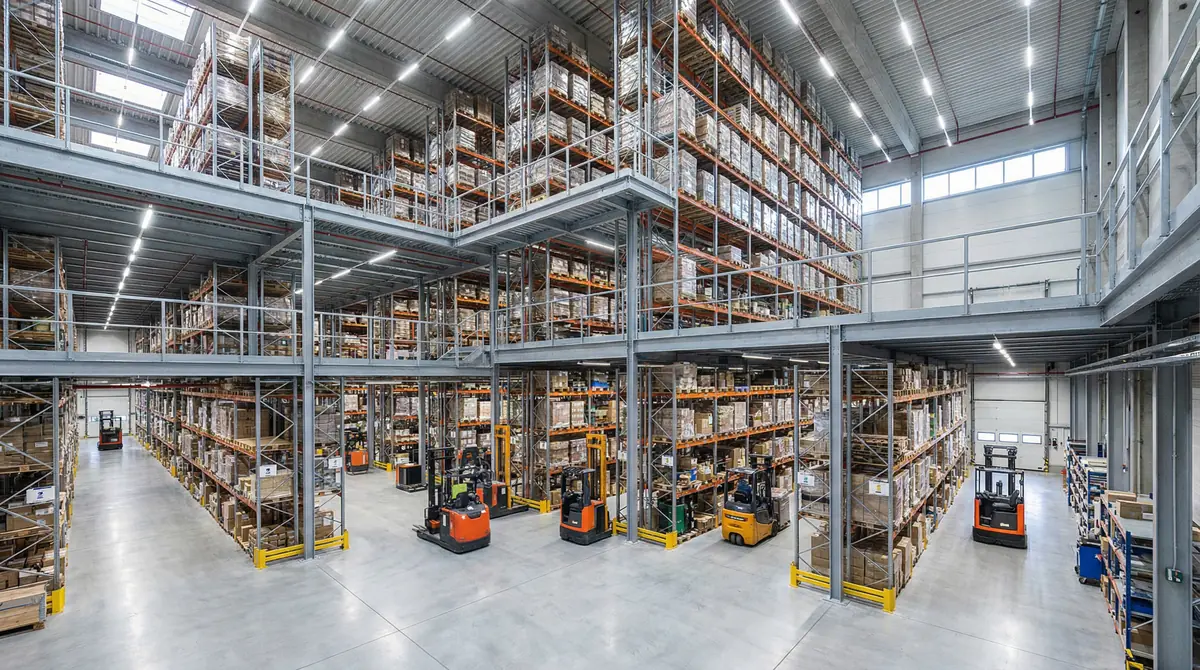
Metal Racking and Platforms for 3PL Warehouses
Planning to launch a logistics hub or 3PL warehouse in Tashkent? Learn how to correctly calculate metal racking and platforms so you can handle peak season loads without overpaying for excess steel.
The role of metal racking and platforms in logistics hubs and 3PL warehouses
For a logistics operator or e‑commerce warehouse in Tashkent, racking and multi‑tier platforms are not just “metal”. Proper calculation of steel structures determines:
- how many pallets and cartons you can actually store per square meter;
- how fast order picking will be;
- how safely the equipment will withstand seasonal peaks;
- how easily you can scale the warehouse without stopping operations.
Metal racking and platforms are the structural frame of the warehouse. An error in load calculation or material selection results either in excessive steel costs or in accident risks and throughput limitations.
What steel structures are used: racking, platforms, frames
For logistics hubs and 3PL warehouses, several types of steel structures are usually combined:
Pallet and selective racking
- The main solution for pallet storage.
- Height‑adjustable beams.
- Ability to adapt to different types of pallets and loads.
Shelving and gravity racking
- For carton and piece picking storage.
- Used in e‑commerce order picking zones.
- Often integrated with conveyors and sorting lines.
Metal platforms and multi‑tier solutions
- Platforms and mezzanine levels on a steel frame.
- Increase the usable volume of the warehouse without expanding the footprint.
- Include stairs, guardrails, decking, and sometimes integration with lifts and conveyors.
Structural frames and auxiliary structures
- Columns, trusses, beams, bracing.
- Stairs, guardrails, catwalks.
- Brackets and fasteners for auxiliary equipment (lighting, cable trays, safety systems).
All these elements must work as a single system. Therefore, calculation of warehouse steel structures is always done according to the technical specification (TS), taking into account the logistics scheme and planned loads.
Basic principles of load calculation for racking and platforms
Load calculation is the key stage. In practice, it is divided into several levels.
1. Load per level and per racking bay
For racking it is important to determine:
- maximum pallet/carton weight;
- number of pallets per level;
- number of levels in a bay.
Based on these data, the following are calculated:
- load on each beam;
- total load on the upright and bay;
- required profile section and type of connections.
2. Load on decking and platform
For metal platforms and multi‑tier structures, the following are considered:
- distributed load (kg/m²) from people, trolleys, equipment;
- local (point) loads from racking uprights, lifts, equipment;
- possible dynamic loads from moving equipment.
This affects the choice of:
- beam sections and secondary joists;
- type of decking (chequered plate, grating, combined solutions);
- support scheme on columns and foundation.
3. Load on columns and base
The total load from racking and platforms is transferred to the columns and then to the floor and foundation. The calculation includes:
- weight of the steel structure itself;
- live load (goods, people, equipment);
- possible additional loads (engineering systems, auxiliary equipment).
At this stage it is important to coordinate the calculation with the actual condition of the warehouse floor: slab thickness, reinforcement, permissible load per m².
4. Safety factors
Safety factors for strength and stability are applied to warehouse steel structures. Specific values depend on the type of structure and operating conditions, but the general principle is the same:
The structure must confidently withstand the design load with a safety margin, rather than operate “at the limit”.
That is why it is important to specify not only current but also planned loads in the TS.
How to allow for load margin for turnover growth and assortment changes
A logistics hub or 3PL warehouse rarely remains unchanged for more than 2–3 years. The following change:
- turnover;
- assortment and packing density;
- share of pallet vs. carton storage;
- customer service format.
To avoid reworking steel structures every couple of years, it makes sense to build in a reasonable margin when calculating racking and platforms.
What to consider when designing “with a margin”
-
Potential increase in average load per level
If you are currently storing pallets of 600–700 kg, and in the future a switch to heavier goods is possible, you should allow for a higher load‑bearing capacity of beams. -
Possibility of adding levels
At the stage of calculating columns and bracing, a scenario of increasing the number of storage levels is considered, even if they will not be installed initially. -
Reconfiguration of zones for another storage format
For example, part of the pallet zone can be converted to carton storage using the same uprights and beams. -
Integration with automation
If you plan to implement conveyors, sorting lines, lifts in the future, it is important to provide fastening elements and additional load reserves for platforms and floors.
Balancing margin and budget
Excessive load margin means extra steel and higher cost. The optimal approach:
- together with the steel structures contractor, develop 2–3 warehouse development scenarios (conservative, base, aggressive growth);
- build in margin for key nodes (columns, main beams, connection nodes), while leaving the option to upgrade secondary elements later.
This approach allows you to control the budget now without blocking future turnover growth.
Materials and manufacturing technologies: from profile to powder coating
The manufacturing technology directly affects reliability, cost, and project timelines.
Main materials
- Carbon steel — basic material for uprights, beams, columns, trusses.
- Hollow sections and cold‑formed profiles — for uprights, joists, bracing.
- Sheet metal — for decking, steps, guardrail elements.
On request, special solutions can be used (for example, galvanized elements in high‑humidity areas), but this increases the budget and lead time.
Key technological operations
- Laser cutting — precise cutting of sheet and profile, stable geometry of parts, reduced rework during installation.
- Metal bending — forming decking elements, stiffeners, brackets, ribs.
- Welding — assembly of structural nodes, trusses, columns, platform frames.
- Machining and drilling — holes for bolted connections, mounting slots.
- Powder coating — protective and decorative coating resistant to wear and corrosion, convenient color coding of zones.
The accuracy of geometry, manufacturing speed, and ease of installation on site depend on how well the “laser cutting — metal bending — welding — painting” cycle is organized.
Factors affecting the cost of racking and platforms
The cost of warehouse steel structures is always calculated according to the TS. The final estimate is influenced by a combination of factors.
| Factor | How it affects cost | Comment |
|---|---|---|
| Warehouse dimensions and height | The higher the racking and platforms, the more steel and the more complex the calculation | Height affects column sections, type of bracing, and decking requirements |
| Storage type (pallets/cartons) | Different requirements for load capacity and element pitch | Pallet systems usually require stronger beams and uprights |
| Design loads | The higher the required load per level/m², the heavier the structure | Load determines profile sections and type of connections |
| Margin for turnover growth | Additional margin increases steel consumption | Can be optimized by adding margin only to key nodes |
| Layout complexity | Non‑standard geometry, building columns, cut‑outs increase labor intensity | Requires custom solutions and more design hours |
| Type of decking and guardrails | Grating, solid plate, combined decking have different prices | Cost depends on metal thickness and amount of welding/fasteners |
| Manufacturing technology | Use of high‑precision equipment may increase part cost but reduce installation costs | Important to consider total project cost “manufacturing + installation” |
| Metal coating | Powder coating, galvanizing, combined solutions | More durable coatings are more expensive but reduce maintenance costs |
| Batch size and repeatability | Large orders reduce unit cost through production optimization | For extensions it is beneficial to use the same sizes |
| Installation and logistics | Difficult access, work in an operating warehouse, night shifts | Affect timelines and cost of installation works |
Without a detailed TS it is not correct to quote even an approximate price. The proper approach is to first calculate according to the TS, then optimize the configuration to fit the budget.
Typical mistakes when ordering and calculating warehouse steel structures
-
No clear load data
Vague wording like “about a ton per level” leads to over‑ or under‑estimating the safety margin. As a result, either overpayment for steel or operating limitations. -
Ignoring future turnover growth
The warehouse is designed “for today” with no development scenarios. After 1–2 years, the structures have to be reinforced or the configuration changed. -
Incomplete layout TS
Building columns, doors, engineering zones are not considered. During installation it turns out that some bays do not fit, and rework is required. -
Choosing solutions solely by lowest price
Savings due to simplified design, thin steel, and weak connections result in rapid wear and load limitations. -
No coordination with equipment and IT systems
Dimensions of stackers, turning radius, locations of scanners and terminals are not considered. As a result, order processing speed drops. -
Underestimating installation time
They plan to launch the warehouse “the same day” the steel structures are delivered. Actual installation and integration with engineering systems take longer. -
No single contractor for steel
Different contractors supply racking, platforms, stairs, guardrails. On site, node and fastener incompatibility arises, increasing time and costs.
Timelines: from TS‑based calculation to on‑site installation
Timelines depend on project scale and production workload, but the general cycle looks like this:
-
Collection and approval of TS
1–5 working days depending on completeness of initial data and warehouse complexity. -
Engineering calculation and commercial offer
Selection of sections, configuration of racking and platforms, preliminary drawings. Usually several working days for options and approvals. -
Design and detailing
Preparation of production drawings, bills of materials, cutting plans. Timeline depends on volume and complexity of steel structures. -
Manufacturing of steel structures
The “laser cutting — bending — welding — painting — quality control” cycle. For medium‑sized projects — from several weeks. -
Logistics and installation
Delivery to site, unloading, assembly, anchoring to the floor and to each other, installation of stairs and guardrails. In an operating warehouse this is often done in stages without stopping operations.
When planning the launch of a logistics hub or 3PL warehouse, it is important to allow a realistic time buffer between completion of steel structure installation and the start of full‑scale operation.
How to prepare a technical specification for racking and platform calculation
A well‑prepared TS saves time and helps you get a workable calculation right away without multiple clarifications.
Minimum data set for the TS
- Warehouse address and dimensions (length, width, height to the bottom of trusses/beams).
- Plan showing building columns, doors, engineering zones.
- Types of loads (pallets, cartons, non‑standard loads).
- Maximum pallet and/or carton weight.
- Planned number of storage levels.
- Required load per m² for platforms and decking.
- Availability and type of warehouse equipment (stackers, reach trucks, forklifts).
- Configuration preferences (aisles, picking zones, buffer zones).
- Planned turnover growth and possible assortment changes.
Based on these data, a preliminary calculation can be made, a racking and platform configuration proposed, and timelines and budget estimated.
Frequently asked questions (FAQ)
1. Can existing racking be used when building a platform?
Often it is possible to integrate existing racking into a new system, but this requires checking its load‑bearing capacity and compatibility with the designed platform frame.
2. How to determine what load per level to allow for if the assortment will change?
Typically, current maximum values are taken, a forecast for the increase in unit storage weight is added, and a reasonable margin is built in. This is discussed at the TS and calculation stage.
3. Is it possible to install racking and platforms without stopping warehouse operations?
In many cases, installation is organized in stages with local shutdown of zones. This must be considered in the delivery and installation schedule in advance.
4. How does a turnkey project differ from supply of steel structures only?
A turnkey project includes calculation, design, manufacturing, delivery, and installation. Supply of steel structures only means that installation and part of the design work are handled by you or a third‑party contractor.
5. How critical is floor condition for racking and platform calculation?
Very critical. The load from columns and uprights is transferred to the floor slab. With a weak base, the floor has to be reinforced or loads redistributed, which affects the design and cost.
6. Is it possible to add extra levels later without reworking the frame?
If a margin in load‑bearing capacity of columns and nodes was built in at the calculation and manufacturing stage, retrofitting is possible. That is why development scenarios should be discussed in advance.
7. Why is powder coating better than regular paint?
Powder coating is more resistant to wear and corrosion, convenient for color coding of zones and levels, and reduces structure maintenance costs.
8. What if there is no accurate warehouse plan?
At a minimum, provide measurements and a sketch showing column and door locations. Ideally, order a site survey or use an up‑to‑date architectural plan. Without this, the calculation will be less accurate.
When it is beneficial to use contract manufacturing for warehouse solutions
If you act as an integrator of logistics solutions or plan to replicate standard warehouses, it makes sense to consider contract manufacturing of steel structures:
- serial production of uprights, beams, decking according to your drawings;
- manufacturing of structural frames, stairs, guardrails under your brand;
- adaptation of standard solutions for different sites in Tashkent and the regions.
In this case, you focus on logistics design and facility management, while the “laser cutting — bending — welding — powder coating” cycle is outsourced to a contractor with the required capacity.
What’s next: how to order a calculation and prepare site data
To obtain a workable calculation of metal racking and platforms for a logistics hub or 3PL warehouse in Tashkent, it is important to start with a proper TS.
Submit a request for calculation
For a prompt calculation, specify:
- city and site address;
- warehouse dimensions (length, width, height, column layout);
- types of loads (pallets, cartons, non‑standard);
- maximum pallet/carton weight;
- required number of storage levels;
- desired load per m² for platforms and decking;
- availability and type of warehouse equipment;
- planned turnover growth and development horizon (1–3 years);
- whether turnkey installation and supervision are required.
Based on these data, it is possible to select the optimal configuration of steel structures, calculate loads with a margin for turnover growth, and propose a technologically sound solution in terms of timelines and budget.