
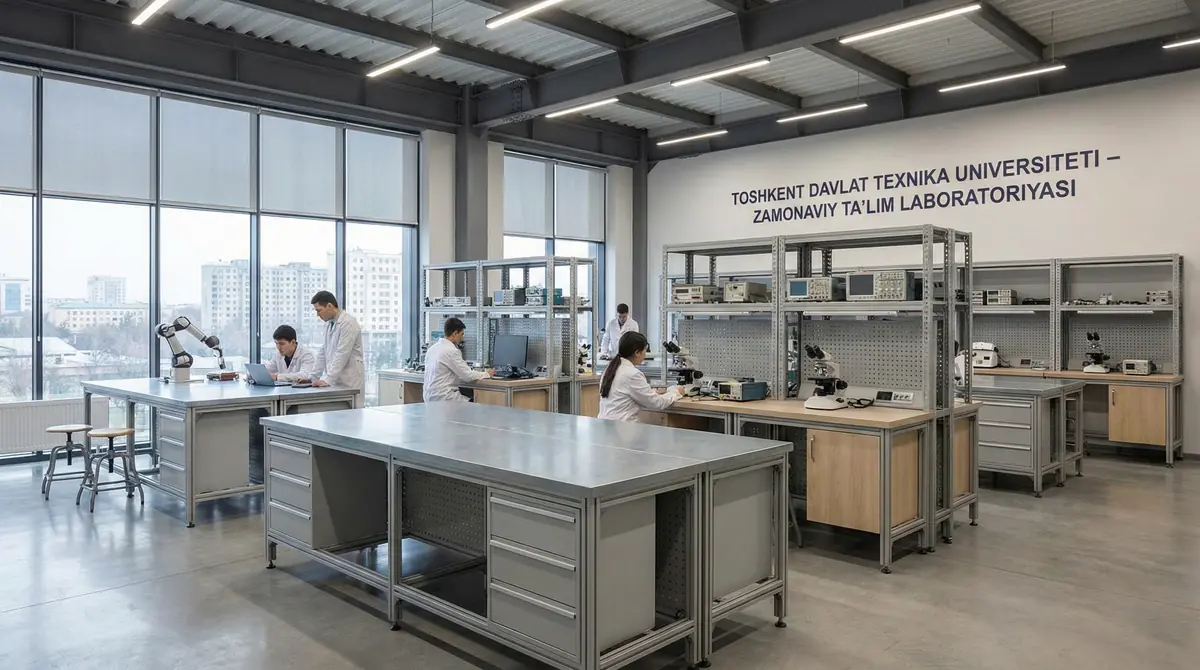
Metal Furniture and Frames for Educational Spaces
Planning to upgrade classrooms, laboratories, or a technopark in Tashkent? Here’s how to estimate the cost of metal furniture and frames, which materials to choose, and what must be specified in the TOR to get an accurate quote.
Why Tashkent’s educational spaces need metal furniture and frames
Classrooms, laboratories, and technoparks in Tashkent are rapidly evolving: STEM rooms, robotics, “smart” labs, and coworking spaces are appearing. Standard furniture often doesn’t fit such spaces — you need durable, modular, and maintainable solutions.
Metal furniture and frames make it possible to:
- withstand high loads (equipment, tools, reagents);
- safely accommodate equipment and utilities;
- quickly reconfigure the space for different learning formats;
- reduce operating costs thanks to durability.
For B2G customers, private schools, universities, and technoparks, the key issue is the budget estimate: how to understand the budget in advance, which solutions to choose, and what to include in the TOR to get a realistic calculation.
Which zones are equipped with metal frames and furniture
Classrooms and STEM rooms
- Frames for student and teacher desks.
- Metal supports and frames for integrating sockets, cable channels, and monitor mounts.
- Shelving and cabinets for storing consumables, educational kits, and robotics.
- Laboratory islands for group work.
University and college laboratories
- Metal frames for lab tables and sinks.
- Frames for fume hoods and protective screens.
- Shelving for reagents, samples, and instruments.
- Specialized racks for analytical and measuring equipment.
Stainless steel and chemically resistant coatings are often used in such zones, and the requirements for rigidity and safety are higher.
Technoparks, engineering and IT spaces
- Frames for workstations for prototyping and assembling devices.
- Modular tables for project teams and hackathons.
- Racks and pedestals for 3D printers and desktop‑format CNC machines.
- Metal frame structures for displaying prototypes and training stands.
For technoparks, scalability is crucial: solutions must be easy to replicate and upgrade as residents grow.
Materials and production technologies: from frame to coating
Various materials and metalworking technologies are used in the production of metal furniture and frames for educational spaces. Functionality, service life, and cost estimates directly depend on these choices.
Main frame materials
- Steel profile tube — the basic option for tables, shelving, and frames. Optimal balance of price and rigidity.
- Sheet steel — for side panels, pedestal bodies, screens, and casings.
- Stainless steel — for lab areas, sinks, and surfaces with regular contact with moisture and chemicals.
Top surfaces (worktops, shelves) can be:
- laminated chipboard/MDF with edging — for standard classrooms and office areas;
- moisture‑resistant and wear‑resistant panels — for workshops and technoparks;
- special chemically resistant surfaces — for laboratories.
Metalworking technologies
- Laser cutting — precise manufacturing of parts according to drawings, cutting holes, slots, and fastening elements. Important for serial production and complex geometries.
- Metal bending — forming profiles, stiffeners, and ducts without unnecessary welds.
- Welding — assembling frames, trusses, and structures. For educational furniture, it is important to ensure dimensional repeatability and neat welds.
- Powder coating — protective and decorative coating resistant to abrasion and regular cleaning.
A combination of these technologies makes it possible to produce both standard and fully custom solutions for a specific project.
What to include in the TOR for an accurate cost estimate
The more detailed the initial data, the more accurate the calculation and the lower the risk of revising the estimate during the process. For metal furniture and frames for classrooms, laboratories, and technoparks, it makes sense to specify in advance:
-
Types of zones and purpose
Classrooms, laboratories, workshops, coworking, prototyping area, server room, etc. -
List of items
- tables (student, laboratory, teacher);
- shelving, cabinets, pedestals;
- frames for equipment and stands;
- special elements (monitor stands, mounts, guards).
-
Dimensions and layout
- room dimensions;
- desired table dimensions, height, depth;
- relation to walls, windows, and utilities.
-
Load requirements
- weight of equipment per table/shelf;
- presence of vibration‑generating equipment (3D printers, machines, compressors).
-
Materials and finishes
- metal (regular steel or stainless steel);
- type of worktops and shelves;
- color and texture of powder coating (by palette or approximate analogues).
-
Volumes and delivery format
- quantity of each type of furniture;
- one‑time delivery or phased fit‑out;
- need for turnkey installation.
-
Deadlines and schedule constraints
- desired launch date for classrooms;
- whether installation can be carried out during class time or only during holidays/weekends.
A calculation based on the TOR allows you to compare several scenarios: basic, optimal, and extended, so you can stay within budget without losing functionality.
Key factors affecting project cost
Below is a generalized table showing which parameters have the greatest impact on the estimate.
| Factor | How it affects cost | Comment for the customer |
|---|---|---|
| Frame material | Medium–strong | Stainless steel is more expensive than regular steel but justified in laboratories and wet areas |
| Metal thickness | Medium | Increases rigidity and service life but adds weight and cost |
| Type of worktops/shelves | Medium | Chemically resistant and moisture‑resistant options are more expensive than standard laminated chipboard |
| Design complexity | Strong | Curved elements, hidden fasteners, and transformable joints increase labor intensity |
| Batch size | Strong | Serial production reduces unit price; one‑off items are more expensive |
| Need for installation | Medium | Affects the total estimate, especially with tight deadlines and complex logistics |
| Load requirements | Medium–strong | High loads require reinforced profiles and additional elements |
| Type of coating | Medium | Multicolor schemes, textured and special coatings are more expensive than basic ones |
| Production lead time | Strong | An accelerated schedule may require additional resources and shifts |
| TOR refinement and design | Medium | Custom design adds stages of coordination and calculations |
It is important to understand that the final price is formed not by a single item but by a combination of all factors. Therefore, a proper TOR and early dialogue with the manufacturer make it possible to manage the budget.
Comparing design options: modular, fixed, transformable
Modular solutions
- A set of standard tables, shelving, and pedestals on metal frames.
- Can be combined and moved between rooms.
- Convenient for schools and universities with changing classroom loads.
In terms of cost: advantageous for serial volumes and phased fit‑out.
Fixed (stationary) structures
- Built‑in laboratory lines, islands, long rows of tables.
- Rigidly tied to utilities and layout.
- Relevant for specialized laboratories and workshops.
In terms of cost: more expensive at launch but more convenient in operation and safer under high loads.
Transformable furniture
- Height‑adjustable, folding, on wheels.
- Suitable for multifunctional classrooms, coworking spaces, and technoparks.
In terms of cost: more expensive due to fittings and complex joints but provides flexibility in space use.
When estimating a project for educational spaces in Tashkent, it makes sense to combine these approaches: a fixed base + modular and mobile elements.
Common mistakes when ordering metal furniture for educational spaces
-
No clear load requirements
Tables and shelving are designed “by eye” and then fail to withstand the actual weight of the equipment. -
Ignoring utilities
Sockets, cable channels, water supply, and ventilation are not taken into account — as a result, frames have to be modified on site. -
Choosing materials “out of habit” rather than by zone
Standard worktops in laboratories, no stainless steel in wet areas — accelerated wear and additional costs. -
Overly general wording in the TOR
“We need lab tables and shelving” without dimensions, loads, or layout. The estimate is approximate and often revised. -
Ordering furniture without considering future expansion
The technopark grows, new residents appear, but existing solutions cannot be scaled or replicated in series. -
Focusing only on the lowest unit price
Service life, maintainability, and the possibility of replacing individual frame elements are not considered. -
Underestimating installation time
The estimate does not account for delivery, assembly, and integration with already installed equipment, which is critical with tight academic schedules.
These mistakes can be avoided by involving the manufacturer early in the project discussion and performing a detailed calculation based on the TOR.
Timelines: from development to installation
Timelines depend on volume, complexity, and production workload, but the sequence of stages is roughly the same:
-
Collection of initial data and TOR
Discussion of tasks, layouts, loads, and materials. At this stage, the basis of the future estimate is formed. -
Preliminary calculation and solution options
Comparison of several configurations: basic, optimal, and extended. The TOR can be adjusted to fit the budget. -
Design and detailing
Development of drawings for metal structures, fastening joints, and selection of profiles and materials. -
Production
Laser cutting, metal bending, frame welding, powder coating, assembly of units. -
Delivery and installation
Delivery to the site in Tashkent or across the regions of Uzbekistan, assembly, installation, and, if necessary, integration with existing furniture and equipment.
When planning the fit‑out of classrooms and laboratories, it is worth considering the academic calendar: some work is more convenient to carry out during holidays or periods of minimal classroom use.
How to structure the project: phased fit‑out of classrooms, laboratories, and technoparks
For B2G projects, private schools, universities, and technoparks, a phased approach is often effective:
-
Pilot zone
One classroom, laboratory, or technopark block is equipped. Solutions, ergonomics, and ease of use are tested there. -
TOR and estimate adjustment
Based on the pilot results, dimensions, materials, types of frames, and fasteners are refined. -
Scaling solutions
Launch of serial production for the remaining rooms and laboratories, taking into account the experience gained. -
Reserve for development
The estimate includes additional modules that can be purchased later and integrated into the existing system.
This approach reduces risks, allows more precise budget management, and delivers a predictable result.
FAQ: answers to common questions from schools, universities, and technoparks
1. Can metal frames be combined with existing furniture?
Yes, provided measurements are taken and compatibility in height, fastenings, and loads is checked. This should be reflected in the TOR and quote request.
2. Is it mandatory to use stainless steel in laboratories?
Not always. For “dry” labs and physics/IT rooms, steel frames with quality coating and suitable worktops are sufficient. Stainless steel is relevant for washing areas and work with active chemicals.
3. What can be optimized in the estimate without compromising safety?
Most often, the design and some finishing solutions: simplify geometry, reduce the number of decorative elements, and standardize frame and worktop types.
4. Is it possible to order only frames first and add worktops and fronts later?
Technically yes, but this must be considered at the design stage. Frames must be calculated for a specific thickness and type of top elements.
5. How to account for future changes in equipment?
The TOR should include a load margin and provide for universal mounting points, removable panels, and a modular frame structure.
6. What if there is only a general concept so far, without a detailed layout?
You can start with an approximate estimate based on aggregated items and work on layouts in parallel. As data is refined, the estimate is detailed.
7. Is phased delivery possible, aligned with budget utilization?
Yes, when planning the project, delivery and installation can be split into stages, synchronized with the budget and academic calendar.
8. How does contract manufacturing differ from buying “ready‑made” furniture?
Contract manufacturing allows you to adapt metal structures to specific rooms, loads, and learning scenarios, and to replicate successful solutions in the required volumes.
What working with BRIX.UZ contract manufacturing provides
A production‑oriented approach to metal furniture and frames for educational spaces includes:
- use of laser cutting, metal bending, welding, and powder coating technologies;
- made‑to‑order manufacturing according to the TOR, taking into account layouts and loads;
- the ability to combine steel and stainless steel within a single project;
- phased fit‑out of classrooms, laboratories, and technoparks.
The estimate is formed transparently: based on materials, volumes, design complexity, and work schedule. This allows B2G customers, private schools, universities, and technoparks in Tashkent to plan their budgets and achieve predictable results.
How to request a quote: what data to prepare
Submit a quote request as early as the concept stage to align architectural solutions and budget from the outset.
For a prompt calculation based on the TOR, prepare:
- purpose of the rooms (classrooms, laboratories, technopark, workshops);
- floor plans or diagrams with dimensions;
- list of required furniture and frames with approximate dimensions;
- load requirements for tables and shelving;
- material preferences (steel, stainless steel, type of worktops);
- approximate volumes (number of units of each type);
- need for installation and desired launch dates;
- if available — photos/drawings of existing solutions to which you need to tie in.
Based on this data, it is possible to prepare an estimate with solution options and propose an optimal balance between functionality, timelines, and budget.