
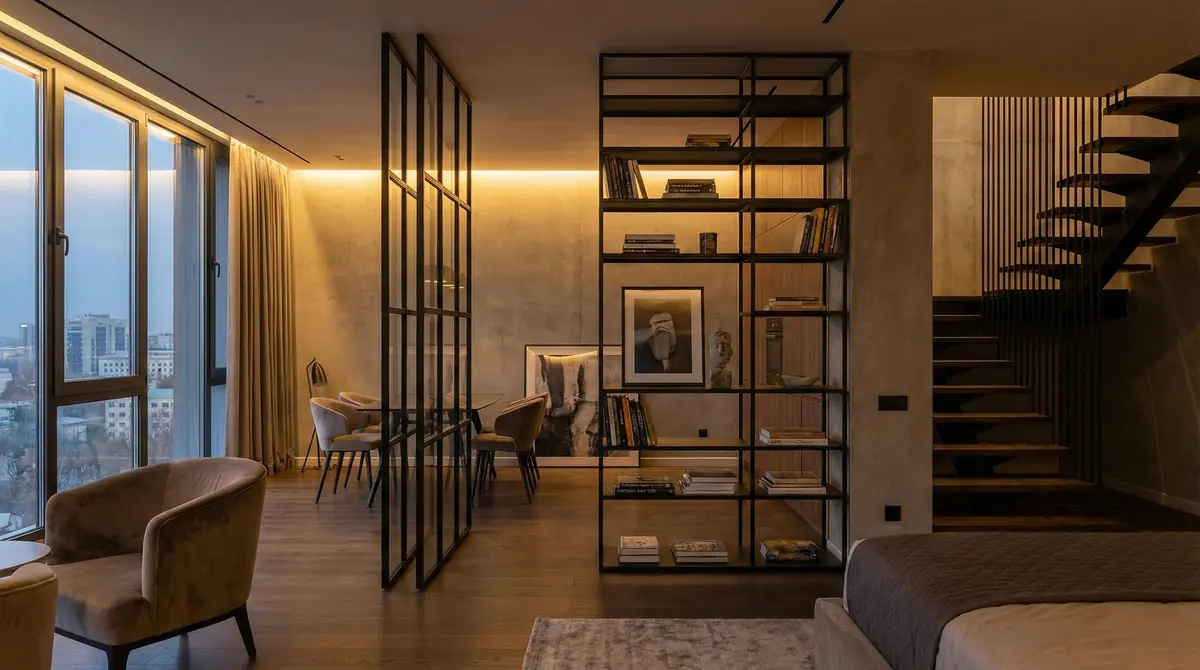
Metal furniture and interior structures for premium apartments in Tashkent
Metal in Tashkent’s premium interiors is no longer just a hidden frame but a key visual element. Let’s break down how to turn a render and an idea into a working specification and a buildable structure.
Features of premium interiors in Tashkent and the role of metal
In premium apartments and penthouses in Tashkent, metal elements have long ceased to be just a hidden frame that no one sees. Metal has become part of the interior’s visual code: thin lines, concealed fasteners, large spans without supports, complex shapes with stable geometry.
For private developers, designers, and architects this gives freedom to:
- create minimalist yet rigid structures;
- hide load-bearing elements within the finishes;
- design furniture and partitions “to size” for a specific room instead of adapting the layout to standard products.
But the more complex the interior, the more important the technology: how exactly sheet metal and profiles become a thin partition, staircase, or cantilever console that does not vibrate and does not warp over time.
What metal solutions are used in apartments and penthouses
Inside residential interiors, metal is most often used as hidden or semi-open frames and decorative structures.
Main product groups:
-
Frame furniture made of metal
Kitchen islands, console units, TV zones, wardrobe systems, full-height shelving, built-in desks and podiums. -
Metal staircases and railings
In-apartment flights, spiral staircases, railings with thin posts, integration of glass and wood into a metal frame. -
Interior partitions and portals
Sliding and fixed partitions with a metal frame, portals around openings, framing of panoramic windows, decorative grilles. -
Decorative panels and cladding
Cladding of columns, niches, fireplace portals, metal frames for wall panels, concealed hatches and inspection doors. -
Hidden load-bearing elements
Metal frames for suspended sanitary modules, sinks, long countertops without visible supports, heavy wall-mounted cabinets.
Almost all of these solutions use the same basic technologies: laser cutting, metal bending, welding, grinding, and powder coating.
Converting a design project into a working specification for production
The key point that determines price, lead time, and result is a correct custom manufacturing specification.
What a designer or architect usually provides:
- layout and wall elevations;
- visualizations (renders);
- basic overall dimensions of the items;
- links to engineering (sockets, water outlets, ventilation, etc.).
This is not enough for production. You need:
- working drawings with millimeter-level dimensions;
- understanding of load-bearing capacities (weight of countertops, appliances, glass);
- material types (mild steel, stainless steel, brass, combinations with MDF, veneer, stone);
- coating requirements (matte, satin, gloss, texture, color by palette);
- installation requirements (stages, access to joints, ability to fit in the elevator, etc.).
If the designer does not have detailed structural drawings, they are refined by the manufacturer: based on the design project, a 3D model and a set of working drawings are created. At this stage, a cost estimate based on the specification is also prepared.
Choosing materials: steel, stainless steel, brass, combinations with wood and glass
For interior structures in premium apartments in Tashkent, the following are most often used:
-
Steel (mild steel)
The main material for hidden frames and painted structures. Provides rigidity, welds well, suitable for powder coating. -
Stainless steel
Used where corrosion resistance and a stable appearance without additional painting are important: decorative elements, handrails, parts in kitchens and wet areas. -
Non-ferrous metals (brass, sometimes copper)
More often as decorative overlays, profiles, frames. Less often as a full-fledged frame due to cost and processing specifics. -
Combinations with other materials
Metal + solid wood/veneer, metal + stone, metal + glass. Precise coordination of thicknesses and tolerances is crucial: the metal must not “play” under the weight of the finishes.
When choosing a material, consider:
- whether the part of the structure is visible or hidden;
- operating conditions (kitchen, bathroom, balcony, enclosed room);
- visual requirements (black matte, brass, “metal with wood effect”, etc.);
- allowable weight of the structure (for example, for thin partitions or wall-mounted elements).
Key technological stages: from 3D model to finished product
The manufacturing process can be roughly divided into several steps.
-
Specification analysis and on-site measurements
Checking actual dimensions, geometry of walls, floors, and ceilings, tying into engineering points. -
Design and 3D modeling
Development of metal frames, fastening nodes, division into assembly units taking into account lifting and bringing into the apartment. -
Preparation of cutting layouts
Based on the 3D model, files for laser cutting and cutting maps for profiles are generated. At this stage, material usage is optimized. -
Laser cutting and metal bending
Parts are cut from sheet metal, and profiles, shelves, frames, and brackets are formed on press brakes. -
Welding and preliminary assembly
Frame assembly, tack welds, geometry check, final welding, weld seam grinding. -
Grinding and preparation for painting or finishing
Removal of burrs, surface leveling, preparation for powder coating or for final finishing of stainless steel/brass. -
Powder coating or other finishing
Application of coating, curing in an oven, color and texture control. -
Trial assembly in the workshop
Test assembly of units, checking joints, adjustments if necessary. -
On-site installation
Delivery, lifting, assembly, leveling, fixing to base structures, and integration with finishing materials.
Laser cutting and metal bending for precise furniture geometry
For premium interiors, precision is critical: gaps, alignment of lines, junctions with stone and wood. Therefore, the basic operations are laser cutting and metal bending.
Laser cutting
Allows you to:
- cut complex contours and holes with sub-millimeter accuracy;
- make concealed grooves and seats for hardware;
- minimize manual rework during installation.
Used for:
- partition frames;
- decorative panels and grilles;
- fastening elements and adapter plates;
- furniture frame parts with precise fit for wood and glass.
Metal bending
Sheet metal is turned into a profile with the required geometry. This allows you to:
- make thin yet rigid elements (shelves, frames, portals);
- hide fasteners inside bent profiles;
- reduce the number of welds and thus the risk of deformation.
Bending is especially important for long elements: doors 2.5–3 m high, portals, tall shelving.
Welding, grinding, powder coating, and final finishes
After cutting and bending, assembly begins.
Welding
For interior structures, it is important to ensure:
- minimal deformation during welding (especially on long elements);
- neat welds in areas that remain visible;
- correct sequence of tack welds and full welding.
Demountable joints are often used: some nodes are welded in the workshop, others are assembled with bolted connections on site.
Grinding and preparation
Welds are ground, edges are rounded, surfaces are prepared for painting or for final finishing of stainless steel/brass. For visible elements, special attention is paid to transitions and flatness.
Powder coating
For interior metal structures, this is one of the main types of coating:
- resistance to abrasion;
- wide range of colors and textures (matte, super matte, metal-effect textures, “soft touch”, etc.);
- uniform coverage of complex shapes.
For stainless steel and brass, mechanical and chemical treatments (satin finishing, polishing, patination) are often used without subsequent painting.
What affects the cost of metal furniture and interior structures
Specific prices depend on the project. Instead of figures, here is the structure of factors considered in the cost estimate based on the specification.
| Factor | How it affects cost |
|---|---|
| Overall dimensions and weight of items | Large portals, staircases, and shelving require more metal, reinforcing elements, and installation time. |
| Type of metal | Stainless steel and brass are more expensive than mild steel, more difficult to process, and require more careful grinding and finishing. |
| Thickness and profile section | Increasing thickness improves rigidity but increases material consumption and weight (installation becomes more difficult). |
| Geometry complexity | Radii, non-standard angles, concealed fasteners, minimal gaps require more precise design and more operations. |
| Volume of laser cutting and bending | The more unique parts and bends, the higher the labor intensity and cost of production preparation. |
| Volume of welding and grinding | Complex frames with many welds and high visual requirements increase labor costs. |
| Type of coating | Powder coating with special effects, complex colors, or combined finishes is more expensive than simple basic finishing. |
| Tolerance requirements | Premium interiors with minimal gaps require more time for fitting in the workshop and on site. |
| Installation conditions | No elevator, complex logistics, night work, limited windows for noise and dust increase installation cost. |
| Batch size | A series of similar elements is usually cheaper per unit than one-off unique items. |
For a preliminary budget estimate, sketches and basic dimensions are sufficient. For an accurate quote, a full specification package and, preferably, on-site measurements are needed.
Typical mistakes designers and clients make when working with metal in interiors
1. Lack of structural detailing
Limiting the project to visualizations without joints and thicknesses leads to changes at the production stage: proportions have to be altered, sections increased, and visible stiffening elements added.
2. Ignoring the weight of structures
Long cantilever countertops, heavy shelving, stone panels on metal frames require load calculations and base checks. Without this, deflection and deformation of finishes are possible.
3. Unrealistic gaps and tolerances
Gaps of 1–2 mm around the perimeter with long lines and unstable wall geometry in reality turn into visible distortions. Technological tolerances and compensators must be planned in advance.
4. Lack of coordination with other contractors
Metal frames are closely linked to stone, wood, glass, electrical, and plumbing. Lack of coordination leads to node conflicts and rework on site.
5. Late involvement of the manufacturer
When the interior is already fully designed and even partially implemented, but the metal structures have not yet been calculated, you have to adapt to existing constraints. This increases costs and can worsen the visual result.
6. Underestimating lead times
Interior metal structures are not “buy ready-made furniture”. Design, manufacturing, and installation take time. Tight deadlines lead to compromises in quality and finishing.
7. Saving on hidden elements
Trying to cut costs by lightening frames and removing reinforcements can lead to vibrations, squeaks, and deformations after move-in.
Lead times: from specification approval to on-site installation
Lead times depend on the volume and complexity of the project, but the sequence of stages is roughly the same.
-
Collection of initial data and cost estimate based on the specification
Analysis of the design project, measurements, development of preliminary solutions, commercial proposal. -
Design and approval of structures
3D models, working drawings, fastening nodes, coordination with other materials and engineering. -
Workshop production
Laser cutting, metal bending, welding, grinding, powder coating, trial assembly. -
Installation and handover
Delivery to site, installation, leveling, final fitting, and handover to the client.
To fit into the overall finishing schedule, it makes sense to involve the metal structures manufacturer already at the stage of detailed interior development, not at the end of the renovation.
FAQ: answers to common questions
Can metal furniture be made strictly from renders without drawings?
Renders help to understand the idea, but production requires working drawings and structural design. These can be developed by the manufacturer, but this is a separate stage that affects both lead time and cost.
What are the minimum metal thicknesses acceptable in interiors?
It depends on the purpose of the element and spans. Visually thin parts often have hidden reinforcements. Thicknesses are selected based on calculations and operating conditions, not just the picture.
Can metal be combined with wood and stone without visible joints?
Yes, but this requires precise design, consideration of material expansion, and a proper installation sequence. Such solutions must be developed in advance, not at the installation stage.
How noisy are metal structures in use?
With proper design and installation, frames do not vibrate or ring. Damping pads, correct support and fixing points, and reinforcements in loaded nodes are used.
Can the structures be disassembled when moving?
Some items are designed to be demountable: shelving, partitions, some furniture elements. Staircases and large portals are more often tied to a specific site; this must be considered at the specification stage.
When is it better to request a cost estimate: before or after rough construction?
Ideally at the stage of detailed interior design and before the start of final finishes. Then geometry, embedded parts, and engineering outlets can be adjusted to real structural solutions.
Can solutions be adapted to an already finished renovation?
Yes, but this limits fastening options and item dimensions. In such cases, accurate measurements and trial assemblies in the workshop are especially important.
Do you only take on large projects or also individual items?
Work is possible both on comprehensive projects (a full package of metal solutions for an apartment/penthouse) and on individual items: staircase, shelving, partition, kitchen frame.
How to request a cost estimate and what to include in the specification
To receive an approximate cost estimate based on the specification and production lead times, it is convenient to prepare a basic data package.
What is desirable to specify and attach:
- room layout with dimensions;
- visualizations or sketches of items (if available);
- overall dimensions of each element (height, width, depth);
- intended metal type (steel, stainless steel, brass, if already defined);
- desired type of coating (powder coating, color, texture, exposed metal);
- load information (stone, glass, appliances, books, etc.);
- photos of the current state of the site (rough/finished stage);
- desired production and installation timeframes;
- site address in Tashkent and access conditions (elevator, floor, working hours).
Based on this data, technical proposals for the structure, indicative lead times, and budget can be prepared.
The next step is to submit your specification and receive a cost estimate for your project.
Submit a request on the BRIX.UZ website or send your materials by email to get professional development of metal furniture and interior structures for your property.
CTA: Submit a request for a cost estimate
To speed up the estimate, please specify:
- contact details (name, phone, e-mail);
- role (private developer, designer, architect, developer);
- link to a folder with materials (plans, renders, specification);
- list of required items (staircases, railings, shelving, partitions, furniture frames, etc.);
- desired production and installation start dates.
The more precise the specification, the faster you will receive a realistic estimate and a technologically sound solution for a premium interior in Tashkent.