
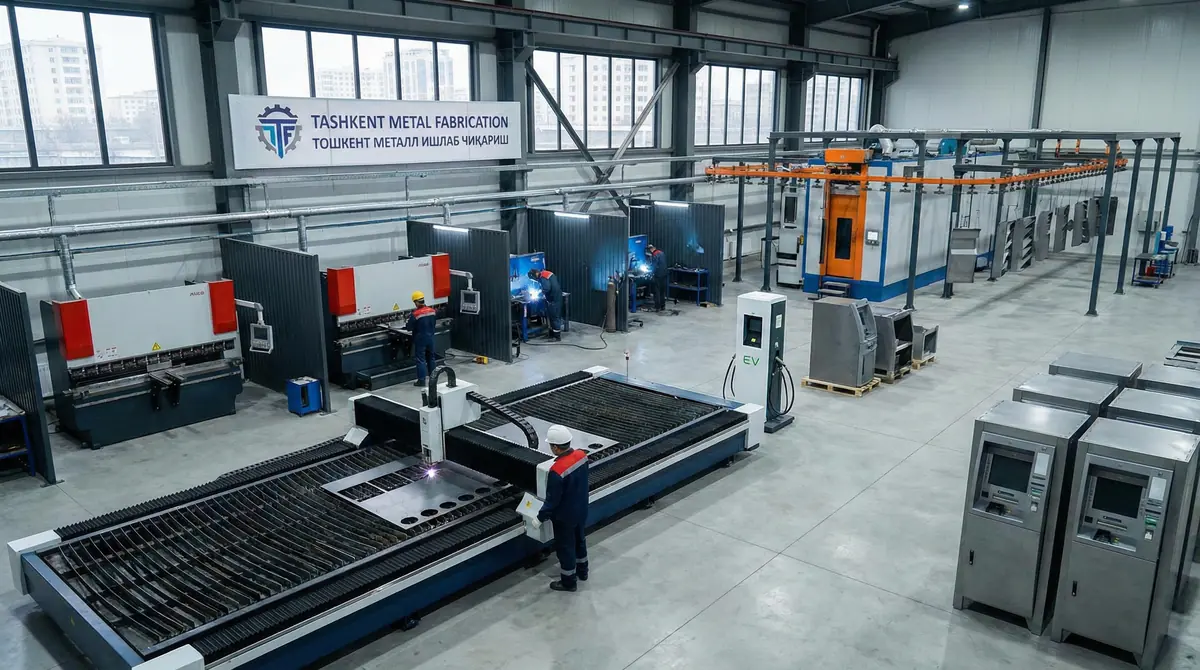
Contract Manufacturing of Enclosures for Charging Stations and ATMs
The enclosure of a charging station or ATM is more than just metal. Vandal resistance, serviceability, and launch timelines all depend on the choice of contract manufacturing partner. Here’s what to look for in the specification and in production.
Why move enclosure production to a contract format
For electronics manufacturers, fintech companies, and charging infrastructure integrators, the enclosure is not a core competence, but it is a critical product element. An in‑house shop for metal structures, laser cutting, bending, and welding requires serious investment and workload.
Contract manufacturing of enclosures in Tashkent allows you to:
- Reduce CAPEX — no need to invest in equipment (laser, press brakes, welding stations, powder coating booths, CNC machining).
- Speed up time‑to‑market — use already established process chains.
- Scale flexibly — quickly increase or decrease batch volumes.
- Focus on electronics and software, not on metal and logistics.
But this works only in one case: if the contract manufacturer is chosen correctly. Below are practical selection criteria specifically for enclosures of charging stations, ATMs, and self‑service terminals.
Requirements for enclosures of charging stations, ATMs, and terminals
Enclosures for these devices operate in different conditions, but they share common features that the contractor must understand already at the quotation stage based on the specification.
For charging stations (AC/DC, parking lots, courtyards, highways)
- Outdoor operation: temperature fluctuations, precipitation, dust, possible impacts.
- Vandal resistance: metal thickness, design of doors and hatches, reinforcements.
- Ease of installation: embedded parts, holes for cable glands, mounting to a foundation or pole.
- Serviceability: access to the power section, boards, terminals without dismantling the entire enclosure.
For ATMs
- Rigidity and stability: to prevent deformation during transportation and installation.
- Accuracy of mounting locations: for the safe, dispensers, bill acceptors, screens.
- Integration with the interior: versions for flush mounting, island placement, outdoor modules.
For payment and information terminals
- Ergonomics: height, screen tilt, placement of printers, scanners, card readers.
- Modularity: ability to change configuration (with/without bill acceptor, scanner, NFC, etc.).
- Appearance: consistent paint quality, neat welds, repeatability from batch to batch.
When choosing a contractor, it is important that they know how to work specifically with these types of products, not just with generic metal structures.
Key technologies: laser cutting, bending, welding, CNC, painting
Laser cutting
For enclosures with many holes and complex geometry, laser cutting is a basic operation.
Pay attention when choosing a contractor:
- maximum sheet size and thickness they can process consistently;
- cut quality and dimensional repeatability in series production;
- ability to work with your DXF/DWG or refine files for production.
Metal bending
Assembly gaps, panel fit, door alignment, and quality of electronics assembly all depend on bending accuracy.
Critical points:
- availability of CNC press brakes and validated bend charts;
- control of metal springback and angle tolerances;
- experience in bending complex box shapes, recesses, reinforcements.
Enclosure welding
Welding is where it’s easy to get deformations and a “warped” enclosure.
Ask the contractor:
- which types of welding are used (MIG/MAG, TIG, etc.);
- how deformations are controlled (clamps, jigs, weld sequence);
- how welds are prepared for painting (grinding, surface leveling).
Powder coating
For both outdoor and indoor solutions, appearance and coating durability are equally important.
Clarify:
- whether they have an in‑house powder coating line;
- how surface preparation is organized (washing, degreasing, phosphating — if used);
- which colors and textures are available, and how repeatability from batch to batch is ensured.
CNC machining and additional operations
Enclosures for ATMs and terminals often require:
- precise holes and pockets after welding;
- threads, chamfers, mounting locations for locks, hinges, mechanisms;
- cutouts for glass, plastic, decorative panels.
Having CNC machining in‑house reduces the number of manual operations and errors.
Materials for enclosures: steel, stainless steel, aluminum
The material affects performance characteristics, price, and technology.
Standard structural steel
- A common choice for indoor terminal and ATM enclosures.
- Requires high‑quality surface preparation and painting.
- A compromise between price and structural rigidity.
Galvanized steel
- Relevant for outdoor charging stations and outdoor terminals.
- Increased corrosion resistance with proper treatment and painting.
Stainless steel
- Used where increased corrosion resistance and a premium appearance are important.
- More difficult to process, with higher requirements for welding and grinding.
Aluminum
- Lightweight structures that require more careful handling in terms of rigidity.
- Requires specific experience with aluminum: bending, welding, milling.
When requesting a quotation based on the specification, it is useful to immediately indicate the preferred material and allow alternatives: “primary option — steel, consider galvanized/stainless for outdoor version.”
What affects the cost of enclosure manufacturing
The cost of contract manufacturing of an enclosure in Tashkent is calculated individually based on the specification. It depends on more than just the metal area.
Main cost factors
| Factor | What it means | How it affects the price |
|---|---|---|
| Material | Steel, galvanized, stainless, aluminum, sheet thickness | More expensive material and greater thickness increase sheet and processing cost |
| Geometry complexity | Number of parts, bends, cutouts, threads, welds | The more complex the design, the more operations and assembly time required |
| Batch size | One‑off batch, pilot, serial production | In series, unit price is lower due to spreading setup and preparation costs |
| Accuracy requirements | Mounting locations for mechanisms, tight tolerances | Requires additional control operations, CNC machining, jigs |
| Coating type | Powder coating, multiple colors, masking contact areas | Increases the number of coating cycles and manual operations |
| Completeness | Hinges, locks, glass, seals, cable glands | Either included in the price or supplied by the customer |
| Documentation | Availability of ready 3D/drawings or only sketch/idea | If documentation is missing, a design engineering stage is added |
| Logistics and packaging | Individual packaging, palletizing, labeling | Affects total batch cost and installation convenience |
Therefore, an accurate quotation is possible only for a specific specification. The more precise the initial data, the more predictable the budget and timelines.
How to assess the contractor’s production capabilities
When choosing a partner for contract manufacturing of enclosures, you need to go beyond generic statements like “we make metal structures.”
Check the following points:
-
Completeness of the process chain
Laser cutting, metal bending, welding, grinding, powder coating, CNC machining, assembly. The more operations are performed at a single site, the lower the schedule risks. -
Experience specifically with enclosures for electronics
The contractor must understand requirements for mounting locations, ventilation, service access, cable entries, and protection against unauthorized access. -
Readiness for pilot batches
Ability to produce prototypes, make design adjustments, and only then launch series production. -
Quality control system
How dimensions, geometry, coating quality, and welds are checked. Whether there are jigs and control assemblies. -
Communication on the specification and changes
Who on your side communicates with the contractor’s design engineer, how changes are recorded, how files and versions are transferred. -
Lead times and production load
Real ability to meet the delivery schedule, especially when volumes increase.
Organizing joint development: from specification to pilot batch
Contract manufacturing of enclosures rarely starts immediately with a large series. A rational path is step‑by‑step.
1. Technical specification
The specification for quotation and project launch for enclosures should preferably include:
- overall dimensions and orientation of the enclosure (floor‑standing, wall‑mounted, built‑in);
- operating conditions (outdoor/indoor, climate, vandal resistance requirements);
- intended material and thickness;
- requirements for service access and cable routing;
- requirements for rigidity and loads (for example, mounting heavy modules);
- appearance requirements (colors, texture, visible/invisible welds);
- volume of the first batch and forecast for subsequent ones.
2. Design engineering
If you have your own 3D models and drawings, the contractor will adapt them to their technology: thicknesses, bend radii, tolerances, mounting points.
If you only have a concept, joint enclosure development will be required, taking into account available technologies (laser cutting, bending, welding, powder coating, CNC machining).
3. Prototype manufacturing
At this stage, the following are checked:
- assembly of electronics inside the enclosure;
- compliance of gaps, fit of doors, panels, modules;
- ease of installation and maintenance;
- compliance with design and brand requirements.
Based on the pilot batch results, changes are made to the design documentation and process.
4. Series launch
After the final version of the enclosure is approved, a schedule is drawn up for deliveries, packaging, logistics, and interaction on future design changes.
Typical mistakes when choosing a contractor and setting the task
1. Focusing only on price per kilogram of metal
An enclosure is not just a set of parts. A cheap kilogram can turn out expensive in rework, service, and reputational risks.
2. Lack of a clear specification
The wording “make an enclosure for our terminal” without dimensions, diagrams, and requirements leads to constant rework and schedule shifts.
3. Ignoring operating conditions
Outdoor charging stations and ATMs require different solutions for material, thickness, coating, and protection than indoor terminals.
4. Underestimating ergonomics and maintenance
If access to components, replacement of consumables, and cable routing are not thought through at the enclosure stage, this will result in higher operating costs.
5. No pilot batch
Launching directly into series without prototypes increases the risk of mass defects and on‑site rework.
6. Not accounting for logistics and packaging
Enclosures can be damaged during transportation and unloading if proper packaging and lifting points are not provided.
7. Weak change management
Verbal changes without documentation lead to different batches of enclosures differing from each other.
Timelines: what the real project schedule consists of
Lead times for contract manufacturing of enclosures depend on several blocks.
-
Preparation of specification and documentation
Time for agreeing requirements, file exchange, and adaptation for production. -
Material procurement
Availability of the required metal in stock or its delivery time. -
Production cycle
Laser cutting → bending → welding → grinding → powder coating → CNC machining (if needed) → assembly/completion. -
Prototype manufacturing and refinement
Allow time for testing and making changes. -
Series and logistics
Batch production schedule, packaging, delivery within Tashkent or to regions.
When requesting a quotation based on the specification, it is useful to immediately indicate the desired timelines for launching the pilot batch and series, so that the contractor can assess the feasibility of the schedule given their workload.
How to request a quotation based on the specification and where to start
To get an adequate quotation based on the specification for contract manufacturing of enclosures for charging stations, ATMs, or terminals, prepare a minimum data set.
It is recommended to send the contractor:
- a brief description of the device and usage scenarios (outdoor/indoor, traffic, vandal resistance);
- dimensions and approximate weight of the target enclosure;
- sketches, 3D models, or drawings (if available);
- intended material and thickness, or several options;
- coating requirements (color, texture, uncoated areas);
- planned volume of the first batch and forecast for 3–6 months;
- desired timelines for receiving prototypes and the first series.
The more complete the information, the faster you can move from a preliminary estimate to a specific proposal on timelines and cost.
FAQ on contract manufacturing of enclosures
1. Is it possible to start without ready 3D models of the enclosure?
Yes, but then a design engineering stage is added to the project. It is important that the contractor can translate requirements for electronics and operation into an enclosure design.
2. Is it necessary to decide on the material right away?
It is advisable to indicate a base option and acceptable alternatives. The contractor can propose material optimization considering operating conditions and budget.
3. How should dimensional tolerances be specified?
If you have critical mounting locations (screens, locks, mechanisms), their tolerances should be specified separately in the specification. Other tolerances can be agreed with the contractor’s process engineer.
4. Can changes be made after the pilot batch?
Yes, this is standard practice. The main thing is to record changes in the documentation and not mix different enclosure versions in one delivery.
5. How are coating and welding quality controlled?
The contractor should describe their process: surface preparation, coating thickness, visual and measurement control, geometry control after welding.
6. Who is responsible for completeness (locks, hinges, glass, seals)?
There are two options: you supply the components and the contractor integrates them into the enclosure; or the contractor handles procurement for agreed items. This must be specified in the specification.
7. Is it possible to produce different enclosure modifications on a single base?
Yes, if modularity is built into the enclosure design at the design stage: interchangeable panels, blanks, universal mounting locations.
8. How should branding requirements be taken into account?
The specification should state corporate colors, requirements for visible elements, and logo placement (if applied not at the metal stage but on the assembled enclosure).
Submit a quotation request
If you need contract manufacturing of metal enclosures for charging stations, ATMs, or self‑service terminals in Tashkent, the optimal first step is to request a quotation based on your specification.
To allow us to quickly estimate timelines and cost, include in your request:
- device type: charging station (AC/DC, outdoor/parking), ATM, payment/information terminal;
- operating conditions: outdoor/indoor, vandal resistance and environmental protection requirements;
- approximate enclosure dimensions and installation option (wall‑mounted, floor‑standing, built‑in);
- desired material and thickness (if you have preferences);
- availability of 3D models/drawings or only sketch/description;
- coating requirements: color, texture, special areas;
- planned volume of the first batch and forecast for further deliveries;
- desired timelines for receiving prototypes and launching series production;
- contact person for technical questions (engineer/PM).
Submit a quotation request — and based on your specification we will propose a manufacturable enclosure design considering available materials, technologies, and required timelines.