
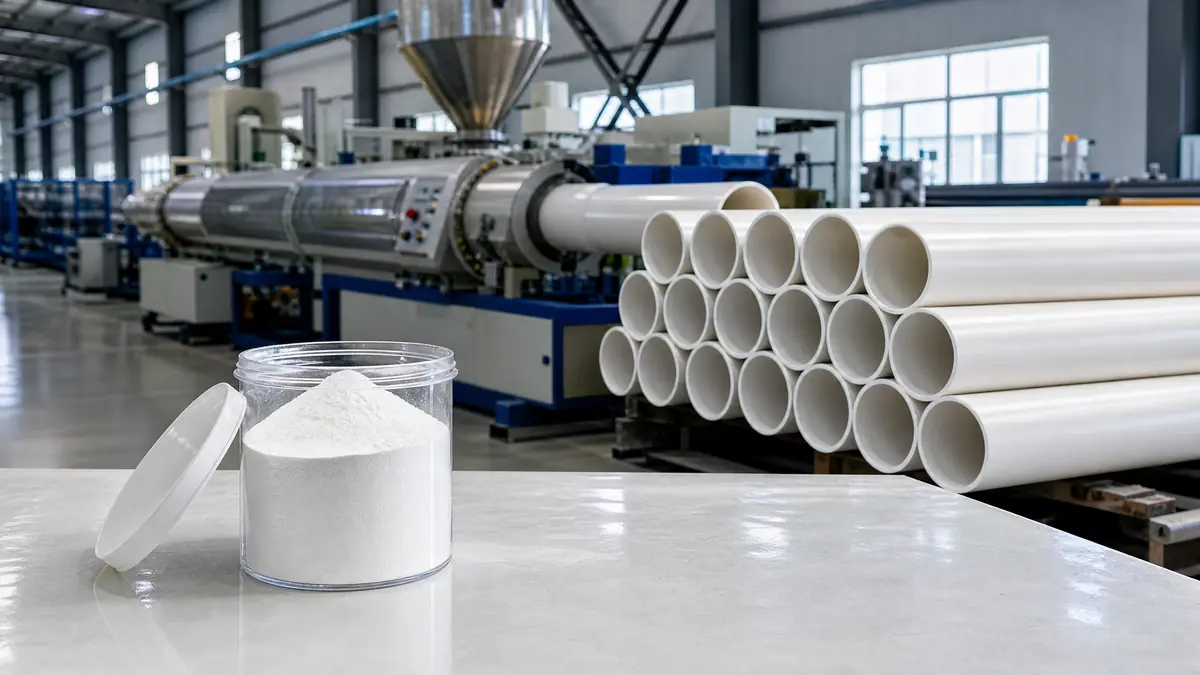
How to Choose a PVC Resin Grade for Pipes and Profiles
SG5, SG7, or SG8—which PVC resin should you choose for manufacturing pipes and profiles? We examine K-value, bulk density, particle size distribution, and other parameters that buyers should check before placing an order.
Why PVC Resin Grades Should Be Selected for Specific Products
PVC resin grades should be selected based on the intended application of the finished product, its mechanical property requirements, and the capabilities of the extrusion line. The grade designation or country of origin alone is not enough: K-value, bulk density, particle size distribution, and processing stability are all important.
For industrial buyers, raw material selection should begin not with searching for the lowest-priced offer, but with defining the production requirements. The same resin may behave differently on different extruders and in different formulations.
In Uzbekistan, storage conditions are also important when organizing procurement. High air temperatures during summer, dust, and humidity in warehouse facilities can make it difficult to preserve packaging quality and raw material stability. Therefore, buyers should evaluate not only the specifications stated in the technical data sheet but also delivery conditions, packaging, and the availability of incoming quality control.
Which PVC Resin Is Suitable for Manufacturing Pipes and Profiles
Suspension PVC resin intended for producing unplasticized compounds is generally considered for rigid pipes and profiles. The specific grade is selected based on the technology, formulation, and requirements of the finished product.
Resin for Pipes
When manufacturing pipes from unplasticized PVC (UPVC, PVC-U), the strength of the finished product, dimensional stability, and wall uniformity are particularly important. The raw material must provide consistent behavior during mixing, fusion, and extrusion.
For piping products, consider the following:
- Pipe application: water supply, sewage, or industrial use;
- Diameter and wall thickness;
- Requirements for ring stiffness and mechanical strength;
- Operating temperature and service conditions;
- Formulation and processing requirements.
Suspension grades with a K-value of approximately 65–67 are often considered for pipe extrusion. This is a preliminary selection guideline, not a universal requirement for every product.
Resin for Profiles
For window, door, and other rigid profiles, important factors include surface quality, dimensional accuracy, color stability, and the ability of the compound to retain its specified properties after processing.
The profile configuration, wall thickness, number of internal chambers, and calibration requirements must all be considered. The raw material should ensure uniform filling of complex dies and stable extruder operation.
Suspension grades with a K-value in the approximate range of 65–68 may also be used for profiles, although the final choice depends on the formulation and equipment.
What Do SG5, SG7, and SG8 Mean?
The designations SG5, SG7, and SG8 frequently appear in commercial offers for suspension PVC resin. They provide a preliminary indication of the material class but do not replace the technical data sheet.
In commonly used grading systems, these grades correspond to the following approximate K-value ranges:
| Grade | Approximate K-value | Application Characteristics |
|---|---|---|
| SG5 | 65–67 | Often considered for rigid pipes and profiles |
| SG7 | 59–62 | May be used in certain extrusion and other compounds |
| SG8 | 55–59 | Used in formulations requiring a different balance of viscosity and processability |
These ranges are approximate. Actual specifications depend on the manufacturer and its classification system.
Buyers should not assume that SG5 is automatically suitable for every pipe manufacturing process or that SG8 is unsuitable for extrusion. Check the actual batch specifications and the raw material manufacturer's recommendations.
When comparing offers, request not only the commercial grade designation but also the technical data sheet with test results.
How K-Value Affects Properties and Processing
The K-value characterizes the viscosity-related properties of PVC resin and is associated with the polymer's molecular weight. The higher the value, the higher the molecular weight and melt viscosity generally are under comparable conditions.
This has practical implications for production:
- A higher K-value may help achieve specific mechanical properties in finished products;
- Processing such resin may require more careful adjustment of temperature and mechanical energy;
- A lower K-value generally improves melt flow, but the final properties depend on the entire formulation;
- Changing the raw material grade can affect line output, energy consumption, and surface quality.
Resin should not be evaluated using the principle that “the higher the K-value, the better.” Excessive viscosity can complicate processing, while an unsuitable value can affect the quality of the finished product.
Before purchasing a new grade, agree with the process engineer on the acceptable K-value range and the conditions under which testing will be conducted.
Which PVC Resin Specifications Should Be Checked?
To compare grades, request a technical data sheet and check several parameters together. These characterize not only the polymer's chemical properties but also its suitability for industrial processing.
| Parameter | What It Affects | What Buyers Should Check |
|---|---|---|
| K-value | Viscosity properties and processing | Compliance with the process specification range |
| Bulk density | Dosing, transportation, and equipment filling | Specified value and batch-to-batch consistency |
| Particle size distribution | Feed uniformity and particle distribution | Particle size and proportion of fine particles |
| Particle porosity | Interaction with formulation components | Compliance with the manufacturer's recommendations |
| Residual monomer content | Raw material safety and quality | Residual vinyl chloride content |
| Volatile matter | Material behavior during processing | Compliance with technical documentation |
| Impurity content | Potential defects in finished products | Cleanliness and absence of foreign inclusions |
Bulk Density and Particle Size Distribution
Bulk density indicates the mass of powder occupying a given volume without compaction. This parameter is important for dosing, transportation, and organizing raw material feeding during production.
Particle size distribution describes how particles are distributed across different sizes. An excessive proportion of fine particles may worsen the dust characteristics of the raw material, while particle non-uniformity can create additional difficulties during dosing and processing.
Compare specifications from different suppliers only when they have been obtained using comparable testing methods.
Porosity and Residual Substances
Particle porosity affects the resin's ability to interact with additives during compound preparation. For rigid products, the raw material must behave consistently with the formulation and mixing conditions being used.
Residual vinyl chloride monomer and volatile matter content must also be taken into account. Request confirmation of these values in the supplier's documentation and verify that they meet your company's internal requirements.
How to Account for Equipment and Formulation
PVC resin must be selected with the extruder, mixing equipment, die, and cooling system in mind. Even a grade that meets the specifications on paper may require adjustments to the processing conditions.
The final behavior of the compound is affected by:
- Extruder type and design;
- Temperature zones and screw rotation speed;
- Intensity of pre-mixing;
- Type of stabilizer system;
- Impact modifiers and processing additives;
- Output capacity and calibration equipment design.
Different formulations are used for pipes and profiles. They may differ in the content of stabilizers, modifiers, lubricants, and other components. Therefore, settings from one production line should not be transferred to another without verification.
When changing suppliers or resin grades, it is advisable to keep the other formulation components unchanged during the initial testing stage. This allows the process engineer to assess the effect of the new raw material more accurately.
How to Conduct Comparative Production Trials
The best way to confirm whether a grade is suitable is to test it on your own equipment according to a pre-agreed testing program.
Before testing begins, record:
- The current resin grade and its technical specifications.
- The compound formulation and component dosages.
- Extruder temperature settings.
- Line speed and output capacity.
- The finished product parameters that need to be checked.
During testing, monitor feed stability, mixing quality, fusion behavior, melt pressure, and material behavior during forming.
After producing the test batch, evaluate geometry, wall thickness, appearance, surface uniformity, and the mechanical properties of the finished product. The set of inspection parameters will differ for pipes and profiles depending on their intended applications.
Do not judge resin quality solely by the appearance of the powder or a brief extruder startup. The results must be reproducible under the agreed production conditions.
How to Calculate the PVC Resin Purchase Volume
The purchase volume is calculated based on planned product output, actual compound consumption, and the raw material inventory required for the production cycle.
Use the following formula for a preliminary calculation:
Resin mass = planned mass of finished compound × proportion of PVC resin in the formulation.
For example, if you plan to prepare 10,000 kg of compound and PVC resin accounts for 80% of its composition, you will need:
10,000 × 0.80 = 8,000 kg of PVC resin.
This is an illustrative calculation, not a standard consumption rate for a specific product. Actual requirements depend on the formulation, production losses, and planned output.
Also consider the following when purchasing:
- Current warehouse inventory;
- Raw material consumption per shift or month;
- Production schedule;
- Minimum delivery batch;
- Ability to store different grades separately;
- Shelf life and storage conditions.
Do not use the mass of the finished product and the mass of pure resin interchangeably in the same calculation. They differ because the compound also contains stabilizers, modifiers, and other components.
How to Get Price Quotes from Sellers on BRIX
To receive offers for suitable PVC resin, open the relevant product on BRIX and submit an inquiry to the seller. Submitting an inquiry is free, and registration is not required.
Follow these steps:
- Open the PVC resin listings section: view PVC resin on BRIX.
- Select a suitable product.
- Click the “Submit Inquiry” button.
- Enter your name and phone number.
- After submitting, answer any additional questions if clarification is needed about the volume, facility, delivery schedule, or region.
The inquiry is sent immediately to the seller of the selected product. The seller will contact you directly by phone or another method and provide the price and offer terms.
To receive a more accurate offer, prepare the following technical information in advance:
- Required grade or K-value range;
- Intended application: pipes, profiles, or other products;
- Required volume in kilograms or metric tons;
- Technical data sheet requirements;
- Production facility address;
- Preferred delivery dates.
You discuss the price, payment terms, and delivery directly with the seller. BRIX is not involved in payment processing. If you want to explore the range offered by a single supplier, the platform also provides a company page listing all its products.
How to Check Quality and Accept a Raw Material Batch
PVC resin acceptance should include checking documentation, packaging, batch identification, and compliance of actual specifications with the agreed requirements.
Before unloading or during acceptance, check:
- Whether the packaging labels match the ordered grade;
- Whether the bags or other transport packaging are intact;
- Whether there are any signs of moisture exposure or contamination;
- Whether there are any visible foreign inclusions;
- The batch number and production date, if indicated;
- Whether the technical data sheet and required documents are provided;
- Whether the delivered quantity matches the accompanying documents.
If necessary, collect representative samples according to your company's internal procedures. For laboratory testing, use the parameters specified in the technical requirements and the manufacturer's documentation.
In Uzbekistan, particular attention should be paid to storage conditions during the hot season. Raw materials should be stored in a dry, clean facility protected from direct sunlight. Follow the manufacturer's recommendations and avoid placing bags directly on damp floors.
If you find damage, contamination, or discrepancies in the documentation, record them before using the raw material and agree on the next steps with the supplier. Do not mix a questionable batch with your main inventory until the cause has been determined.
Common Mistakes When Choosing PVC Resin
The most common mistakes involve selecting resin based on a single parameter and failing to conduct production trials.
- Choosing based only on SG5, SG7, or SG8. A commercial grade designation does not replace the technical data sheet.
- Buying based on the highest K-value. A higher value does not automatically improve every product property.
- Ignoring bulk density. Differences can affect dosing and raw material feeding stability.
- Comparing technical data sheets without checking test methods. Identical specifications should be obtained using comparable methods.
- Replacing resin without a trial run. New raw material may require equipment adjustments and formulation verification.
- Failing to inspect the batch upon receipt. Even a familiar grade designation does not rule out deviations in a specific delivery.
- Providing insufficient information in the supplier inquiry. Without the volume, specifications, and facility address, it is more difficult to prepare an accurate offer.
FAQ: Frequently Asked Questions About Choosing PVC Resin
1. Which PVC resin grade is best for pipe manufacturing?
For UPVC pipes, suspension SG5 resin with a K-value of approximately 65–67 is often considered. The final choice depends on pipe design, formulation, and equipment.
2. Can the same resin grade be used for both pipes and profiles?
In some cases, yes, provided its technical specifications are suitable for both production processes. The results must be confirmed through trials on the specific production lines.
3. How does SG5 differ from SG7 and SG8?
In commonly used grading systems, the main difference is related to viscosity characteristics and K-value. To make a selection, check the actual specifications in the technical data sheet.
4. Which is more important when selecting resin: K-value or bulk density?
Both parameters are important, but they describe different raw material characteristics. K-value is related to the polymer's viscosity properties, while bulk density describes the powder's volumetric characteristics and dosing behavior.
5. Is it necessary to test a new resin grade?
Yes, if you are changing suppliers or raw materials. A trial run helps verify processability, production stability, and finished product properties.
6. Which documents should I request from the seller?
Request a technical data sheet containing the grade specifications, batch identification details, and available documents confirming the stated quality parameters.
7. How should PVC resin be stored in Uzbekistan?
Store raw materials in a dry, clean facility protected from direct sunlight. Follow the manufacturer's recommendations regarding temperature, humidity, and packaging storage conditions.
8. How can I get offers from several sellers?
Find the required products on BRIX, open a product page, and click “Submit Inquiry.” Enter your name and phone number. The inquiry is sent immediately to the seller of the relevant product, who will contact you directly.
Get Price Quotes from Sellers on BRIX
To find suitable PVC resin for pipes or profiles and receive a commercial offer, use the BRIX catalog.
- Open the PVC resin catalog.
- Select the product you are interested in.
- Click “Submit Inquiry.”
- Enter your name, phone number, raw material volume, and facility address.
- Provide the resin specifications and preferred delivery dates.
- Wait for the seller to call or message you with the price and terms.
Submitting an inquiry is free and does not require registration. The seller receives it immediately and contacts you directly. Before confirming your purchase, compare the commercial terms with the technical data sheet, trial results, and your production requirements.