
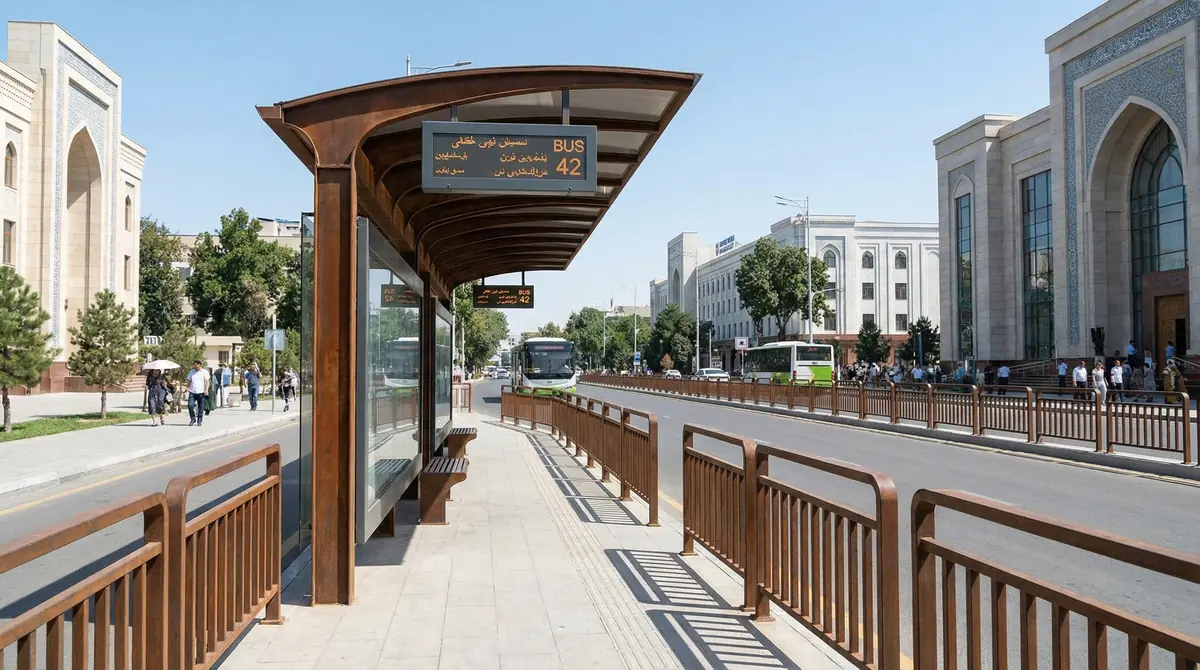
How to Estimate the Cost of Bus Stops, Railings, and Canopies
Planning to upgrade bus stops, railings, and canopies in Tashkent or the regions? Here’s a breakdown of what goes into the cost estimate for metal structures and how to avoid budget overruns.
The Role of Metal Structures in the Urban Infrastructure of Uzbekistan
Bus stop shelters, railings, and outdoor canopies are basic elements of the urban environment in Tashkent and other cities of Uzbekistan. For administrations and design institutes they are simultaneously:
- an element of improvement and safety;
- a line of capital and operating expenses;
- part of the city’s visual identity.
To prevent the project from “ballooning” during implementation, it’s important to calculate the estimate for metal structures not formally, but based on the actual technical specification (TS), selected materials, and manufacturing technologies.
Which Objects Are Included in the Estimate: Shelters, Railings, Canopies
Bus Stop Shelters
The metal frame of a bus stop shelter usually includes:
- a load-bearing frame made of profile pipe or rolled metal;
- roofing (sheet metal, polycarbonate, sandwich panels, etc.);
- posts and trusses to withstand wind and snow loads;
- glazing or infill elements (sheet metal, glass, polycarbonate);
- benches, backrests, and sometimes hanging elements for outdoor advertising.
Railings
Railings in the urban environment are used:
- along roads and pedestrian crossings;
- along embankments and slopes;
- on stairs, ramps, and entrance groups.
The structure can be:
- made of carbon steel with anti-corrosion protection;
- made of stainless steel (for areas with high humidity and intensive use);
- combined (metal + decorative elements).
Outdoor Canopies
Canopies for entrance groups, parking lots, courtyards, and public spaces include:
- a frame made of metal structures (columns, trusses, beams);
- roofing material (metal, polycarbonate, etc.);
- fastening elements to existing buildings or foundations.
All these objects are calculated using the same logic: calculation based on the TS, selection of materials and technologies, assessment of installation and logistics costs.
Basic Elements of an Estimate for Urban Metal Structures
When preparing an estimate for urban metal structures, several blocks are usually distinguished:
-
Design and Calculation
- development of the structural scheme (hangar frame, trusses, columns — using similar logic, but on a smaller scale);
- verification of load-bearing capacity, selection of cross-sections;
- preparation of production drawings (including for laser cutting and metal bending).
-
Materials
- rolled metal (profile pipes, sheet metal);
- stainless steel — when increased corrosion resistance is required;
- roofing and cladding materials;
- fasteners and hardware.
-
Manufacturing of Metal Structures
- cutting (laser cutting or mechanical cutting);
- metal bending (for profiles, brackets, decorative elements);
- welding of frames, joints, and embedded parts;
- grinding, surface preparation for painting;
- powder coating or other types of protective and decorative coatings.
-
Installation and Commissioning
- preparation of foundations, anchoring, installation of columns and posts;
- on-site assembly of shelters, railings, and canopies;
- possible connection to existing elements (facades, stairs, road barriers);
- cleanup and handover of the site.
-
Logistics and Organizational Costs
- delivery of metal structures within Tashkent and the regions of Uzbekistan;
- loading and unloading operations;
- temporary storage for phased installation.
Materials and Technologies: How Choice Affects Cost and Service Life
Two bus stops or canopies with the same dimensions can differ in cost estimates by several times. Materials and manufacturing technologies play a key role.
Choice of Frame Material
-
Carbon steel
- plus: optimal price/strength ratio;
- minus: requires high-quality anti-corrosion protection, especially for outdoor use.
-
Stainless steel
- plus: high corrosion resistance, presentable appearance, minimal maintenance;
- minus: higher cost of material and processing.
For railings in high-load areas (metro stairs, major transfer hubs), stainless steel may be justified from a life-cycle perspective.
Processing and Production Technologies
-
Laser cutting
- increases the accuracy of parts, reduces metal waste;
- speeds up assembly in production and installation on site.
-
Metal bending
- allows reducing the number of welded joints;
- improves the appearance and rigidity of structures.
-
Welding
- manual or semi-automatic, depending on the series and weld requirements;
- affects labor intensity and production time.
-
Powder coating
- forms a durable coating for outdoor use;
- allows maintaining the city’s or project’s color scheme.
Factors Affecting Price: From TS to Logistics and Installation
Below is a generalized table showing which project parameters have the greatest impact on the final estimate.
| Factor | How It Affects Cost | Comment for TS |
|---|---|---|
| Dimensions and number of objects | Proportional to the volume of metal and work | Specify length, width, height, number of shelters/linear meters of railings/canopies |
| Type of material (steel, stainless steel) | Changes the cost of metal and processing | Immediately fix where carbon steel is acceptable and where stainless steel is required |
| Metal thickness and profile cross-sections | Affects weight, price, and installation | Do not overestimate without calculation, but consider regional wind and snow loads |
| Type of coating (powder coating, primer+enamel) | Changes the cost of materials and preparation | Specify requirements for color, durability, and operating area in the TS |
| Structural complexity | Increases labor intensity of welding, bending, and assembly | The more non-standard joints and curved elements, the higher the cost |
| Installation conditions | Affect installation costs | Whether dismantling of old structures is needed, work in confined conditions, night shifts |
| Logistics across Uzbekistan | Affects delivery and organization of work | Specify city, access conditions, need for phased delivery |
| Implementation deadlines | May require additional shifts and resource reallocation | Urgent projects are usually more expensive than standard deadlines |
The more detailed the initial TS, the more accurately the contractor can assess each of these factors.
Specifics of Cost Estimation by Object Type
Bus Stop Shelters
When estimating the cost of bus stop shelters for Tashkent and the regions, the following are taken into account:
- number of size types (one type or several options by length/equipment);
- presence of additional elements: benches, trash bins, information boards, spaces for outdoor advertising;
- type of roofing and glazing (anti-vandal solutions, transparency, light transmission);
- design requirements (simple frame or architectural elements).
It is important to decide in advance whether the project will be serial (one type of shelter for the entire city) or variable (different solutions for different districts). Serial production reduces the unit cost due to repeatability of parts and joints.
Railings
For railings, the key estimate parameters are:
- length in linear meters;
- height and spacing of posts;
- type of infill (horizontal/vertical elements, decorative inserts);
- material (carbon steel or stainless steel);
- fastening method (to concrete, to metal structures, to existing stairs, etc.).
The cost is also affected by the need for custom-made transition elements and connections to existing structures.
Outdoor Canopies
When estimating canopies for entrance groups, parking lots, and public spaces, additionally consider:
- support scheme (on separate columns, to the building facade, combined);
- canopy overhang length, spacing of supports;
- type of roofing material and its weight;
- need for drainage and snow retention.
Canopies are often designed as metal structures with trusses and columns, similar in logic to a hangar frame, but with different loads and architectural requirements. This is reflected in the calculation of metal consumption and labor intensity.
Common Mistakes in Preparing TS and Estimates
Below are mistakes that regularly lead to revisions of estimates and deadlines during the project.
-
Lack of clear dimensions and layouts
- The TS only states “standard bus stop” or “road railing” without dimensions and references. As a result, the estimate is based on assumptions and then changes.
-
Unaccounted installation conditions
- No information about underground utilities, equipment restrictions, or street operating mode. During installation, additional work and downtime appear.
-
Gap between architectural concept and production
- The sketch looks good but does not take into account real welding, bending, and painting technologies. The contractor has to rework the solution, which changes the estimate.
-
Understated anti-corrosion protection requirements
- In pursuit of savings, coating thickness is reduced or the surface preparation system is simplified. After a few years this leads to accelerated wear and additional costs.
-
Ignoring serial production and standardization
- Each district orders unique versions of shelters and railings. The estimate grows due to the large number of different joints and tooling.
-
Failure to account for regional logistics
- The estimate does not include real costs for delivery and assembly in remote cities of Uzbekistan. As a result, the project exceeds the budget.
-
Tight deadlines without adjusting the estimate
- The requirement to “do it faster” without understanding that this may require additional shifts and overtime, and therefore increase cost.
Avoiding these mistakes is helped by a detailed calculation based on the TS and early involvement of the manufacturing contractor in discussing the solution.
How to Organize Interaction with a B2G Contractor
For urban infrastructure projects, not only price and deadlines are important, but also process transparency. Recommended interaction procedure:
-
Preliminary TS
- description of object types (shelters, railings, canopies);
- approximate dimensions and quantities;
- photos or diagrams of installation locations.
-
Technical Consultation
- discussion of materials (steel/stainless steel, type of coating);
- verification of the feasibility of the architectural solution considering technologies (laser cutting, bending, welding, powder coating);
- preliminary assessment of deadlines.
-
Refined TS and Calculation Based on TS
- fixing all parameters in a document;
- detailed calculation of metal structures and work broken down by stages.
-
Schedule Approval
- division into stages: manufacturing, delivery, installation by addresses;
- coordination with other contractors (road works, landscaping).
-
Production and Installation Control
- interim acceptance of joints and coating samples;
- photo reports or site visits to production if necessary.
This approach reduces the risk of estimate revisions and delays at the implementation stage.
Manufacturing and Installation Timeframes: What to Include in the Project Schedule
Timeframes depend on volume, complexity, and production workload, but when planning urban projects, several general points should be considered:
- TS development and calculation — time for coordinating solutions between the administration, designer, and contractor.
- Manufacturing of metal structures — includes metal procurement, laser cutting, bending, welding, preparation, and powder coating.
- Logistics — especially important for deliveries to the regions of Uzbekistan, where phased delivery is required.
- Installation — depends on the number of addresses, access conditions, and the need for night or “window” work.
With tight deadlines, the contractor may propose:
- standardization of size types to speed up production;
- phased commissioning of objects (for example, first shelters on main roads, then in courtyards);
- parallel preparation of foundations and manufacturing of structures.
All these solutions must be reflected in the estimate and schedule.
FAQ: Answers to Common Questions from Administrations and Designers
1. Can one standard shelter type be used for the entire city?
Yes, provided that the standard solution meets requirements for dimensions, safety, and architectural appearance. Serial production reduces unit cost and simplifies maintenance.
2. What is better for railings: carbon steel or stainless steel?
It depends on the application area and budget. For standard road railings, carbon steel with high-quality anti-corrosion protection is often sufficient. Stainless steel is justified in places with higher loads and appearance requirements.
3. Can the design be changed after the estimate is approved?
Yes, but this will lead to recalculation. Any change in dimensions, material, or coating affects the volume of metal and labor intensity, and therefore cost and deadlines.
4. How to account for possible vandalism in the estimate?
Through the choice of materials and structural solutions: reinforced profiles, anti-vandal fasteners, use of impact-resistant infill. These requirements must be fixed in the TS so that the contractor includes them in the calculation.
5. How detailed should the TS be for calculation?
The more detailed, the better. Minimum: dimensions, quantity, material, type of coating, installation conditions, design requirements. If necessary, the contractor will help refine the TS based on standard solutions.
6. Can the estimate be split into manufacturing and installation?
Yes, this is common practice. Manufacturing of metal structures and installation can be calculated as separate line items, which is convenient for tenders and budget control.
7. How to estimate deadlines in advance without a detailed design?
Based on aggregated parameters (number of shelters, meters of railings, canopies), the contractor can provide approximate deadlines. The exact schedule is formed after calculation based on the TS and approval of the scope of work.
8. Can the same facilities be used for other urban structures?
Yes. Laser cutting, metal bending, welding, and powder coating technologies used for shelters and railings are also suitable for other urban infrastructure elements: small architectural forms, information boards, outdoor advertising elements.
What Data Are Needed for an Accurate Calculation Based on TS
To obtain a realistic estimate for metal bus stop shelters, railings, and outdoor canopies, it makes sense to immediately specify the following in the request to the contractor:
- list of objects: shelters / railings / canopies;
- approximate dimensions and quantities for each type;
- proposed material (steel, stainless steel, combined);
- coating requirements (type, color, operating area);
- presence of additional elements (benches, trash bins, information boards, sign mounting points);
- addresses or typical installation conditions (city, district, access features);
- desired manufacturing and installation deadlines;
- interaction format: manufacturing only or manufacturing + turnkey installation.
Summary: How to Get a Realistic Estimate and Avoid Overruns
A correct estimate for metal bus stop shelters, railings, and outdoor canopies for cities in Uzbekistan is based on three principles:
- detailed TS with clear dimensions, materials, and installation conditions;
- informed choice of technologies (laser cutting, bending, welding, powder coating) considering the required service life;
- transparent breakdown of the estimate by stages: design, materials, manufacturing, logistics, installation.
To move from general discussions to specific figures, a calculation based on your TS is required.
Submit a Request for Calculation
For a preliminary cost estimate, specify:
- object types: bus stop shelters / railings / outdoor canopies;
- approximate dimensions and quantities for each type;
- proposed material (steel, stainless steel) and type of coating;
- city and installation districts (Tashkent or other regions of Uzbekistan);
- whether sketches/drawings are available (yes/no);
- required manufacturing and installation deadlines;
- work format: manufacturing only or manufacturing + installation.