
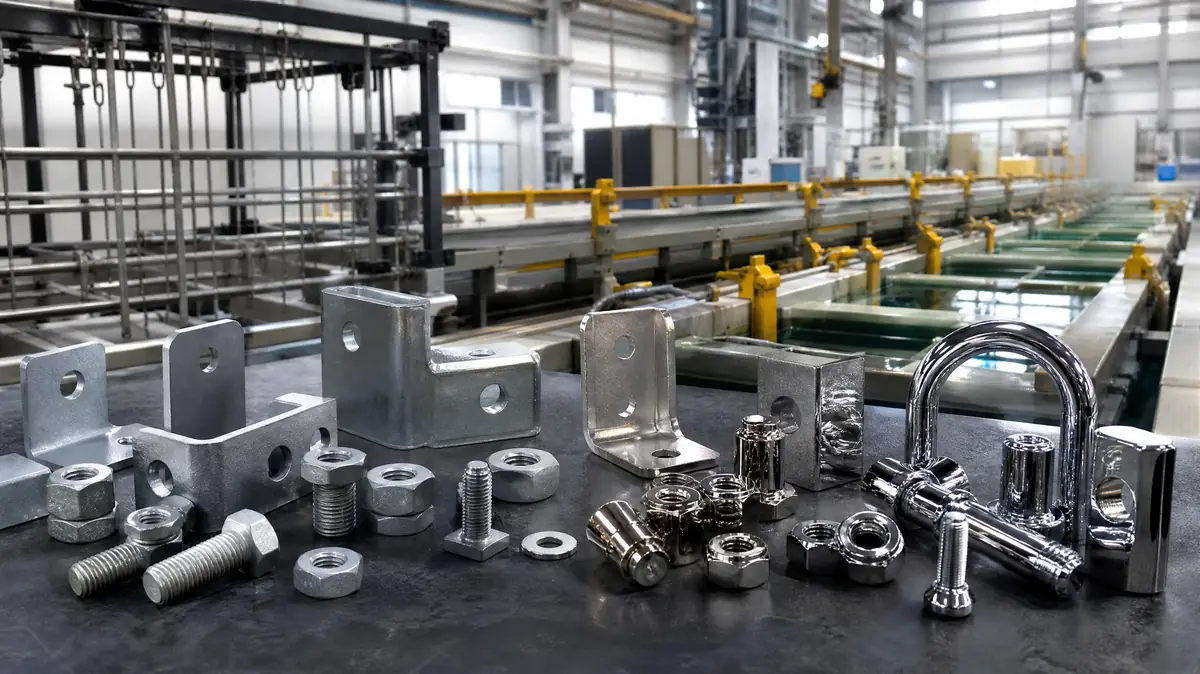
Electroplating of Metals: Comparison of Protective Coating Types
Zinc plating, nickel plating, or chrome plating: which electroplated coating should you choose for construction components? We compare protective properties, technological limitations, and operating requirements in Uzbekistan.
What Is Electroplating and Why Is It Needed?
Electroplating is a thin metallic layer applied to a product's surface using electrolysis. It is used to protect against corrosion, improve wear resistance, modify electrical properties, and enhance the appearance of components. For a construction contractor, the key is to select a coating based not on the name of the technology, but on the operating conditions of the specific product.
When choosing a coating, it is important to consider the base material, component geometry, and exposure to moisture, chemicals, and other metals. The same fastener may perform reliably indoors in a dry environment but quickly lose its protective properties at an outdoor construction site.
Unlike a paint coating, an electroplated layer forms directly on the metal surface. Its protective properties depend on its chemical composition, thickness, continuity, and the quality of surface preparation.
How Does Electrochemical Protection Work?
During electroplating, a metal product is placed in an electrolyte, and an electric current is used to deposit metal onto its surface. Before this process, the component is cleaned to remove dirt, oils, oxides, and other contaminants that could prevent uniform coating application.
The protection mechanism differs depending on the metal used. For example, zinc protects the steel substrate not only as a physical barrier but also through electrochemical interaction: if the coating is damaged, zinc can corrode preferentially relative to the steel. Nickel and chromium primarily function as barrier layers, so defects and pores can become sites of localized corrosion of the underlying metal.
What Types of Electroplated Coatings Are Used?
Zinc plating, nickel plating, and chrome plating are the most common options considered for construction and industrial products. The choice depends on what matters most: protecting the steel substrate, wear resistance, decorative appearance, or specific operating properties.
Zinc Plating
Zinc coating is one of the most widely used methods of protecting steel components against corrosion. It is used for fasteners, metal hardware, individual equipment components, connecting parts, and products that must remain functional when exposed to atmospheric moisture.
The main advantage of zinc is its ability to provide electrochemical protection for steel. Even when the coating sustains minor damage, it can continue protecting the adjacent substrate surface.
However, zinc plating should not automatically be considered a universal solution for all conditions. Coating thickness, passivation quality, the presence of damage, and the aggressiveness of the surrounding environment all matter. In particular, continuous exposure to salts and chemical solutions can significantly shorten the coating's service life.
Nickel Plating
Nickel plating creates a metallic layer with good surface hardness, wear resistance, and decorative properties. It is used for equipment components, fasteners, mechanisms, and products where appearance and resistance to mechanical wear are important.
Nickel coating primarily serves as a barrier. If the layer contains pores, cracks, or damaged areas, corrosion of the base metal may begin at those locations. Therefore, for critical components, surface preparation and coating continuity requirements must be agreed upon in advance.
Chrome Plating
Chrome plating is used when high surface hardness, wear resistance, or a distinctive metallic shine is required. It is commonly used for certain mechanical components, rods, tooling components, and decorative parts.
It is important to distinguish between decorative and functional chrome plating. A decorative system may include several underlayers, such as copper and nickel, while functional chrome plating is focused on the working properties of the surface.
When placing an order, the intended use of the component must be specified separately. The term "chrome plating" alone does not define the required thickness, structure, or operating properties of the coating. Environmental and production requirements associated with the technology used must also be considered.
Copper Plating and Tin Plating
Copper plating is often used as an intermediate layer in multilayer coatings, as well as to improve electrical conductivity and surface processing properties. Copper plating does not provide universal standalone corrosion protection for steel under all conditions.
Tin plating involves applying a layer of tin. It is used for certain electrical components and parts where solderability and contact surface properties are important. For outdoor construction structures, this option is generally not a universal substitute for zinc plating.
Comparing Electroplated Coatings: Which One Should You Choose?
For standard steel fasteners exposed to atmospheric moisture, zinc plating is often considered. For mechanisms with more demanding surface requirements, nickel or chrome plating may be suitable.
| Coating Type | Main Function | Advantages | Limitations | Typical Applications |
|---|---|---|---|---|
| Zinc | Corrosion protection for steel | Electrochemical protection, practicality | Sensitivity to aggressive environments and damage | Fasteners, steel components |
| Nickel | Barrier and decorative protection | Hardness, appearance, wear resistance | Coating defects can cause localized corrosion | Equipment components, mechanisms |
| Chrome | Increased hardness and wear resistance | Hard surface, decorative appearance | Requires proper preparation and technology | Rods, functional and decorative components |
| Copper | Intermediate layer and electrical conductivity | Good processability, conductivity | Not universal corrosion protection for steel | Electrical components, multilayer coatings |
| Tin | Protection and improved solderability | Suitable for certain electrical contacts | Limitations under mechanical and operating conditions | Electrical components |
When comparing coatings, consider not only the coating name but also its structure. For example, a multilayer system with copper and nickel underlayers may have different properties from single-layer nickel plating.
How to Choose a Coating for Operating Conditions in Uzbekistan
When selecting electrochemical protection in Uzbekistan, it is important to consider hot summers, temperature fluctuations, dust, seasonal precipitation, and localized humidity. Additional factors include irrigation, contact with soil, construction mortars, and industrial contaminants.
Requirements for metal products installed indoors in dry rooms may be less stringent than those for outdoor components. However, condensation can still occur indoors, especially during temperature fluctuations and in areas with inadequate ventilation.
Consider the Installation Location
Before selecting a technology, divide products into the following groups:
- Dry indoor spaces — assess the risk of condensation, mechanical wear, and contact with household chemicals.
- Outdoor structures — consider rain, dust, surface heating, and periodic wetting.
- Wet areas — check the coating's resistance to continuous or repeated exposure to water.
- Industrial premises — consider possible contact with process solutions, vapors, and contaminants.
- Components in contact with soil — separately assess exposure to moisture, salts, and soil conditions.
Particular attention should be paid to components that come into contact with dissimilar metals. In the presence of moisture, galvanic corrosion may occur between them. Therefore, it is important to assess not only the coating itself but also the entire joint assembly.
What Parameters Should Be Agreed Upon Before Placing an Order?
Before sending a batch for electroplating, prepare a technical specification. It should describe the product material, coating purpose, thickness requirements, appearance, and acceptable defects.
Key parameters:
- Substrate material. Specify the grade of steel or other metal, if known. Different materials require different preparation procedures.
- Product purpose. Indicate whether the required result is corrosion protection, a decorative surface, electrical conductivity, or wear resistance.
- Coating thickness. Agree on the nominal value and permissible deviations. Consider operating conditions and component requirements.
- Coating type. Specify the particular metal and, if necessary, the sequence of underlayers.
- Passivation and finishing. For zinc coatings, clarify whether additional treatment is required and specify its requirements.
- Product geometry. Identify holes, threads, recesses, sharp edges, and hard-to-reach areas.
- Quality control. Define thickness measurement methods, appearance inspection procedures, and acceptable deviations in advance.
For high-strength steel components, separately discuss the risk of hydrogen embrittlement, which may occur during certain surface preparation and coating application operations. The need for and conditions of subsequent treatment should be determined together with the process engineer, taking the material and product purpose into account.
How to Calculate the Volume of Electroplating Work
The cost and production workload of an electroplating order are generally estimated based on surface area, the number of components, geometry, and process complexity. Therefore, specifying only the total batch weight is insufficient.
Use the following formula for a preliminary surface area calculation:
S = N × S₁, where:
- S — total surface area of the batch;
- N — number of identical components;
- S₁ — surface area of one component.
For a rectangular component with dimensions a, b, and c, the total area of all six sides is calculated using the formula:
S₁ = 2 × (ab + ac + bc).
All dimensions must first be converted to the same units of measurement. For components with complex shapes, surface area is determined using a drawing, 3D model, or technical documentation.
When calculating the area, remember to account for holes, internal surfaces, threads, and recesses. Geometry affects coating distribution: thickness may vary on protruding surfaces and inside recesses.
For a preliminary inquiry to a seller or service provider, prepare the product quantity, drawings, dimensions, batch weight, and required surface characteristics. If the exact surface area is unknown, attach a drawing and ask them to clarify the calculation method.
How to Compare Supplier Offers
Compare offers based on the same technical specification. If one contractor offers zinc plating at a specified thickness while another offers decorative nickel plating, comparing their final prices alone would be misleading.
Request information from each contractor on the following points:
| Criterion | What to Clarify | Why It Matters |
|---|---|---|
| Technology | Coating type and sequence of operations | Determines the properties of the protective layer |
| Thickness | Nominal value and tolerances | Affects protective performance |
| Preparation | Cleaning, degreasing, oxide removal | Affects coating adhesion |
| Geometry | Ability to treat internal areas | Helps prevent uncoated areas |
| Inspection | Measurement and testing methods | Allows objective batch acceptance |
| Documentation | Process description and inspection results | Simplifies verification of order compliance |
| Logistics | Packaging, transportation, and handover conditions | Helps preserve the surface after processing |
Also clarify who is responsible for product preparation, masking areas that must not be coated, and restoring threaded connections if necessary. These operations must be agreed upon before work begins.
Get Quotes from Sellers on BRIX
To compare available offers, visit products with electroplated coatings on BRIX and submit an inquiry to the seller you are interested in.
How it works:
- Open a suitable product on BRIX.
- Click "Submit an Inquiry."
- Enter your name and phone number. The inquiry is free, and registration is not required.
- To receive an accurate offer, provide the quantity, coating specifications, project address, and desired deadlines.
- Wait for a call or message from the seller: the inquiry is sent directly to the seller of the relevant product, who will contact you independently and provide the price and terms.
After submitting the inquiry, you can answer additional questions about the quantity, project, deadlines, and region. This helps the seller prepare a more accurate offer. You agree on the price, payment, and delivery directly with the seller. BRIX is not involved in payment.
If you need to compare the product range of a single supplier, visit their company page, where all their products are listed.
How to Check the Quality of an Electroplated Coating
Coating quality is assessed based on appearance, thickness, continuity, adhesion to the substrate, and compliance with the agreed technology. A visual inspection alone is insufficient for the full acceptance of a critical batch.
Main Inspection Methods
Visual inspection. Check surface uniformity and ensure there is no peeling, blistering, cracking, uncoated areas, or pronounced staining. For decorative products, additionally agree on color and gloss requirements.
Thickness measurement. Use an appropriate coating thickness gauge. Magnetic and eddy-current methods are applied according to the substrate material and coating type. X-ray fluorescence inspection is used for certain applications. The method must be suitable for the product design and coating characteristics.
Adhesion testing. If necessary, adhesion tests are conducted according to a previously agreed method. The testing method is selected based on the material, thickness, and intended purpose of the coating.
Corrosion resistance testing. Accelerated salt spray tests and other laboratory methods may be used to assess resistance. The results of such tests cannot be directly equated with a specific number of years of service at a construction site.
For critical products, agree on the sampling size, measurement points, and procedure for documenting results before sending the batch for processing.
How to Properly Accept and Store Treated Components
Carry out acceptance according to the technical specification and agreed quality criteria. Before signing the documents, check that the batch matches the order, verify the quantity, and review the inspection results.
Practical checklist:
- Verify the quantity of products and batch markings.
- Check that the coating type matches the technical specification.
- Inspect the surface for damage, missed areas, and peeling.
- Check coating thickness using the agreed method.
- Ensure that threads, holes, and mating surfaces retain the required geometry.
- Obtain the agreed documentation and measurement results.
- Check the packaging and ensure there is no damage from transportation.
After acceptance, store products in a dry, well-ventilated area. Avoid prolonged contact with water, aggressive substances, and damp packaging. Components should not be stacked in a way that causes their surfaces to become scratched or damaged during handling.
If defects are found, separate the affected products from the main batch and document their condition. Decide whether to rework, reapply the coating, or replace the products based on the agreed requirements and technical feasibility.
What Mistakes Are Commonly Made When Choosing Electrochemical Protection?
Most problems arise from insufficiently detailed technical specifications and a lack of acceptance criteria.
The most common mistakes include:
- Choosing based only on the coating name. Zinc plating, nickel plating, and chrome plating serve different purposes. First, determine the operating conditions.
- Ignoring the substrate material. Not every metal can be treated in the same way. Preparation must account for the chemical composition and surface condition.
- Failing to specify coating thickness. Without an agreed value, it is impossible to objectively verify compliance with the order.
- Underestimating the importance of geometry. Internal holes, threads, and deep recesses may receive uneven coating.
- Ignoring contact between different metals. In the presence of moisture, electrochemical corrosion may occur at connection points.
- Accepting products based only on appearance. An attractive shine does not prove sufficient thickness or corrosion resistance.
- Failing to agree on inspection methods. Quality disputes are best prevented before processing begins.
FAQ: Frequently Asked Questions About Electroplating
1. Which electroplated coating provides the best protection against steel corrosion?
Zinc plating is used for many steel fasteners because zinc provides electrochemical protection for steel. The final choice depends on operating conditions and the required performance characteristics.
2. What Is the Difference Between Electrolytic Zinc Plating and Hot-Dip Galvanizing?
In electrolytic zinc plating, zinc is deposited from an electrolyte using an electric current. In hot-dip galvanizing, the steel product is immersed in molten zinc. These technologies differ in coating structure and thickness, component requirements, and applications.
3. Can Stainless Steel Be Electroplated?
Yes, this treatment is possible, but it requires specialized surface preparation and selection of an appropriate process. The feasibility and suitability of the coating should be agreed upon with the service provider.
4. What Determines the Thickness of an Electroplated Coating?
It depends on the technology, substrate material, electrolyte composition, processing conditions, component geometry, and process duration. The required thickness must be specified in the technical specification.
5. Can Threaded Components Be Electroplated?
Yes, but changes in dimensions after coating application must be taken into account. For precision connections, agree on tolerances, masking, and thread inspection in advance.
6. How Can Coating Quality Be Checked Without a Laboratory?
You can perform a visual inspection and measure accessible parameters using an appropriate measuring instrument. However, specialized tests may be required to assess adhesion, composition, and corrosion resistance.
7. Does Nickel Plating Protect Against Corrosion Better Than Zinc Plating?
Not in all cases. Nickel primarily creates a barrier layer, while zinc also provides electrochemical protection for steel. The choice depends on the environment, design, and intended use of the product.
8. What Information Is Needed to Order Electroplating Services?
Specify the material, dimensions, quantity, weight or surface area, coating type and thickness, operating conditions, drawings, and project address. Also agree on inspection requirements and completion deadlines.
Get Quotes from Sellers on BRIX
To select a suitable electroplated coating for construction and industrial applications, compare available products and seller offers on BRIX.
How to submit an inquiry:
- Open products with electroplated coatings.
- Click "Submit an Inquiry" on the selected product page.
- Provide your name and phone number — free of charge and without registration.
- Specify the quantity, coating characteristics, project address, and deadlines.
- Wait for a call or message from the seller who received your inquiry and will independently provide the price and terms.
Before submitting your inquiry, prepare a technical specification or drawing. This will help the seller understand the processing requirements and provide a detailed offer. You agree on payment, delivery, and all other terms directly with the seller.