
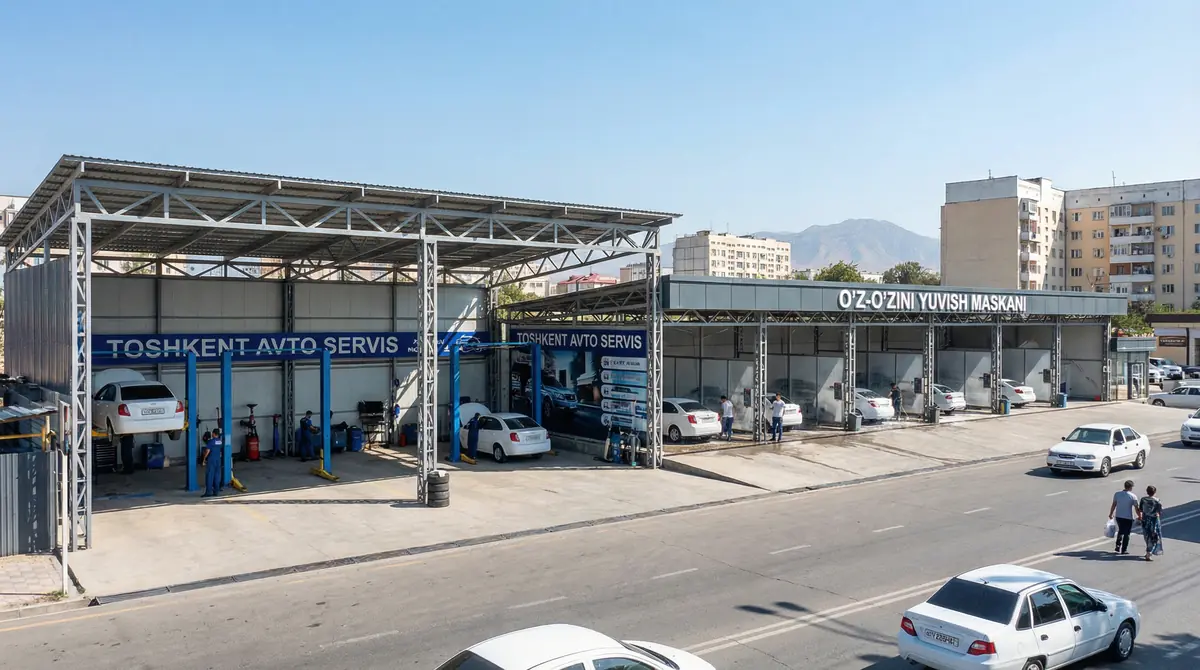
Fast-erected metal structures for service stations and car washes
Planning to open a service station or self-service car wash in Tashkent? Let’s break down how the fast-erected metal structure technology works: from the technical brief and design to installation and commissioning.
Why fast-erected metal structures are chosen for service stations and car washes
For auto repair shops, tire services, and self-service car washes, launch speed, a predictable budget, and scalability are crucial. Fast-erected metal structures allow you to solve these tasks without full-scale capital construction.
Key advantages:
- Speed — the frame of a hangar, canopy, or box can be manufactured and installed in weeks, not months.
- Layout flexibility — spans, heights, and the number of bays are easily adapted to the format of a service station or car wash.
- Modularity — the facility can be expanded: adding bays, canopies, and technical rooms.
- Controlled cost price — most of the work is done in the workshop (contract manufacturing), with only installation on site.
For Tashkent and Uzbekistan this is especially relevant: the roadside service market is growing, and the time to launch a point on the highway or in the city directly affects payback.
Typical facility formats: service station, tire service, self-service car wash
Service stations and auto repair shops
For auto repair shops, the following metal structure solutions are most often used:
- hangar frame with spans for 2–6 bays;
- separate canopies for vehicle reception/hand-over;
- metal structures for a mezzanine (spare parts warehouse, office);
- stairs and railings for access to the second level.
Important parameters in design:
- clear height for lifts and equipment;
- column spacing so as not to interfere with entry and maneuvering;
- ability to install doors of the required width and height.
Tire service and small roadside points
For tire service and small shops, compact boxes and canopies are used:
- metal frame for one or two bays;
- external canopies for seasonal wheel storage;
- light enclosing structures.
Here the critical factors are:
- minimum manufacturing and installation time;
- convenient logistics: access, turning, parking.
Self-service car washes
For self-service car washes, metal structures are the core of the facility:
- canopy frame over the bays;
- trusses and columns taking into account spans and height for equipment;
- brackets and embedded parts for utilities and advertising elements.
Features:
- increased humidity — it is important to plan metal protection (powder coating, galvanizing of individual elements);
- open spans without unnecessary columns so as not to interfere with entry and exit.
Process chain: from technical brief to facility launch
Work with fast-erected metal structures for service stations and car washes always begins with a technical brief (TB). The quality of the TB determines the accuracy of the estimate and timelines.
Basic chain:
- Collection of initial data and TB
- Preliminary calculation and concept
- Metal structure design
- Contract manufacturing in the workshop
- Logistics and on-site installation
- Final adjustments and preparation for operation
1. Collection of initial data and TB
The TB records:
- facility format: service station, tire service, self-service car wash, combined service;
- site dimensions and desired building/canopy size;
- number of bays, height, type of doors;
- requirements for enclosing structures (walls, roofing, partially open areas);
- need for stairs, railings, technical platforms;
- presence of an existing foundation or requirements for a new one.
2. Preliminary calculation and concept
At this stage, the basic frame scheme is formed:
- type of hangar frame (single-pitch, double-pitch, canopy);
- approximate column spacing and height;
- estimated steel volume.
Based on the results, you can estimate the cost and time range and understand how well the concept fits into the budget.
3. Metal structure design
Design includes:
- calculation of trusses, columns, bracing;
- development of connection nodes and support on the foundation;
- placement of stairs, railings, technological openings;
- preparation of KM/KMD documentation for production.
At this stage, loads (equipment, snow, wind), the climatic specifics of Tashkent, and requirements for driveways and heights are taken into account.
4. Contract manufacturing in the workshop
Metal structures are manufactured in the workshop, not on site. This shortens timelines and improves accuracy.
Main operations:
- laser cutting of sheet metal for nodes, plates, embedded parts;
- metal bending for profiles, brackets, reinforcement elements;
- welding of trusses, columns, beams, stairs, railings;
- machining (drilling, milling of individual parts);
- powder coating or other protective coating.
5. Logistics and on-site installation
Finished elements are delivered to the site and assembled according to the design:
- installation and alignment of columns;
- installation of trusses and bracing;
- fastening of purlins, battens, additional elements;
- installation of stairs, railings, brackets.
Then walls and roofing (sandwich panels, profiled sheet, etc.), doors, and additional elements are installed.
6. Final adjustments and preparation for operation
After installation of the metal frame, the following works are carried out:
- engineering systems (ventilation, water, electricity — by specialized contractors);
- installation of service station or car wash equipment;
- final checks and commissioning.
Hangar frame design: schemes, spans, trusses, columns
Choosing the frame scheme
Several basic schemes are used for auto repair shops and car washes:
- Portal frame hangar — a classic solution for multi-bay service stations.
- Canopy on columns — for self-service car washes and tire services.
- Combined solutions — closed box + open canopy.
The scheme is chosen based on:
- number of bays and their width;
- need for closed/open areas;
- requirements for height and spans.
Spans and column spacing
For comfortable entry and operation, it is important to correctly select:
- span width — so that the vehicle and equipment are comfortably accommodated;
- column spacing — so that columns do not interfere with doors and maneuvering.
The larger the spans and the higher the frame, the more steel is required, which affects cost and production time.
Trusses, columns, bracing
The frame consists of:
- trusses — load-bearing elements of the roof or canopy;
- columns — vertical supports;
- bracing — elements that ensure structural rigidity.
Design takes into account:
- placement of doors and openings;
- possible attachment points for equipment and utilities;
- wind and snow loads in the region.
Choice of materials: steel, enclosing structures, coatings
Steel for the frame
Depending on the tasks and budget, the following are selected:
- profile types (I-beam, channel, rectangular tube, etc.);
- wall thickness and cross-section of elements;
- reinforcement options in high-load areas.
For elements in contact with aggressive environments (wash zones, chemicals), the following may be used:
- stainless steel for individual nodes and supports;
- additional protective coatings.
Enclosing structures
For walls and roofing, the following are used:
- sandwich panels of various thicknesses (for heated boxes);
- profiled sheet for cold areas and canopies;
- combined solutions (bottom — sandwich, top — profiled sheet).
The choice depends on:
- need for year-round operation and heating;
- service format (quick tire service vs. full-service auto repair shop);
- appearance requirements.
Protective coatings
To increase the service life of metal structures, the following are used:
- powder coating — uniform coating with good durability;
- primers and enamels for internal/hidden areas;
- combined protection systems.
For self-service car washes, it is important to pay attention to areas of constant wetting and splashing.
Production: laser cutting, metal bending, welding, painting
Laser cutting
Laser cutting allows you to:
- accurately manufacture plates, gussets, embedded parts;
- make holes and slots for bolted connections;
- speed up on-site assembly due to high precision.
Metal bending
Metal bending is used for:
- manufacturing profiles of complex shapes;
- reinforcement elements and brackets;
- decorative and protective elements.
Welding
Welding is a key stage in the manufacture of:
- trusses and beams;
- frames and posts;
- stairs and railings.
Weld quality affects the rigidity and service life of the frame, as well as installation speed.
Powder coating
Powder coating is performed in the workshop and provides:
- smooth coating without runs;
- resistance to corrosion and mechanical impact;
- the ability to match the color to the corporate style of the service.
On-site installation: foundation, frame assembly, connection nodes
Foundation and embedded parts
Before installing metal structures, it is necessary to:
- construct the foundation (strip, pile, slab — according to the design);
- install embedded parts and anchors.
Correct foundation geometry has a strong impact on the speed and quality of frame assembly.
Frame assembly
Installation stages:
- Unloading and layout of elements by zones.
- Installation and alignment of columns.
- Installation of trusses and bracing.
- Installation of purlins and additional elements.
After that, stairs, railings, brackets for equipment and outdoor advertising (signboard, lightbox, 3D letters if needed) are installed.
Connection nodes
Special attention is paid to:
- bolted connections (quality, tightening torque);
- welds performed on site;
- support points on the foundation and junctions with enclosing structures.
What affects the cost of metal structures for service stations and car washes
The final project price is always calculated based on the TB. Below are the main factors that shape it.
| Factor | How it affects cost |
|---|---|
| Facility dimensions (length, width, height) | The larger the spans and height, the more steel and the more complex the trusses — the volume of work and manufacturing cost increase. |
| Facility format (service station, tire service, car wash) | Car washes require reinforced and protected structures; service stations need height for lifts and crane beams, which increases steel consumption. |
| Frame type (hangar, canopy, combined) | A canopy is usually cheaper than a closed hangar; combined solutions are more complex in design and installation. |
| Choice of materials (profiles, panels, coatings) | Steel thickness, profile type, sandwich panels vs. profiled sheet, and type of protective coating significantly change the budget. |
| Insulation and microclimate requirements | Heated boxes with insulated walls and roofing are more expensive than cold canopies and light structures. |
| Volume and series (single facility or network) | In serial production of several facilities, unit cost decreases due to repeatability. |
| Node complexity and non-standard solutions | Mezzanines, non-standard stairs, railings, and equipment integration increase labor intensity. |
| Site and installation conditions | Limited access, cramped conditions, and the need for special equipment affect installation costs. |
To obtain a realistic estimate, it is important to provide as much data as possible about the facility and work format.
Typical mistakes when ordering fast-erected metal structures
-
Lack of a clear TB
An order like “make a frame for a 4-bay service station” without dimensions, heights, and equipment format leads to multiple redesigns and schedule shifts.
-
Underestimating height and spans
Saving on height or span width results in problems with installing lifts, doors, and vehicle passage.
-
Ignoring future expansion
The frame is designed “tight”, with no possibility to add bays or a canopy. As a result, when expanding, load-bearing elements have to be reworked.
-
Insufficient attention to metal protection at car washes
Without proper painting and material selection in high-humidity areas, corrosion appears and additional repair costs arise.
-
Lack of coordination with equipment
The frame and enclosing structures are designed without considering the dimensions and requirements of service station or car wash equipment, which leads to rework.
-
Saving on design
Trying to “assemble on site” without a full design increases the risk of errors, cost overruns, and delays.
-
Unprepared site and foundation
Uneven foundation, incorrect levels, and misaligned embedded parts complicate installation and require on-site modifications.
Project timelines in Tashkent conditions
Timelines depend on volume and complexity, but the structure is always similar:
- TB development and preliminary estimate — from a few days, if initial data are available.
- Metal structure design — from 1–2 weeks for typical solutions, longer for complex facilities.
- Contract manufacturing (laser cutting, bending, welding, painting) — from 2–4 weeks depending on steel volume and production workload.
- On-site installation — from a few days for small canopies to several weeks for large hangars.
Timelines are also affected by:
- seasonality (weather conditions for installation);
- readiness of the foundation and site;
- availability of access roads and special equipment.
FAQ on fast-erected metal structures for auto service
1. Can I first install a canopy/frame and then complete it to a full service station?
Yes, with competent design, the frame can initially be laid out with a margin for subsequent expansion and enclosure with walls.
2. What metal structures are needed for a self-service car wash?
Usually it is a canopy on columns with trusses of the required span, embedded parts for equipment and utilities, as well as additional elements for fastening enclosures and advertising.
3. Can the same frame be used for a service station and tire service?
The frame can be designed as universal, but heights, spans, and door locations are best initially laid out for the most “demanding” format.
4. What needs to be prepared to estimate the cost of metal structures?
At a minimum: dimensions, facility format, number of bays, height, requirements for insulation and type of enclosing structures, as well as a site layout.
5. How are local conditions in Tashkent taken into account?
Design takes into account the region’s climatic loads, soil characteristics, and installation feasibility within the city or outside it.
6. Is it possible to manufacture only the metal structures without installation?
Yes, in a contract manufacturing format it is possible to manufacture metal structures according to your design and hand over the kit for self-installation.
7. How is welding and painting quality controlled?
Quality control is organized at the production stage: checking geometry, welds, surface preparation, and coating uniformity.
8. Can outdoor advertising elements be integrated into the frame?
Yes, during design you can immediately include brackets and platforms for a signboard, lightbox, 3D letters, and other outdoor advertising elements.
How to order an estimate based on a TB and what data to prepare
To obtain an accurate estimate of metal structures for an auto repair shop, service station, or self-service car wash in Tashkent, it is important to collect initial data in advance.
Submit a request for an estimate
For a prompt estimate based on the TB, prepare:
- facility format: service station, tire service, self-service car wash, or combined service;
- site plan (sketch or diagram with dimensions and reference points);
- proposed building/canopy dimensions (length, width, height);
- number of bays, type and size of doors;
- requirements for enclosing structures (heated/cold box, type of walls and roofing);
- need for stairs, railings, mezzanines, technical platforms;
- information about the existing or planned foundation;
- desired manufacturing and installation timelines;
- contact details for clarification questions.
Based on this data, a technical solution, implementation timeline, and cost estimate for metal structures can be prepared specifically for your project in Tashkent conditions.