
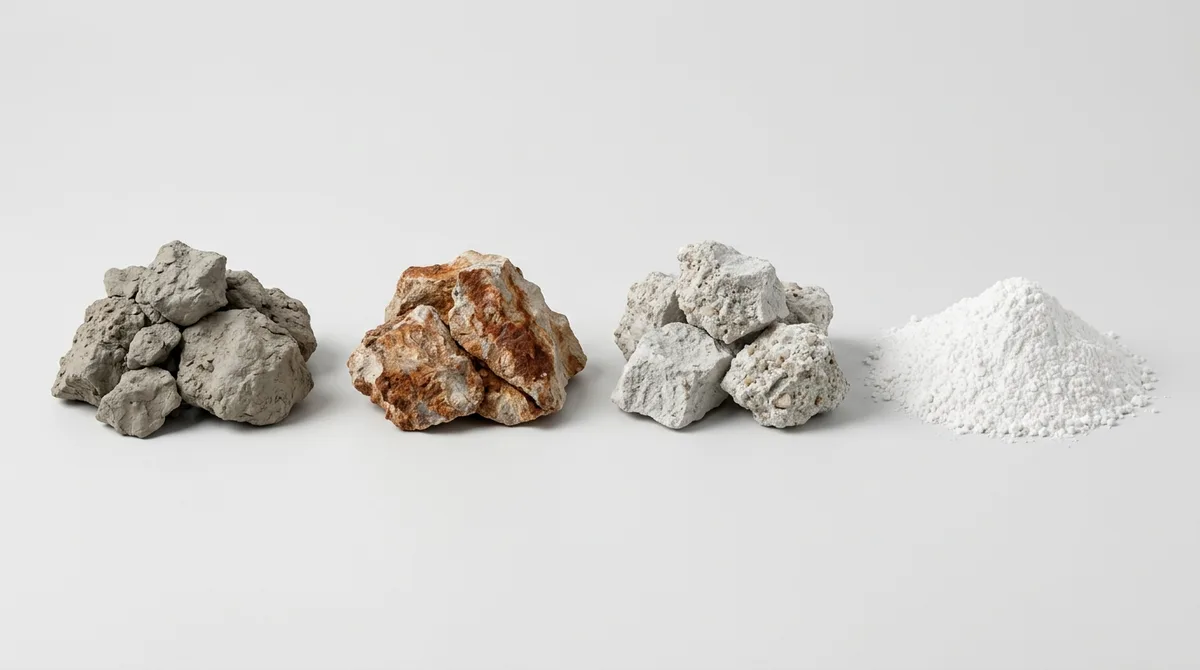
Angren kaolin: types, composition, grades AKF-78 and AKS-30 (АКФ-78, АКС-30) and their uses
What kaolin is mined in Angren, how grey secondary kaolin differs from variegated and primary kaolin, what beneficiated kaolin АКФ-78 (AKF-78), АКС-30 (AKS-30) and АКТ-10 (AKT-10) is, which kaolin you need for bricks, tiles, faience and cement, and what the producer charges for it.
In brief
- Angren kaolin is mined as a by-product of brown coal (lignite) mining. Secondary kaolin lies in the upper part of the coal seam, primary kaolin lies beneath it.
- Unbeneficiated (crude) secondary kaolin comes in grey and variegated varieties. It is sold by JSC Uzbekugol (O‘zbekko‘mir, often called Uzbekkumir) in bulk, in any volume required.
- Primary kaolin contains a lot of quartz sand. The Angren beneficiation plant uses it to make the grades АКФ-78 (AKF-78), АКС-30 (AKS-30) and АКТ-10 (AKT-10).
- What to buy: for bricks and cement — grey or variegated secondary kaolin; for tiles and sanitary faience — grey secondary or АКС-30; for paper, porcelain and glazes — АКФ-78; as a filler for rubber, adhesives and household chemicals — АКТ-10.
- Key properties: Al2O3 (alumina), Fe2O3 (iron, which determines the colour after firing), whiteness, moisture and fineness.
- On BRIX you can leave a request for any type of kaolin — the price will be quoted for your volume.
What kaolin is
Kaolin is a light-coloured clay based on the mineral kaolinite. Pure kaolinite contains about 39.5% Al2O3, 46.5% SiO2 and 14% bound water. Natural kaolin always contains impurities: quartz sand, mica, iron and titanium oxides.
The value of kaolin is determined by two indicators. The more Al2O3 it contains, the closer it is to pure kaolinite and the higher its refractoriness. The less Fe2O3, the whiter the product after firing. That is why the same “kaolin” can cost several times more or less, depending on its purity.
Kaolin of the Angren deposit
The Angren deposit in Tashkent region is known above all for coal, but here the coal seams alternate with kaolin clays. Secondary kaolin lies in the upper part of the coal seam, primary kaolin beneath it. During overburden removal, JSC Uzbekugol extracts a lot of kaolin as a by-product and offers it “in any required quantity”. In Uzbek documents kaolin is called “oqgil”, i.e. “white clay”.
The reserves are large, but estimates differ between sources. More than 0.45 billion t of grey secondary kaolin alone has been explored on the outskirts of Angren. According to 2023 data, the explored and approved reserves of kaolin clays amount to 900 million t, of which about 450 million t are suitable for alumina production.
Unbeneficiated primary and secondary kaolin from selective mining is covered by the O‘z DSt 3607-2022 standard.
Types of Angren kaolin
| Type | Appearance | Al2O3 | Fe2O3 | SiO2 | Uses |
|---|---|---|---|---|---|
| Secondary grey, unbeneficiated | grey lumps of clay | 18.5–24.5% | 1.5–4.5% | 39.8–57.9% | tiles, ceramics, bricks, cement |
| Secondary variegated, unbeneficiated | light clay with rusty and brown spots | 24.2–25.1% | 3.8–4.0% | 53.6–58.8% | cement, bricks, coarse ceramics |
| Primary, unbeneficiated | white rock with quartz sand | per analysis | per analysis | high quartz | raw material for beneficiation, faience |
| АКФ-78, beneficiated | fine white powder, whiteness about 80% | 32–35% | under 1% | about 47% | paper, porcelain, faience, glazes, insulators |
| АКС-30, beneficiated | light, with residual quartz | 25–30% | about 0.7% | 56.6–57.4% | sanitary faience, tiles, refractories, chamotte |
| АКТ-10, beneficiation product | light powder | about 13.7% | about 1% | about 77.6% | filler: household chemicals, adhesives, rubber, cables |
The figures come from published studies of Angren raw material. The composition differs from batch to batch, so always request an analysis for production use.
Studies also identify white varieties of Angren kaolin clays: they contain up to 37–39% Al2O3 and less than 1% Fe2O3.
Beneficiated kaolin: АКФ-78, АКС-30, АКТ-10
Beneficiated kaolin in Angren is produced by the kaolin beneficiation plant. Its history began with Cabinet of Ministers Resolution No. 385 of 7 November 1996, which set up the Kaolin joint venture with the German company Kulenkampff und Konitzki. The plant was commissioned in 1998 with a design capacity of 200 thousand t of beneficiated kaolin per year. After the plant's bankruptcy and an auction in 2009, its facilities are run by Angren-Kaolin LLC.
The plant's raw material is unbeneficiated primary kaolin. It is beneficiated by the wet process: washed free of sand and impurities. The output is three grades.
АКФ-78 is the purest grade. Al2O3 averages 32–35%, Fe2O3 is under 1%, whiteness is about 80%, and more than half of the particles are finer than 1 µm. Its main use is as a filler for paper. АКФ-78 also goes into porcelain, faience, glazes, insulators, cables, plastics, paints and coatings, and kaolin wool.
АКС-30 is kaolin for ceramics. It contains more residual quartz sand, so its Al2O3 is 25–30%. Iron is low, about 0.7% Fe2O3. It is used for sanitary faience, facing tiles, refractories, fireclay (chamotte) bricks and art ceramics.
АКТ-10 is the quartz fraction left after beneficiation: about 77.6% SiO2 and 13.7% Al2O3. It is an inexpensive inert filler for household chemicals, adhesives, resins, rubber goods, cables and plastics.
Where kaolin is used
| Production | Suitable kaolin | What to look at |
|---|---|---|
| Bricks and wall materials | grey or variegated secondary | plasticity, moisture, lump size |
| Cement | variegated or grey secondary | Al2O3 and Fe2O3 for calculating the raw mix |
| Tiles and porcelain stoneware | grey secondary, АКС-30 | Fe2O3 and colour after firing |
| Sanitary faience and faience | АКС-30, АКФ-78 | whiteness, Fe2O3, batch uniformity |
| Porcelain, glazes, insulators | АКФ-78 | whiteness, fineness |
| Paper | АКФ-78 | whiteness, share of particles finer than 1 µm |
| Refractories and chamotte | АКС-30, АКФ-78 | Al2O3, refractoriness |
| Rubber, cables, plastics, adhesives, household chemicals | АКТ-10, АКФ-78 | fineness, purity, moisture |
In Uzbekistan, ceramics are made mainly from Angren kaolins: unbeneficiated secondary and beneficiated primary. One example of the scale of demand is the Crown Ceramic porcelain stoneware plant in Kuvasay with a capacity of 8 million m² per year. It runs on 97% local raw materials, mainly from Kuvasay and Angren, and consumes 100 t of red and grey kaolin per day.
How to choose kaolin for your production
- Decide what matters more: colour or price. White products need kaolin with low Fe2O3 — beneficiated or clean secondary kaolin. For bricks and cement, inexpensive variegated kaolin will do.
- Request a chemical analysis of the batch: Al2O3, Fe2O3, SiO2, and for white products also TiO2 and whiteness.
- Check the moisture. You pay for the water in the batch, and moisture affects dosing.
- Clarify the fineness — the sieve residue or the share of fine particles. This is important for paper, glazes and fillers.
- Test a trial batch in your own recipe before signing a contract for a large volume.
- Fix the tolerances in the contract: ranges for Al2O3, Fe2O3 and moisture, and the sampling and acceptance procedure.
How much kaolin costs
Unbeneficiated kaolin is a cheap raw material. For reference, here is the JSC Uzbekugol price list for unbeneficiated secondary kaolin in effect from April 2025 (prices in UZS (soum) per tonne, VAT included):
| Type | up to 5 thousand t | 5–10 thousand t | over 10 thousand t |
|---|---|---|---|
| Grey secondary | 53,281 | 47,743 | 43,923 |
| Variegated secondary | 49,058 | 43,959 | 40,442 |
Variegated secondary kaolin from the Apartak open-pit mine cost 33,490 UZS/t including VAT under the price list of 1 April 2025.
At such prices, delivery makes up a significant part of the total. That is why you should compare offers with delivery to your plant rather than the price at the mine. Beneficiated kaolin costs several times more than unbeneficiated kaolin, and its price is quoted for the grade, packing and volume. Check current prices when ordering.
How to buy kaolin on BRIX
The Kaolin section brings together all types of Angren kaolin:
- Grey secondary kaolin, unbeneficiated (crude) — for tiles, ceramics, bricks and cement;
- Variegated (mottled) secondary kaolin — the most affordable, for cement and bricks;
- White primary kaolin, unbeneficiated (crude) — raw material for beneficiation and faience;
- Beneficiated kaolin AKF-78 (АКФ-78) — for paper, porcelain and glazes;
- Beneficiated kaolin AKS-30 (АКС-30) — for sanitary faience, tiles and refractories;
- Kaolin filler AKT-10 (АКТ-10) — for household chemicals, adhesives and rubber.
Next to them you will find lump limestone from Angren for cement and lime, and in the Coal section — brown coal for firing.
How to leave a request:
- Open the type of kaolin you need.
- Click “Leave a request” and enter your name and phone number. No registration is required.
- Specify the volume in tonnes, composition requirements, delivery method and the address of your plant.
- If you need a batch analysis or a trial delivery, say so straight away.
- The supplier will contact you and quote the price and terms.
Supply and acceptance
- Supply form. Unbeneficiated kaolin is shipped in bulk, by dump truck or rail wagon. Beneficiated kaolin — in bulk or in bags by arrangement.
- Samples. Take a sample from every truck or wagon and compare it with the supplier's analysis.
- Moisture. Check it against the contract: wet kaolin weighs more and takes a long time to dry.
- Uniformity. Variegated and grey kaolin vary in colour even within one batch. For ceramics, the raw material must be uniform from delivery to delivery.
Frequently asked questions
How does primary kaolin differ from secondary kaolin?
Primary kaolin has stayed where the parent rock weathered, so it contains a lot of quartz sand — it is usually beneficiated. Secondary kaolin was carried and deposited by water. It is finer and more plastic, but contains more iron impurities.
Which kaolin is needed for bricks and cement?
Unbeneficiated secondary kaolin — grey or variegated — will do. For cement the higher iron content is not a problem, so buyers often choose the most affordable, variegated kaolin.
What is АКФ-78?
It is the main grade of beneficiated Angren kaolin: Al2O3 32–35%, Fe2O3 under 1%, whiteness about 80%. It is mainly used as a filler for paper, and also for porcelain, faience and glazes.
How does АКС-30 differ from АКФ-78?
АКС-30 contains more residual quartz, so its Al2O3 is lower — 25–30%. It is used for sanitary faience, tiles and refractories, where maximum whiteness is not needed.
Why is variegated kaolin cheaper than grey?
Variegated kaolin contains more iron oxides, so the product comes out coloured after firing. It is not suitable for white ceramics, but for cement and bricks this does not matter.
What is kaolin called in Uzbek?
In the producer's documents it is “oqgil”, meaning “white clay”. Listings also simply say “kaolin”.
Can I buy a small batch?
Yes. Leave a request with the volume you need — the supplier will offer a suitable shipment format.
Sources
- JSC Uzbekugol: products — kaolin and limestone (uzbekcoal.uz)
- Price list for unbeneficiated secondary kaolin, 2025 (uzbekcoal.uz)
- Grey kaolins of Angren: reserves and composition (7universum)
- White, grey and variegated kaolin clays of Angren (7universum)
- Cabinet of Ministers Resolution No. 385 of 07.11.1996 on the Kaolin JV (lex.uz)
- Beneficiated kaolins AKF-78 and AKS-30: properties (Journal of Chemical Technology and Metallurgy)
- Crown Ceramic: raw materials for porcelain stoneware (uza.uz)